
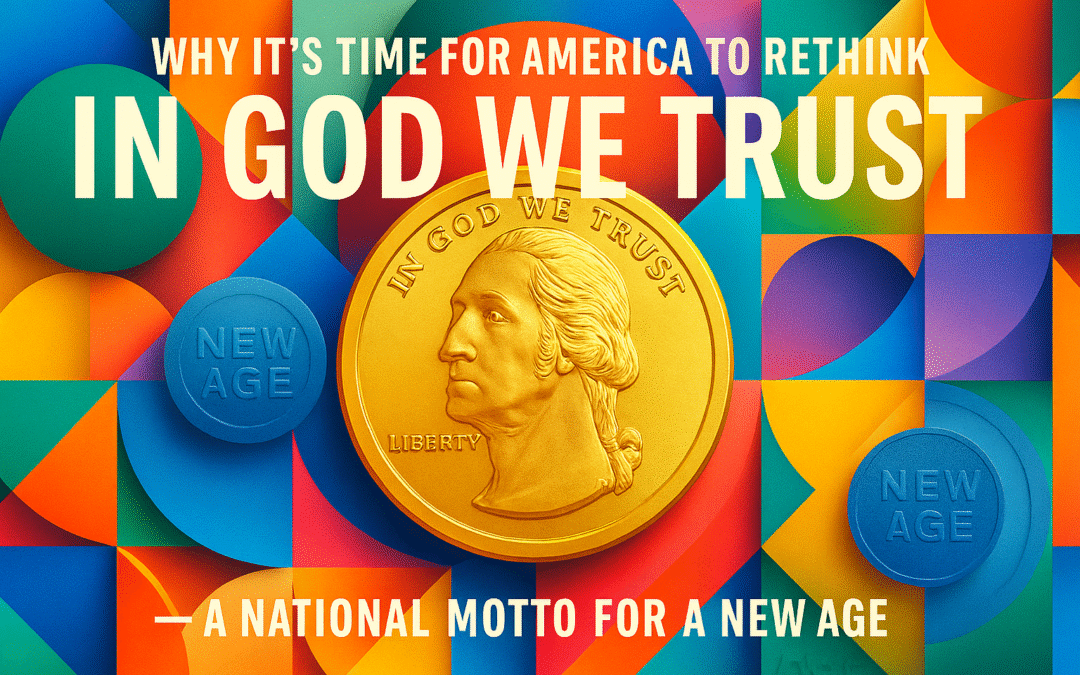
Introduction: The Motto That Time Outgrew
Take out your wallet, glance at a dollar bill, or look up at a government building. You’ll find it, pressed in capital letters, glittering in the corridors of American power: “In God We Trust.” On its face, it sounds both timeless and wholesome. But stop and ponder — whose God, exactly, are we trusting? And why is the world’s most diverse democracy still staking its official motto on an ancient invocation, in the age of science, space, and streaming?
It’s not just about six words. Every time a kid in a public school recites the Pledge, every time an immigrant handles their first greenback, or a new entrepreneur launches another PayPal transaction, “In God We Trust” speaks louder than any flag-waving pep talk. It props up a picture of the nation that feels increasingly out of touch with the lived realities, beliefs, and dreams of its people.
This isn’t about God-bashing, nor is it just the latest quirky crusade from the secular left. Instead, it’s a call for the United States to update its symbolic software: to champion a motto that fits the scientific, pluralistic, and ever-renewing society we are—and strive to be. Let’s dive deep into the historical backstory, legal twists, shifting public attitudes, and the ingenious alternatives that could define the next era of American unity.
Unearthing “In God We Trust”: How Did It Get Here?
Not Quite Founding Father Material
Contrary to what many believe, “In God We Trust” wasn’t scribbled by the Founders while penning the Declaration of Independence or the Constitution. Instead, the roots of this motto lie in the fevered days of the Civil War, a time when national anxiety, existential threat, and bursts of religious fervor swept the country. In 1861, a Pennsylvania minister wrote to Secretary of the Treasury Salmon P. Chase, pleading for a nod to the divine on U.S. coins. By 1864, the phrase appeared on a humble two-cent piece, later fluttering in and out of various denominations as presidents and Congresses came and went.
But for almost a century, “In God We Trust” remained a kind of numismatic extra. The true national motto—literally, the one associated with the Great Seal and official documents—was “E Pluribus Unum” (“Out of Many, One”), capturing the union of states and the promise of a vast, diverse melting pot.
“In God We Trust”: Born in the Red Scare
So why the big switch in the 1950s? Enter the Cold War. Facing a world carved by the iron curtain, the U.S. found itself fixated on distinguishing itself from “godless” communism and the officially atheist Soviet Union. Lawmakers reached for religious language to draw a stark contrast. In 1954, “under God” was shoehorned into the Pledge of Allegiance. By 1956, “In God We Trust” was on its meteoric rise, pushed by President Eisenhower and blessed with bipartisan congressional support. Within a year, it was stamped on every dollar bill in America.
Proponents argued this new motto captured the “spiritual” essence of the American project, never mind the nation’s clear constitutional commitment to religious neutrality. The symbolism gained traction in schools, courts, and public buildings—not as pure heritage, but as a deliberate embrace of religious identity in state affairs.
“E Pluribus Unum”—The Forgotten Classic
Before the mid-1950s, Americans rallied around “E Pluribus Unum” to symbolize unity from diversity: the forging of one nation from many peoples, backgrounds, and belief systems. The 1956 adoption of “In God We Trust” relegated this inclusive vision to a footnote, transforming the motto from a celebration of pluralism to a religious assertion.
Was this really an upgrade in American values, or a symptom of Red Scare anxiety? Historians—and many modern Americans—find it hard not to see it as the latter.
The Constitutionality Conundrum: Does “In God We Trust” Break the Rules?
First Amendment Showdown
The U.S. Constitution’s First Amendment is clear: “Congress shall make no law respecting an establishment of religion, or prohibiting the free exercise thereof.” The famed “Establishment Clause” is the bedrock of separation of church and state. Yet the courts have faced a steady parade of challenges to the national motto’s constitutionality.
Courtroom History: Ceremonial Deism or Covert Endorsement?
From the late 20th century onwards, federal appeals courts have consistently rejected arguments that the presence of “In God We Trust” on money, buildings, and official documents amounts to state-sponsored religion. What’s the rationale? Judges have leaned into the doctrine of “ceremonial deism”—the notion that some religious references are so customary and generic, they have lost their spiritual “bite” and become harmless trappings of tradition.
Supreme Court Justice Sandra Day O’Connor called such expressions “ceremonial deism,” arguing that their historical weight strips them of true religious significance—reducing them to ritualistic, nonsectarian affirmations of national values.
The Skeptics Fire Back
Critics argue this is legalistic whitewashing. If an overt reference to deity, perpetually displayed and recited by a government, “loses” all its religious meaning, what does that say about the state’s understanding of faith or inclusivity? Should Muslims, Hindus, atheists, or agnostics see the national motto on every piece of currency and feel “included” by a bureaucratic ruling that their discomfort is ceremonial, not real?
Legal theorists have pointed out that the so-called “reasonable person” in these tests all too often defaults to a reasonable Christian perspective—further baking Christian privilege into governmental symbols. Imagine a future where “In Allah We Trust” was the motto, or “In No God We Trust”—would the courts be so quick to say this was merely tradition, stripped of endorsement? Such hypotheticals reveal how fraught and exclusionary the current standard can be.
Activism and Slow Victories
Despite decades of court defeats, groups like the Freedom From Religion Foundation, American Atheists, and Americans United for Separation of Church and State continue to press cases, rally public opinion, and secure incremental wins—such as the removal of “In God We Trust” from standard Mississippi license plates in 2023, or successful blocks of religious displays mandated in some state schools.
Yet major constitutional reform remains stalled, throttled by judicial precedent and a tradition that many—especially in today’s Congress—are eager to defend.
America, the Faithful? The Demographics of Belief (and Nonbelief)
Faith on the Retreat, Diversity on the Rise
It might shock many to realize that “In God We Trust” was adopted at the very peak of U.S. religiosity. Today, the immense wave of secularization that has transformed Europe and much of the developed world has reached American shores.
- As of 2025, only about 62% of American adults identify as Christian—down sharply from 78% in 2007.
- The so-called “nones”—those who claim no religious affiliation—now make up nearly 29% of adults. This includes roughly 5% atheists, 6% agnostics, and nearly 19% who say “nothing in particular”.
- Non-Christian religions (Judaism, Islam, Hinduism, Buddhism, etc.) together represent another 6–7%, reflecting immigration-driven growth in pluralistic faith communities.
What’s more, America is becoming younger, more tan, and more urban—trends correlated with lower levels of religious identification.
Why Are People Losing Their Religion?
A majority of those disaffiliating cite a loss of belief in core religious teachings, but a growing share also point to politicization, anti-LGBTQ policies, and high-profile church scandals. The secular demographic is also younger, more highly educated, and more urban-dwelling than the national average—suggesting that future generations are even less likely to resonate with an explicitly religious national motto.
In God We Distrust? Public Opinion on Religious Diversity
Surveys reveal that most Americans now view the nation’s openness to people from around the world, regardless of religion, as “essential” to our identity—especially among agnostics, atheists, and younger Americans.
Even among Christians, support for religious diversity remains high, though sharply divided by partisanship. Notably, a 2024 RealClearPolitics poll found that only 17% of Americans want “In God We Trust” removed from currency. While majorities still back the motto—often out of tradition—support dramatically plummets among the young, Democrats, and secular populations.
Immigration, Identity, and the Problem of “In God We Trust”
The Nation of Welcome (and “God”)
America sees itself as a promised land for immigrants—those yearning to breathe free, fleeing persecution, or seeking new beginnings. But what does it mean to tell each new arrival that the country’s defining motto presumes both a belief in God and trust in a particular type of deity?
Agencies like the U.S. Citizenship and Immigration Services explicitly brand the nation as “a nation of welcome and possibility,” striving to project inclusion, fairness, and respect across faith lines. Yet the God-motto can feel alienating or exclusionary to those from cultures with different gods or no gods, deeply secular backgrounds, or traditions that hold state-religion divisions as core to freedom. It sends a mixed message: “You’re free to worship as you please—just don’t forget, we still trust in one specific kind of divine being.”
For new Americans, especially those escaping religious persecution or hailing from non-Christian-majority states, “In God We Trust” isn’t just a slogan; it’s a cultural wall with a subtle, yet persistent, holiness test.
When Religious Displays Become Law
Recent years have seen a rise in legislative attempts in several states to mandate displays of “In God We Trust” in all public classrooms. Oklahoma, Louisiana, Texas, and Arkansas—all states with sizable immigrant populations—have attempted, or outright passed, laws requiring prominent religious (often Christian-leaning) messages in schools.
Such measures clash with the societal need to create environments where all children—regardless of their or their parents’ beliefs—feel equally American. Inevitably, controversies erupt when requests arise to post the motto in other languages (Arabic, Hebrew, Hindi) or with non-Christian symbolism, exposing the true, exclusionary impulse at work.
What If America Went Motto-Free (or Motto-Secular)?
National Unity Without Deity: Worldwide Case Studies
Does a nation fall apart without invoking God on its coins? Hardly. Many of the world’s most peaceful, prosperous, and globally admired countries either use entirely secular mottos or go without any official motto at all:
| Country | Official Motto | Religious Reference? |
|---|---|---|
| France | Liberté, Égalité, Fraternité (Liberty, Equality, Fraternity) | No |
| Germany | Einigkeit und Recht und Freiheit (Unity, Justice and Freedom) | No |
| Brazil | Ordem e Progresso (Order and Progress) | No |
| Canada | A Mari Usque ad Mare (From Sea to Sea) | No |
| South Africa | !ke e: ǀxarra ǁke (Unity in diversity) | No |
| India | Satyameva Jayate (Truth Alone Triumphs) | No |
| United Kingdom | Dieu et mon droit (God and my right) — Monarch’s Motto | Partially (monarch only) |
| United States | In God We Trust | Yes |
Many countries go further, with no official national motto at all: Australia, Germany, Japan, Switzerland, and Sweden fly their colors without inscribing any motto on their currency or public buildings.
Countries that do maintain religious mottos—such as El Salvador or Ecuador (“God, Union, Liberty”)—tend to be smaller, less pluralistic, and less committed to strict secularism.
The upshot? A sense of national identity and unity does not require invoking the divine. Secular or unity-based mottos foster pride, loyalty, and civic belonging just as robustly—perhaps more so, given their inclusivity.
E Pluribus Unum: An Aspirational Upgrade
If the U.S. were to revisit its motto, the most natural choice is a return to “E Pluribus Unum.” Not only does it resonate with America’s founding period, but it speaks directly to the heart of the immigrant and pluralist American dream. Out of many faiths, backgrounds, and origins, one nation—stronger together, open to reinvention.
Other contenders, like “Justice for All” or “Liberty and Equality,” would instantly recenter the national story on values that transcend belief systems.
How Could America Change Its Motto? Pathways to Reform
Legal and Congressional Avenues
Changing the national motto would require congressional action—just as it did in 1956. Congress could pass a joint resolution, signed by the President, designating a new or restored motto. This has clear precedent; “In God We Trust” came through just such legislation.
Legal challenges to the current motto have not succeeded at the Supreme Court, but ballot initiatives at the state or local level have forced changes on specific displays—most notably in Mississippi, where a lawsuit compelled the state to issue a standard license plate without the religious message.
Political and Cultural Strategies
Changing the motto is as much a campaign of public persuasion as legislation. Advocates must:
- Educate the public on the actual historical timeline (the Founders did not create “In God We Trust”).
- Make the case for inclusivity, framing the issue around welcoming all beliefs (and nonbelief) equally.
- Highlight positive global examples where unity and secularism reinforce, not undermine, patriotism.
- Mobilize coalitions across faith and secular lines—many religious Americans are deeply committed to church-state separation in principle.
- Leverage direct democracy in states that allow referenda to test public support, even if federal change is slow.
Legal Precedents to Watch
- Wooley v. Maynard (1977): The Supreme Court ruled New Hampshire could not force its motto (“Live Free or Die”) on objecting drivers’ license plates.
- Griggs v. Graham (2023): A judge ruled that Mississippi could not force “In God We Trust” on all license plates, affirming Free Speech rights.
The momentum is on the side of greater accommodation and optionality—a fertile ground for future reform.
Rethinking the Motto: Ceremonial Deism in the Crosshairs
The Ceremonial Deism Farce
The argument that “In God We Trust” is harmless “ceremonial deism” has not aged well in a society that increasingly values genuine pluralism and the lived experience of being an outsider. Scholars and advocates point out the dangerous double standard: if “ceremonial” assertions mean so little, why are they worth fighting for? If they mean a great deal—as many religious conservatives claim—shouldn’t they be equally offensive to nonbelievers and minority faiths?
Worse, ceremonial deism has been weaponized to excuse all sorts of government religiosity, often pushed by activist groups who want to signal Christian privilege under the guise of tradition. As legal commentator Caroline Mala Corbin frames it, the “reasonable person” test courts often cite is itself usually the perspective of a reasonable Christian—excluding the lived experience of Jews, Buddhists, atheists, and others.
Imagine, as legal commentators have, a scenario where “In Allah We Trust” is suddenly the American motto. Would Christians or Jews accept “ceremonial” explanations for their discomfort? The thought experiment reveals the inherent bias and unsustainability of the doctrine.
Scientific Progress and the Future of National Identity
The Scientific Age vs. The Divine Hypothesis
It’s not 1956 anymore. Science, technology, and rational inquiry are foundational to every major American achievement. From life-saving vaccines and Mars rovers to the code running through every Silicon Valley start-up, innovation is powered by evidence, not dogma.
In an era where the fastest-growing communities are rooted in scientific humanism, secular morality, and a global sense of planetary stewardship, does an official motto pinned to ancient supernatural claims still make sense? Secular values—rooted in rationality, empathy, and universal rights—are now widely recognized as the bedrock of democracy and progress worldwide.
Atheism as a Foundational Orthodoxy?
This is not to say everyone should or must be an atheist—but that reason, not revelation, should guide public policy. Atheism—understood as noncompulsory belief in the absence of deities—has become the default worldview for scientific advancement, moral universalism, and many global human rights frameworks.
From the Universal Declaration of Human Rights to the educational standards of Finland or Canada, secularism is not a threat to freedom, but its amplifier.
A country’s motto should project the values that are sustainable, durable, and legitimately universal—not a vestige of one era’s religious insecurities.
What Might a New American Motto Look Like?
If the United States wants a motto for the ages—one that stirs pride in every citizen, not just the faithful ones—it should be built on open arms, scientific curiosity, honest plurality, and the promise of new beginnings. Here are just a few contenders:
E Pluribus Unum: “Out of Many, One”
- A classic, deeply rooted in American tradition.
- Celebrates immigration, pluralism, and the ongoing project of unity.
Justice for All
- Direct, values-driven, and universally appealing.
- Moves the conversation from what we believe to how we treat each other.
Liberty, Equality, Opportunity
- Invokes revolution and reform, not dogma.
- Honors the past, tests the present, prepares for the future.
Or maybe, in bold new spirit: “We Trust Each Other.”
Conclusion: Choosing the Future — Not Just the Past
Changing the national motto isn’t a small matter or a trivial snub to tradition. It’s an act of collective imagination—a promise to present and future Americans that citizenship means belonging, regardless of background or beliefs.
America’s greatest strength has never been its loyalty to a single dogma, but its uncanny ability to reinvent itself—to welcome the explorers, the doubters, the seekers, and the American mystics. The scientific spirit, secular morality, and national unity are not mutually exclusive; they are the blueprint for the American experiment’s next chapter.
“In God We Trust” was born of crisis and fear, not a visionary belief in unity or liberty. It is time to retire this Cold War relic and restore a motto that belongs to every American—one as limitless, inclusive, and forward-looking as the very idea of America itself.
Ready for a national motto to match our national future? The first step isn’t trust in God. It’s trust in ourselves—and each other. Let’s get to work.
Reference Sources
- “In God We Trust” is unconstitutional and problematic – The Reflector
- In God We Trust | The First Amendment Encyclopedia
- Religion, immigration & racial, religious diversity | Pew Research Center
- United States national motto – Wikipedia
- E Pluribus Unum, and the Original American Motto | Secular Coalition for America
- Scientific Humanist Democracy is the Next Step in Human History | Science Abbey
- The Dangerous Fallacy of Ceremonial Deism | Psychology Today
- PRRI Religious Change in America report
- Supreme Court rejects atheists’ attempt to scrub ‘In God We Trust’
- America the secular? What a Changing Religious Landscape Means for US Politics | Religion News Service
System Ent Corp Sponsored Spotify Music Playlists:
https://systementcorp.com/matchfy
Other Websites:
https://discord.gg/eyeofunity
https://opensea.io/eyeofunity/galleries
https://rarible.com/eyeofunity
https://magiceden.io/u/eyeofunity
https://suno.com/@eyeofunity
https://oncyber.io/eyeofunity
https://meteyeverse.com
https://00arcade.com
https://0arcade.com