
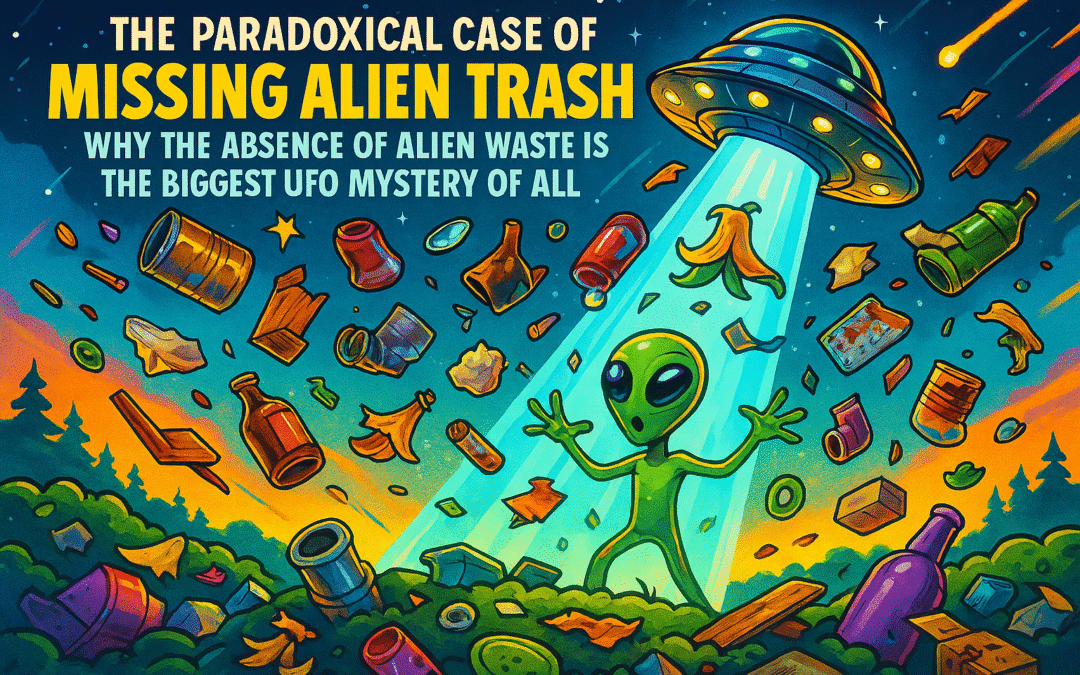
Introduction: The Most Overlooked Question in UFO Lore
If aliens are dropping by (or hovering above) Earth, shouldn’t they, well, leave a mess? It’s a question that, astonishingly, hasn’t gotten the attention it deserves. From the first “flying saucer” sighting over Mount Rainier in 1947 to today’s viral videos of “tic tac” UFOs, we’ve racked up tens of thousands of UFO reports. Lawns have been scorched, pilots have been astonished, and governments have gone from stony silence to formal hearings in Congress. Yet amid all this cosmic commotion, one prosaic but vital detail is missing: Where is all the alien trash?
Think about it. Humans, for all our cleverness, can’t so much as launch a Mars rover or host a million-person music festival without leaving behind souvenirs—spent rocket casings, bottles, a stray tent, or two. If extraterrestrials have arrived in shiny starships or sent probes skittering through our skies, shouldn’t there be hardware left over—a crashed engine, a piece of polished alloy, spent batteries, greasy food wrappers, or at the very least, a cosmic cigarette butt? Even invisible, hyper-advanced aliens operating in absolute secrecy ought to produce waste—biological, technological, or environmental. So why, after a century of UFO excitement and countless global efforts to find alien life, has nobody found so much as a single, verifiable snippet of alien waste on Earth?
In this blog, we’ll explore this under-appreciated mystery from every conceivable angle, blending science with speculation and philosophy with pop-culture, and uncover what the absent alien trash heap means for believers, skeptics, and the curious alike.
Types of Alien Waste: What Should We Expect?
Before we tackle the mystery, let’s get specific: What exactly would “alien waste” entail? Here are the main categories we might anticipate if extraterrestrial visits or their artifacts were truly real:
| Alien Waste Type | Examples | Detection Methods |
|---|---|---|
| Technological Artifacts | Engine parts, alloys, microchips, crashed probes, tools | Physical recovery, analysis |
| Biological Remnants | Tissue, bodily fluids, excreta, microbiota, pollen, DNA | DNA/RNA analysis, microscopy |
| Structural Debris | Landing pads, vehicle imprints, structural fragments | Ground surveys, satellite scans |
| Environmental Signatures | Chemical pollutants, unexplainable isotopes, irradiation | Soil/air/water sampling, sensors |
| Environmental Disruption | Radiation spikes, plant mutations, soil compaction, patterns | Environmental monitoring |
Discussion of Alien Waste Expectations
Super-advanced civilizations might use ultra-clean technology, but even the most careful machines leak or shed microscopic traces—think metal shavings, coolants, packaging, or even a scrap of their equivalent to a sandwich wrapper. Biological entities deposit skin, hair, microbes, or waste. Technological devices, as seen on Earth, naturally degrade, leave byproducts, and occasionally fail catastrophically. Space travel produces its own suite of byproducts: radioactive decay, gamma bursts, rare isotopic ratios, and perhaps even faint “technosignatures” in local materials.
If even a fraction of historical UFO reports point to real, visiting alien vehicles—no matter how stealthy or eco-friendly—the universe’s experience (and entropy’s arrow) suggests that waste, remnants, or side-effects must exist. The utter absence of unambiguous samples is the core of our paradox.
Historical UFO Sightings: Artifacts Wanted, None Found
Close Encounters and the Global Artifact Shortfall
From Roswell to the Phoenix Lights, every “classic” UFO event hints at tantalizing physicality but ultimately proves empty-handed regarding definitive artifacts. A crashed saucer here, a mysterious light there, yet the hard evidence cupboard remains bare. Consider the infamous 1947 Roswell incident, where rumors of alien debris and bodies became foundational UFO lore. In every retelling, physical traces multiply in imagination, yet decades of thorough investigation and modern forensic analysis agree: the debris was earthly in origin, tied to then-classified surveillance balloon arrays.
Other well-studied sightings—the Rendlesham Forest incident, the Westall school landing, or the Maury Island encounter—are also joined by a conspicuous lack of anything unequivocally unearthly. Reports feature burn marks, radiation surges, or mysterious indents, but controlled lab investigation never shows anything unambiguously alien—a fragment, device, or sample that defies natural or human technology.
More recently, the Pentagon’s Unidentified Anomalous Phenomena (UAP) reports confirm more than 1,652 modern cases. Most are closed as drones, birds, weather, or satellites, and the few left “unexplained” have no recovered hardware. The U.S. government’s All-domain Anomaly Resolution Office (AARO), NASA, and their international peers have found no proof among hundreds of UFO cases studied for decades—not even a “smoking gun” bolt, pin, or scrap.
Why Is This Absence So Damning?
If aliens are clumsy enough to crash in the desert or visible enough to buzz airliners, shouldn’t at least one fragment, no matter how tiny, have turned up by now? This gap between sighting and evidence is not merely bad luck—it’s a scientific embarrassment.
Biological Evidence in Ufology: Mummies and Microbes or Just Missteps?
The Allure of Alien Goo
A recurring theme in UFO folklore involves the recovery of not only mysterious debris but also alien “biological” specimens—so-called bodies, tissues, blood samples, or mummified remains. Famous examples include rumors of autopsies at Roswell, the bizarre ‘alien’ mummies displayed in Mexico’s Congress, and the endless parade of “alien implant” stories told by abductees.
Science vs. The Ooze
When these claims have been put to scientific scrutiny, disappointment reigns. The Roswell “bodies” were later explained as parachute test dummies or tragic casualties of aircraft mishaps. The recent Peruvian/Mexican “alien corpses” (with 30% “unknown DNA”) turned out to be probable hoaxes—composite remains of humans and animals, or naturally mummified bodies subjected to folklore and fame.
Despite advancements in DNA sequencing and forensic science, not a single biological sample from UFO cases has yielded verifiable evidence of non-terrestrial life. Even the strictest sample-handling protocols, applied to reported landing sites, have failed to find outlier isotopic ratios, unknown amino acids, or “foreign” cell structures.
Technological Artifacts: The Myth of Off-World Gadgets
Reverse-Engineering and the Persistent Rumor
The modern UFO canon teems with tales of secret government warehouses brimming with crashed spacecraft, reverse-engineering labs, and nonhuman hardware. From Bob Lazar’s “Element 115” stories to alleged “memory metals” at Roswell, these claims have captivated generations. Whistleblowers, ex-intelligence officials, and ambitious legislators have stoked the fires, feeding new Netflix documentaries and YouTube exposés.
Yet again, when subjected to public, peer-reviewed scrutiny, the evidence evaporates. The AARO’s transparent analysis of an alleged “Roswell metal sample”—a layered magnesium and bismuth artifact rumored to possess anti-gravity capabilities—demonstrated unequivocally terrestrial origin: a failed magnesium alloy test piece, not exotic alien tech.
Similarly, Harvard’s Avi Loeb and collaborators conducted daring expeditions searching for remnants of interstellar objects in the Pacific, collecting “spherules” whose composition could be analyzed. Early claims of “alien technology” gradually gave way to the realization that further study was needed, and that most findings—so far—likely reflect extreme, natural cosmic material rather than non-terrestrial engineering.
Environmental Traces: Radiation, Pollution, and the Non-Event Horizon
Not a Scorched Earth: Lack of Lasting Side Effects
If alien craft truly landed, hovered, or crashed on Earth, wouldn’t their passage leave unmistakable scars—radiation, exotic isotopes, chemical residues, altered microbes, or scorched soil? In iconic cases from the 1950s to the present, investigators have measured for these signatures.
While some cases, like Falcon Lake or Rendlesham Forest, reported slightly elevated levels of radiation or ground anomalies, the findings never amounted to clear, reproducible evidence of advanced technology. Soil, grass, and air samples always returned within the realm of ordinary terrestrial phenomena—natural occurrences, mundane contamination, or explainable by human technology.
Meanwhile, the environmental fallout of humanity’s own spacefaring efforts—such as lunar landers, Mars rovers, and orbiting satellites—remains highly visible. “Alien” visitors, if frequent, would likely also have left trails visible by environmental impact assessments, but nothing unambiguously off-world has been observed.
Government, Science, and the Problem of Provenance
Official Investigations: The AARO, NASA, and the Ever-Elusive Artifact
Today, efforts to systematically investigate unidentified phenomena are at unprecedented levels. The US government’s AARO and its foreign counterparts now apply rigorous, scientific methodologies to thousands of encounters. Yet, as of late 2025, all publicly disclosed investigations still report “no evidence of extraterrestrial craft, materials, or biological remains” anywhere—whether in the form of debris, waste, or secretive “retrieval” programs.
Even the much-hyped Kona Blue “reverse engineering” program, revealed via declassified documents, was canceled for a devastatingly mundane reason: no alien technology was ever recovered to study in the first place. Congressional hearings and independent commissions alike continue to reiterate: artifacts, if they exist, remain entirely absent from any credible, peer-reviewed science.
Transparency vs. Conspiracy
Given decades of allegations about concealment—Area 51, “memory metal” troves, alien autopsies—the persistence of zero confirmed public evidence suggests not just opacity, but plausible absence. Recent breakthroughs in transparency (and pressure to release all extant materials) have only reinforced this verdict.
Search Methods: Signals, Artifacts, and the SETI Dilemma
From Listening for Signals to Searching for Debris
The scientific search for extraterrestrial intelligence splits into two main modes: listening for signals (SETI, radio waves, technosignatures) and artifact SETI (hunting for physical objects, “alien waste,” or modified environments).
SETI’s ongoing radio programs have—by analogy to the Fermi paradox—not detected any clear beacons or “hello world” messages, nor unambiguous electromagnetic emissions that outstrip normal cosmic radio noise.
“Artifact SETI” argues that if aliens have ever visited the Solar System, artifacts should exist: crashed probes, debris, long-lived “messenger” probes, or even large-scale astroengineering projects (Dyson spheres, orbital megastructures). To date, comprehensive searches of the planets, the Moon, and near-Earth space have yielded no such evidence. Missions scanning the lunar and Martian surfaces have also failed to spot any unmistakable alien ruins or detritus—no hidden probes, mining pits, or crash debris larger than modest detection limits.
Interstellar Objects: ‘Oumuamua, 3I/ATLAS, and the Probe Hypothesis
The recent discovery of fast-moving, interstellar objects such as ʻOumuamua and 3I/ATLAS led to excited speculation that they could be “alien probes” or artifacts of nonhuman design.** A thorough battery of observations and analyses suggested natural origins, despite their weirdness: neither chemical composition nor trajectory ultimately required artificial causes.
Avi Loeb and collaborators remain open to the possibility that such objects could be technological, but they freely admit that only new data or direct collection could confirm such an extraordinary claim.
The Fermi Paradox, Absence of Waste, and Science’s Most Annoying Silence
“Where Is Everybody”—And Where’s Their Trash?
The Fermi Paradox—the vexing question, “Where is everybody?”—is more pointedly rendered: If intelligent aliens exist and have visited or could visit, why have we found no sign of them, not even their litter? The paradox intensifies with every null result: billions of planets, plenty of time, and high odds, but cosmic silence and squeaky-clean parks wherever we look.
Historically, some scientists mistook the lack of alien signals or artifacts as evidence against extraterrestrial life. But as the decades pass, experts realize that our search has only covered a microscopic fraction of the “cosmic haystack.” We have not yet “drained the ocean,” merely sampled a pond or two.
Evidence of Absence—or Absence of Evidence?
The core philosophical puzzle: Is the lack of alien waste evidence that aliens aren’t here—or just that we’re looking in the wrong way, at the wrong time, or with the wrong tools? Philosphers and scientists agree: absence of evidence is only evidence of absence when, if aliens were here, we’d expect to see it.
With UFOs, this is crucial. If even a quarter of sightings involved physical traces, by now, with millions of people looking, we should expect at least some unambiguously alien detritus—fragments with nonterrestrial isotopes, microtechnology, or DNA, for instance. The embarrassing paucity of debris thus speaks volumes.
Philosophical Reflections: What the “Alien Waste Paradox” Means
Skepticism, Bias, and the Burden of Proof
A critical take: We gravitate toward elaborate cover-up explanations, secret government hoards, or improbable “clean-up” scenarios because we’re uncomfortable with the more basic reality—absence. Some argue that the lack of waste is itself powerful evidence against visitation. Others counter that superior civilizations might clean up perfectly, or avoid creating waste at all.
Occam’s Razor—favoring the simplest hypothesis—suggests that the lack of evidence points more convincingly to the absence of visiting aliens than to perfect concealment. We’ve scoured crash sites for over 75 years and come up empty; at some point, “no evidence” tips toward “no visitors.” Still, due modesty: perhaps we’re asking the wrong questions, using the wrong tools, or searching for the wrong kind of evidence altogether.
Responsibility, Uniqueness, and the Human Story
Some philosophers note that, if we are alone, humanity bears staggering responsibility—we could make the universe conscious, or fail and leave it silent forever. The lack of alien waste thus isn’t just a scientific mystery; it’s an existential call to action.
Speculative Solutions: Six Ways to Explain the Missing Alien Waste
Why is our evidence bin so clean? Here’s what theorists and storytellers propose:
- Perfect Stealth/Cleanliness: Hyper-advanced civilizations operate with zero-waste precision, meticulously cleaning every trace.
- Nonphysical Probes or Entities: Advanced alien “visitors” are digital, energetic, or otherwise nonphysical; their “waste” is invisible or indistinguishable from nature.
- Alien Environmental Ethics: Aliens avoid contamination, following strict cosmic “Leave No Trace” principles or ethics.
- Our Search Is Incomplete: The cosmic haystack is vast, and we’re looking in the wrong places, missing micro-artifacts or other subtle traces.
- No One Ever Came: The simplest answer—no visitor, no waste.
- Government or Cosmic Cover-Up: Agencies or even aliens themselves systematically clean up, hide, or shield all evidence. Though this is a pop-culture favorite, it fails Occam’s Razor and ignores decades of null results.
The Media and Pop-Culture Lens: The Waste-Free Alien in Our Heads
Hollywood loves a story of brave scientists whisking away crashed saucers, men in black cleaning up messes, and government labs filled with alien junk drawers. For decades, films, TV, and tabloids have supplied vivid imagery—alien body bags, secret vaults, and reversed-engineered gadgets—filling in for the harder realities.
In truth, every generation’s most “shocking” alien waste drama, from the “Alien Autopsy” hoax to modern streaming docuseries, yields no hard proof and frequently recycles the same tropes. This myth-making is irresistible but misleading. Real science’s painstaking forensic standards aren’t satisfied by rumor.
Environmental Ethics: Would Alien Waste Even Look Like Ours?
As human space exploration ramps up and “planetary protection” becomes crucial, we’re forced to confront what kind of environmental scars our own species is already leaving on the Moon, Mars, and beyond. If aliens exist, they may abide by even stricter standards, preserving nursery worlds or minimizing evidence of their presence. Some planets may even be deliberately “quarantined” to let evolution unfold undisturbed.
But, tellingly, our own efforts at cleanliness inevitably leave traces. Even the best-intentioned scientists have left lunar landers, rover tires, and orbital junk. The lack of even a single foreign boot-print is, once again, telling.
AI, The Great Filter, and the Waste Conundrum
Could AI be the reason neither we nor anyone else leaves cosmic trash behind? Recent scholarly work suggests that rapid advances in artificial intelligence may act as a “Great Filter,” limiting the lifespan of technological civilizations. If AI destroys or stalls all civilizations at the edge of interstellar travel, none survive to pepper the stars with probes, habitats, or waste.
Even AI civilizations might produce cosmic “technosignatures” (infrared glow from huge computers, engineered atmospheric chemicals, etc.), yet still, we see no firm evidence.
Conclusion: The Messiest Paradox Is No Mess At All
The question of missing alien waste is a window into the deep conundrums of science, skepticism, and story. For impact, it rivals even the Fermi Paradox:
- If the universe is teeming with civilizations, why does our own planet remain remarkably free of their leavings—no gadgets, no goo, no garbage dumps?
- If even a smidgeon of UFO lore reflected real, physical visitation, the odds overwhelmingly favor some debris, biological trace, or enduring signature to have been conclusively found.
- Decades of modern science—with better tools and international cooperation—has instead found zero.
Which leaves us with a cosmic itch that can’t be scratched—not just “Where is everybody?” but “Where is everybody’s trash?” Until someone scoops up an unambiguous alien artifact (or successfully proves they were here and tidied up perfectly), the empty alien landfill stands as perhaps the most overlooked, hardest-hitting question in the UFO debate.
If we’re waiting for the ultimate close encounter—the day we trip over a lost alien wrench or spot their fossilized biochip—it hasn’t happened yet. Until then, Earth remains immaculate on the interstellar audit, with nary a wrapper, blob, or bolt left behind.
So next time someone asks “Do you believe in UFOs?” you can reply: “I’ll believe it the moment someone finds the trash.”
System Ent Corp Sponsored Spotify Music Playlists:
https://systementcorp.com/matchfy
Other Websites:
https://discord.gg/eyeofunity
https://opensea.io/eyeofunity/galleries
https://rarible.com/eyeofunity
https://magiceden.io/u/eyeofunity
https://suno.com/@eyeofunity
https://oncyber.io/eyeofunity
https://meteyeverse.com
https://00arcade.com
https://0arcade.com