
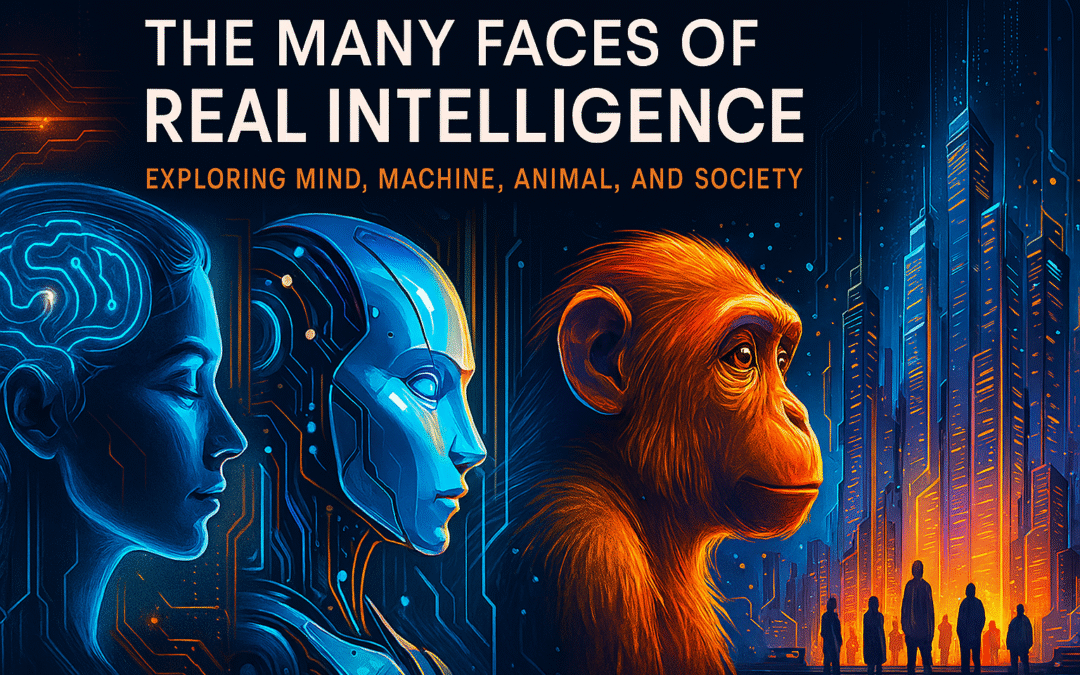
Introduction: What Is “Real Intelligence,” Anyway?
What does it mean to be truly intelligent? Is it the methodical genius of a chess grandmaster or the street smarts of a savvy city dweller? Is it the effortless way an octopus slips through a maze, the uncanny mimicry of a parrot, or the quirky genius behind AI recommendation engines curating your next Netflix binge? The concept of real intelligence is wonderfully slippery—both omnipresent and elusive, showing up in bustling human cities, cephalopod puzzle boxes on the seafloor, humming neural networks of silicon, and the dynamic dances of bee colonies in sunlit meadows.
In this upbeat dive, we’ll chase intelligence through every nook and cranny— biological, artificial, emotional, and social —discovering how it manifests in humans, animals, plants, and machines. Along the way, expect to meet crows that outsmart your local fox, robots that might outwork you (but not outplay you—yet!), savvy elephants, and bees whose waggle dance reveals a wisdom nature is still decoding.
Hold onto your neurons: “real intelligence” is richer and more extraordinary than any test score (or Turing test) could ever capture.
Rethinking Intelligence: Definitions, Debates, and Paradigms
What is intelligence? Despite centuries of study (and some hard-won Nobel Prizes), there’s still no single answer everyone agrees on—only lively debates crossing philosophy, neuroscience, psychology, computer science, and even botany. Classic definitions often anchor intelligence as the ability to learn from experience, solve problems, and adapt to environments. But dig deeper, and you’ll find definitions spiraling out: some see intelligence as a monolithic “g-factor” (general ability), while others decompose it into a constellation of skills—mathematical, social, creative, practical, emotional, and more.
The Spectrum of Intelligence Theories
- Spearman’s “g-factor”: Spearman’s statistical sleuthing in 1904 led to the idea of a general intelligence underpinning all cognitive abilities—the mystical “g”. If you’re good at one thing, you’re likely good at others; g is the glue connecting your logical, spatial, and verbal prowess.
- Thurstone’s multiple abilities: Louis Thurstone rebelled, suggesting intelligence is about distinct skills—like word fluency, spatial visualization, and memory. Later work nested these skills in a hierarchical model with g still at the top.
- Gardner’s Multiple Intelligences: Howard Gardner shattered the single-IQ paradigm. In his model, talents like kinesthetic (dancers, athletes), musical, spatial, interpersonal, and naturalist intelligence each deserve recognition.
- Sternberg’s Triarchic Theory: Robert Sternberg championed the idea that intelligence isn’t just about analytical logic. It’s also creative (generating novel ideas) and practical (“street smarts”).
The AI Era: Machine Intelligence and Anthropocentrism
With the AI revolution, the definition debate has reached fever pitch. Is your autocorrect “intelligent”? What about language models, search engines, or a warehouse robot deftly avoiding obstacles? Researchers like Legg and Hutter offer a pragmatic—if dizzying—definition: “Intelligence measures an agent’s ability to achieve goals in a wide range of environments“. This task-based view is neutral; it applies whether the agent is a dog, drone, or data center. But critics warn that anthropocentric yardsticks (IQ tests or chess ability) may not capture the true genius of a bee or the pragmatic resilience of plant roots.
Provocatively, some argue for a non-anthropocentric intelligence—one that values the unique ways animals, plants, and systems solve problems relevant to their own survival, not ours.
Biological Intelligence: The Mind at Work
The Cerebral Orchestra: Human Cognition Unpacked
Human intelligence is as much a marvel of cellular biology as it is of experience and culture. The human brain, with about 86 billion neurons wired through trillions of synapses, is the ultimate parallel processor. Intelligence emerges from this symphony of structure and activity—where and how the music plays matters.
Biological Underpinnings
- Brain volume correlates with IQ, but it’s no simple relationship. While larger whole-brain volumes predict better cognitive performance (with a correlation of ~0.3-0.4), it’s the density and interconnectivity—particularly in the prefrontal cortex and parietal lobes—that seem most crucial.
- Neural efficiency: Brains that solve problems with less energy use are “smarter” on certain metrics.
- Plasticity: Intelligence isn’t fixed—new connections grow throughout life. Even adults can “rewire” their brains through practice and learning (neuroplasticity is real, and you can thank it for your new language skills or Brazilian jiu-jitsu exploits).
Nature, Nurture, and Neurotransmitters
- Genetics play a role (with heritability estimates for intelligence ranging broadly), but environment—nutrition, stimulation, education, sleep—makes an enormous difference in cognitive development.
- Neurotransmitters like dopamine and glutamate influence learning, motivation, attention, and plasticity. Too much or too little, and brain function falters.
Human Abstract Thinking: The Ultimate Trick
One thing that sets humans apart is our penchant for abstract, context-independent thinking. Recent neuroscientific discoveries show that our neurons store concepts—people, places, ideas—in a context-free way, enabling us to reason in generalities and build complex narratives. Unlike most animals, our neurons “light up” for a person whether they’re at the beach or the market, supporting our ability to make analogies, reflect, and invent new stories.
Intelligence in Animals: A Parade of Minds
Let’s step away from Homo sapiens and marvel at the spectacular creativity of Earth’s other minds.
Avian Intelligence: Crows and Parrots Rule the Roost
- Crows (especially New Caledonian crows) craft tools from sticks or even wire, passing modifications through generations—evidence of cumulative cultural evolution. Crows can solve causal puzzles on the first attempt, plan multi-step solutions, understand water displacement, and even perform simple arithmetic.
- They recognize individual human faces, remember kindness or malice for years, and even teach their findings to peers—earning them a reputation as the “feathered apes”.
- Parrots, like the legendary African grey “Alex,” have shown the ability for symbolic communication (identifying numbers, colors, and shapes), context-appropriate word use, and remarkable puzzle-solving prowess equal to great apes.
Marine Minds: Octopuses and Dolphins
- Octopuses are the escape artists of the ocean with brains distributed through their arms, each arm able to act independently in carrying out complex manipulations and tool use, such as opening jars, building shelters from coconut shells, and using siphons to short out aquarium lights (no joke). They show vivid play behavior and even individual personality quirks.
- Dolphins use signature whistles (names) to identify and call each other, grasp abstract concepts, and pass down foraging tricks—evidence for both intelligence and culture.
Mammalian Wonders: Elephants and Dogs
- Elephants mourn their dead, remember the calls of relatives lost long ago, display empathy by comforting distraught companions, and have passed the mirror test for self-awareness. Their tool use includes fashioning fly swatters and plugging waterholes.
- Dogs, through thousands of years of co-evolution with humans, have developed a finely tuned sensitivity to human emotions, gestures, and even laughter, showcasing a unique kind of synthetic social intelligence.
Collective and “Swarm” Intelligence
- Bees, through their “waggle dance,” perform group-level navigation—encoding direction, distance, and quality of food through dance, interpreted by others using both visual and vibratory cues. Some evidence shows this language is socially learned and shaped within each hive.
- Ants coordinate without centralized control—solving foraging, building, and defense problems as highly adaptable societies.
Plant Intelligence? The Debate Unfolds
Plants lack brains, but researchers have shown they can sense “neighbors” (by chemical cues, light ratios), anticipate threats, “remember” past stresses, and change behavior based on prior experience—hints of “minimal cognition” or at least complex information processing. Botanists still contest the word “intelligence” here, but it’s clear plants are not passive green statues.
Machines That (Sometimes) Think: Artificial Intelligence’s View of Intelligence
Symbolic and Statistical AI: Two Roads Diverged
The AI field itself is a microcosm of the wider debate: does intelligence come from explicit reasoning (like a mathematician) or from experience-based pattern recognition (like a child or a neural net)?
- Symbolic AI: “Good Old-Fashioned AI” (GOFAI) is logic- and symbol-based. Early systems like MYCIN could diagnose bacterial infections using rule-based reasoning. Symbolic AI boasts transparency and explainability but struggles with ambiguity, nuance, and dynamic learning. Today it survives in hybrid “neurosymbolic” systems, combining logic with statistical power.
- Statistical AI: Modern AI is dominated by data-centric, learning-based statistical techniques—especially neural networks. Pattern recognition, recommendation systems (your Spotify playlists), and large language models (like ChatGPT) learn from vast troves of data, excelling at perception but sometimes failing at “simple” tasks (like common sense, or knowing cows don’t belong on the beach).
Universal “Artificial” Intelligence?
Legg and Hutter’s “universal intelligence” aims to compare AI, animal, and human intelligence under a single metric—goal achievement over a spectrum of possible environments weighted by their complexity. This model recognizes that no system is universally optimal: performance in diverse contexts trumps skill in a narrow domain. Think: a Deep Blue chess computer is smart at chess, but would flop at foraging for berries or recognizing sarcasm.
The Limits (and Oddities) of Artificial Intelligence
- Adversarial examples: Even state-of-the-art AI is easily fooled. Add a few pixels to a picture of a panda, and an algorithm might see a gibbon. Machine “understanding” often isn’t real understanding, but sophisticated pattern matching with shallow context.
- Robustness and safety: Attempts to make AI robust to such adversaries haven’t solved the problem—defense is a continuous arms race.
- Common sense and creativity: AI excels where problems are well-structured and data is abundant, but falters at tasks humans find “trivial,” such as recognizing context, drawing inferences, or learning new rules from sparse data.
As a famous quip goes: so far, “easy things are hard, and hard things are easy” for AI.
Robotics: Embodied Artificial Intelligence
AI-powered robots are pushing the boundaries between the digital and the physical. Companies like Boston Dynamics have delivered robots (Spot, Atlas) that can run, leap, dance, inspect dangerous environments, and manipulate objects with dexterity approaching human hands. Warehouse bots, humanoids, and drone swarms are quietly revolutionizing work, manufacturing, and logistics. These embodied AIs bring new challenges—balancing dexterity, learning, safety, and collaboration with human coworkers.
- Boston Dynamics’ Atlas demonstrates whole-body manipulation, dynamic agility, and now human-like grippers with opposing thumbs—a major breakthrough in robotic dexterity.
- AI-powered warehouse robots are slashing costs, improving safety, and creating entirely new kinds of jobs—think “robot wranglers,” not just picker-uppers.
Beyond the Brain: Emotional, Social, and Collective Intelligence
Emotional Intelligence: Your Brain, Your Feelings
“Smarts” isn’t just solving math equations. Emotional intelligence (EQ) is the capacity to perceive, use, understand, and manage emotions—both your own and others’. High EQ isn’t just nice to have; it’s critical for leadership, relationships, and personal wellbeing.
The Neuroscience of Feelings
- Amygdala: The brain’s early-warning system, detecting fear and arousing emotional memory.
- Prefrontal Cortex: Our emotional “regulator,” allowing us to pause, reflect, and reframe feelings instead of immediately reacting.
- Insula and ACC: Integrate bodily sensations, empathy, and “gut feelings”.
Functional brain imaging reveals that emotion regulation is a dynamic back-and-forth—the “bottom-up” power of the amygdala checked by the “top-down” control of the cortex. With training (mindfulness, therapy), we can rewire our emotional circuits for better outcomes.
Social Intelligence: The Currency of Human (and Animal) Societies
Humans are the ultimate social animals. Our intelligence is deeply and fundamentally social—from understanding irony, reading faces, and predicting others’ actions to forming alliances and building civilizations.
Theory of Mind: Entering Other Minds
“Theory of mind” is the ability to model what others are thinking and feeling. It develops in early childhood and is crucial for empathy, social navigation, storytelling, and negotiation. Neurologically, theory of mind relies on a network involving the temporoparietal junction (TPJ) and medial prefrontal cortex (mPFC). This machinery allows us to “juggle” perspectives, understand sarcasm, and infer unspoken motives.
Deficits in theory of mind are linked to conditions like autism and schizophrenia, but even for neurotypical people, these abilities vary widely.
Machiavellian Intelligence and Collective Minds
There is growing evidence that intelligence evolved in large part because of social pressures. Primates, dolphins, elephants, and some birds display “Machiavellian intelligence”—the strategic mindreading, bluffing, and alliance-building needed for social success.
But social intelligence isn’t just an individual affair. Collective intelligence emerges in collaborative networks, from ant colonies solving logistics to human cities steering economies. Groups can pool information, remember more, and adapt faster than any single member.
Animal Societies: Bees, Ants, and the Waggle Dance
The waggle dance of the honey bee is a beloved icon of nonhuman social intelligence. Through this dance, bees encode abstract information about distance, direction, and quality of nectar sources, using this “language” to recruit and direct nestmates. Studies show the dance is socially learned, and dialects can persist across generations—a hallmark of culture. Other species, from slime mold to corvids, also display forms of collective wisdom—decentralized, emergent, and robust.
Embodied Intelligence & Enactivism: Thinking in Action
One of the most exciting recent philosophical movements is enactivism. Here, cognition isn’t just something brains do—it’s an active, organism-wide process deeply entwined with the environment, body, and history. Minds don’t just compute—they enact worlds through sensory-motor engagement. This approach has revolutionized understanding of perception, learning, and adaptation, and it blurs the lines between intelligence and life itself.
Intelligence in Complex Systems: Beyond Individuals
Plant Intelligence and Swarm Brains
Can swaying sunflowers and silent root networks be intelligent? While hotly debated, evidence grows that plants process information, anticipate threats, “remember” droughts, and solve spatial problems collectively—sans neurons. Root tips may “act like brains,” and whole plants, through chemical signaling, can coordinate elaborate responses to changing environments. Some liken plant intelligence to beehives—a distributed cognitive web.
Similarly, ant colonies, bee hives, and even human crowds display swarm intelligence—problem-solving without bosses, using simple rules and interactions to produce complex, adaptive behaviors.
The City as a Brain, the Internet as a Mind
Cities, organizations, and nation-states solve problems, reproduce, and even “remember” collective history. Social media and the internet create new forms of emergent cognition. AI systems, too, increasingly act as distributed agents—sometimes “collaborating,” sometimes “competing,” always changing the definition of what it means to be “smart”.
Philosophical Perspectives: What Separates Mind From Machine?
Kant, Phenomenology, and the Human Difference
Immanuel Kant argued (long before silicon was even a gleam in Babbage’s eye) that intelligence is not mere calculation or following instructions but arises from the active synthesis of experience by a conscious, embodied self—a mind able to place itself in, and at a distance from, experience. The very act of making a memory or choice depends on this distance, something algorithms as we know them cannot simulate.
From a Kantian perspective, machines—even if rule-following or “learning”—lack the self that makes experience meaningful, memory possible, and choice authentic. Thus, intelligence is not reducible to information processing or rule manipulation.
The Debate on Artificial Moral Agency
Could a sufficiently advanced AI ever become not just an implicit ethical agent (helping humans without moral agency itself) but an explicit or full moral agent with universalizable maxims and self-reflection? Most philosophers argue this would require rationality and self-determination in the Kantian sense—not just efficient goal-directed behavior, but the capacity for reflective choice.
At present (and possibly forever), our machines remain powerful tools—sometimes clever, sometimes frustrating, but not yet truly intelligent in the way Kant meant.
Enactivism and Beyond
Moving away from strict “brain in a vat” approaches, modern philosophy (drawing on Merleau-Ponty, Varela, Thompson, and others) suggests intelligence must be embodied, active, and emergent. Perceiving, learning, and meaning-making are not just “processing” but ongoing enactments between organism and environment. This blurs the boundary between cognition and life, underscoring the deep evolutionary roots and diverse manifestations of “real intelligence.”
“Real Intelligence”: Lessons and Leaps
Intelligence—Unboxed!
So, what is “real intelligence?” It is not a quantity to be measured with yardsticks or a quality to be ascribed only to brains. Instead, it is:
- Diverse and contextual: Intelligence looks different in every species, context, or system—adapting to what matters for survival and success in that niche.
- Biological, technological, collective, and cultural: We find intelligence not just in skulls or servers, but in hives, societies, and root webs; not just in neurons or circuits, but in networks of interaction.
- Embodied and enacted: Real intelligence always “has a body”—whether carbon, silicon, or cellulose—and acts in the world, drawing on experience and engagement.
- Often emotional and social: Feelings, relationships, and story-telling are core avenues of intelligence, glueing societies and minds together.
- Continually evolving: Each era brings new forms and new questions, expanding the boundaries of the possible.
Big Questions for Tomorrow
- Will machines ever be truly intelligent in the human sense—or will machine and human intelligence forever be different species of mind?
- Can collectives—hive, city, or internet—be said to “know” or “feel”? Does intelligence live in the parts, or the whole?
- What new forms of intelligence are emerging as life, technology, and culture entwine ever more deeply?
- Can humility—an openness to a universe of genius beyond our anthropocentric stories—be our highest intelligence of all?
System Ent Corp Sponsored Spotify Music Playlists:
https://systementcorp.com/matchfy
Other Websites:
https://discord.gg/eyeofunity
https://opensea.io/eyeofunity/galleries
https://rarible.com/eyeofunity
https://magiceden.io/u/eyeofunity
https://suno.com/@eyeofunity
https://oncyber.io/eyeofunity
https://meteyeverse.com
https://00arcade.com
https://0arcade.com