
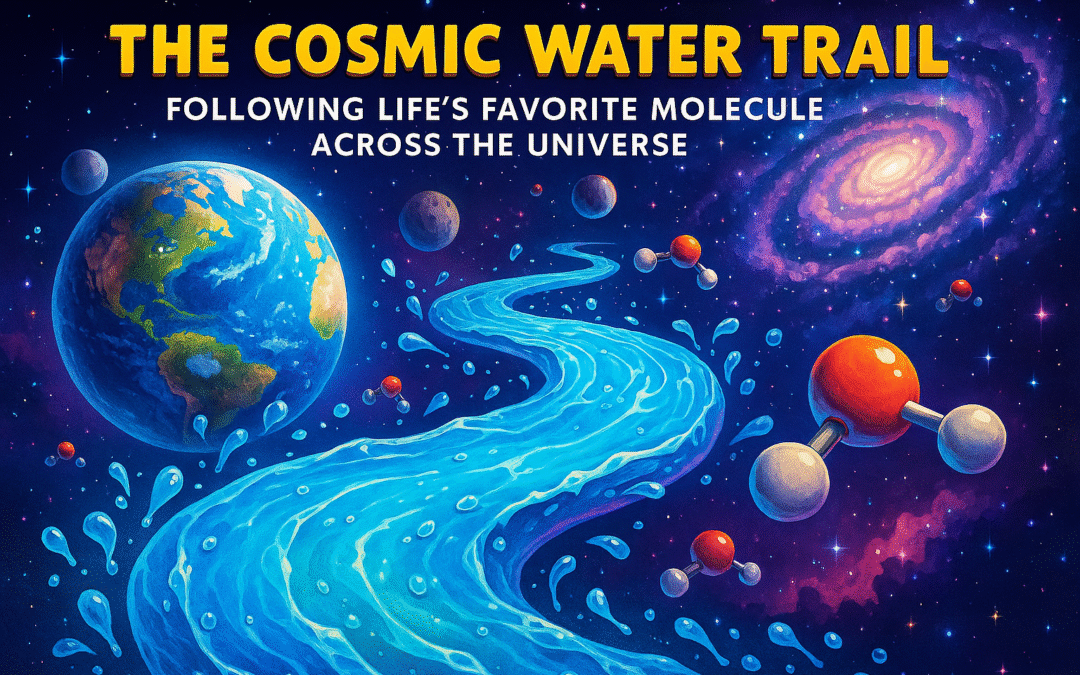
Introduction: Why Water Makes Worlds Rock
Water—so simple, so ordinary, yet the key ingredient that transforms lifeless spheres into living worlds. For everyone from curious stargazers to planetary scientists and bold astrobiologists, the hunt for water across the cosmos is the greatest treasure hunt of our time. Why? Because wherever there’s water, the possibility exists for life as we know it to take hold. This isn’t just a scientific hypothesis—it’s a guiding principle that shapes how we explore Mars, chase icy plumes on distant moons, and peer into the atmospheres of faraway exoplanets.
From the familiar blue oceans of Earth to the shadowy craters of the Moon, the sprawling chaos terrains of Europa, and the steamy atmospheres of planets dozens of light-years away, water appears in forms more diverse and dramatic than most sci-fi authors ever imagined. So buckle up, space explorers: the presence and quest for water on other worlds is a story packed with breakthroughs, mind-bending extremes, and tantalizing hints at alien life.
Stardust Origins: Where Cosmic Water Begins
Before plunging into alien oceans and icy craters, let’s ask a cosmic question: where did all the water in our solar system come from in the first place? The answer takes us billions of years back, to a time before planets or even stars had formed.
Born From Stellar Alchemy
The universe’s most abundant element—hydrogen—was forged in the Big Bang. Oxygen, by contrast, bubbled up inside stars through nuclear fusion and then spread outward during supernova explosions. Only then could these two elements combine to make water. Recent simulations show that some of the first stars, so-called Population III giants, likely seeded the cosmos with water much earlier than once thought—within 100-200 million years after the Big Bang, “flooding” primordial molecular clouds with vast reserves of H₂O.
Icy Grains and Molecular Clouds
In our own galaxy, the Milky Way, water is astonishingly common in the icy mantles that coat dust grains inside molecular clouds—the star nurseries of the cosmos. NASA’s upcoming SPHEREx mission will map our entire galaxy in unprecedented spectral detail to search for cosmic reservoirs of frozen water and other prebiotic molecules where planetary systems form.
Among the marvels: the Orion Nebula alone is thought to create enough water every day to fill Earth’s oceans 60 times over!
Across the Early Solar System: Bombardment and Delivery
With all that water floating in space, how did some of it reach Earth and our neighboring planets? The answer is both violent and beautiful.
Cometary and Asteroidal Bombardment
As the solar system coalesced, asteroids and comets—icy leftovers from planetary formation—served as the water delivery trucks for our budding world. The chemical and isotopic “flavors” (deuterium-to-hydrogen ratios) found in both comets and meteorites have recently been shown to closely match Earth’s oceans, giving strong evidence that these cosmic ice-balls helped make our planet habitable.
Recent observations of Halley-type comet 12P/Pons-Brooks and comet 67P/Churyumov–Gerasimenko confirm that at least some comets are chemically indistinguishable from Earth’s water, resolving a major scientific debate that raged for decades.
Water’s Volatile Journey
But the young inner solar system was a dangerous neighborhood. As planets formed and grew, most water near the Sun vaporized in the intense heat. Only after the solar system cooled and stabilized could water delivered by comets and asteroids persist. On Earth, volcanic outgassing added still more water vapor, continually “recharging” the world’s oceans by releasing it from deep inside the mantle.
Liquid Legacies: Water’s Fate on Rocky Planets
Not all rocky worlds kept their water. Some, like modern Earth, maintained rich oceans. Others lost theirs to the vacuum of space or to greenhouse hellscapes.
Venus: The Lost Ocean World
Billions of years ago, Venus may have hosted vast surface oceans, making it the solar system’s first possible “ocean world”. But a runaway greenhouse effect, instigated by intense solar heating and a lack of a magnetic field, boiled off the water, which then escaped into space.
Mars: Ocean Views and Subsurface Surprises
Of all the planets, Mars offers perhaps the most dramatic “what if?” Mars was once blue—swathed by rivers, lakes, and, as new research continually strengthens, a planet-wide ocean that covered a third of its surface.
- Recent radar data from China’s Zhurong Rover has added strong evidence for an ancient, large Martian ocean: the rover’s instrument detected sedimentary structures—analogous to terrestrial coastal features—buried beneath the Martian surface, pointing to a thriving shoreline in the planet’s northern lowlands.
- Geological research has uncovered mature river deltas and topographically inverted channel belts: classic signatures of rivers emptying into a massive standing body of water.
- Mars’ north polar vortex, recently explored by ESA’s ExoMars Trace Gas Orbiter and NASA’s Mars Reconnaissance Orbiter, revealed extreme polar winters that freeze water vapor out of the air, affecting seasonal chemistry and ozone distribution—a cosmic freezer, locking and unlocking water over eons.
But while Mars once sang with blue, it lost both its atmosphere and water at alarming rates. NASA’s MAVEN mission measures modern atmospheric loss equivalent to 400 kilograms per hour, and over 87% of its original water may have escaped to space.
Modern Martian Water: Brines and Frost
Despite its desolate appearance, Mars still hosts water—frozen in caps, buried as subsurface ice, and, tantalizingly, perhaps in transient liquid brines.
- Mars rovers and landers have found that Martian soils typically contain about 2% water by weight, while dust storms, ancient lakebeds, and recurring slope lineae suggest water’s presence is both ancient and recently active.
- The holy grail has been liquid water, long thought impossible on the freezing, low-pressure surface. Yet new research shows that salty brines, especially of calcium perchlorate, can form brief, millimeter-thin films of liquid during Martian dawns and dusks, particularly around seasonal frost deposits.
This means that even on modern Mars, there are seasonal windows—albeit fleeting and minuscule—where conditions allow liquid water, with huge implications for potential microbial life and future exploration.
The Icy Outlands: Moons With Hidden Oceans
If you want to find abundant water in the solar system, head out beyond the asteroid belt. Here, the giant planets’ moons hide a shocking abundance of liquid water—much of it far greater in volume than Earth’s oceans.
Europa: Frozen Shell, Salty Ocean
Jupiter’s moon Europa is the poster child for “ocean worlds” in astrobiology. Its surface is a shell of fractured, young ice**—and below that, a global ocean possibly over twice the volume of Earth’s combined oceans. Tidal flexing by Jupiter’s gravity keeps the ocean liquid, and the constant cycling of icy blocks (chaos terrains) brings material from the interior up to the surface and possibly vice versa.
Recent findings from Hubble and JWST have revealed dynamic surface features: crystalline water ice, carbon dioxide, sodium chloride (table salt), and hydrogen peroxide all found in “chaos” regions, implying active cycling between the subsurface ocean and the surface. Spectral fingerprints suggest new material emerges every 10-15 days.
Europa’s ocean may even be in direct contact with its rocky seafloor, providing all three of life’s requirements: liquid water, chemical energy, and organic building blocks. In this view, Europa is tantalizingly similar to Earth’s own deep-sea hydrothermal vent ecosystems, where life thrives despite perpetual darkness.
Upcoming Missions: The Europa Clipper and JUICE
NASA’s Europa Clipper, arriving by 2030, will conduct dozens of close flybys to probe Europa’s ice, search for plumes, and measure the ocean’s characteristics. ESA’s JUICE mission, launched in 2023, will carry the most advanced set of instruments ever for studying icy moons and their subsurface oceans, focusing on Europa, Ganymede, and Callisto.
Enceladus: The Cassini Geyser Show
Saturn’s moon Enceladus turned out to be the most unexpectedly dramatic ocean world. In 2005, the Cassini spacecraft discovered giant plumes erupting from “tiger stripe” fractures near the moon’s south pole—jets of water vapor, ice, salts, and organic molecules.
- Cassini flew through these plumes, directly sampling the ejected material. Analyses revealed complex organic compounds, salt-rich particles, and hints that hydrothermal processes drive reactions deep beneath the ice.
- Excitingly, amino acids and other life-related molecules could survive close to the surface, protected by the plume ejection process even against harsh radiation. This makes Enceladus a prime target for life-detection missions, since we don’t have to dig deep to search for biosignatures.
Future missions—including concepts for landers—are in the works, with Enceladus now a top-priority target for both NASA and ESA after these discoveries.
Titan: Methane Lakes and a Hidden Ocean
Saturn’s largest moon, Titan, is unique as the only world besides Earth to feature stable surface lakes and seas—but here, the lakes are filled not with water, but with liquid methane and ethane. Titan’s climate includes methane rain, rivers, and even massive cyclones, creating a hydrological cycle eerily reminiscent of Earth’s but with hydrocarbons replacing water.
Beneath its thick hydrocarbon-misted atmosphere, Titan is also believed to possess a deep, salty subsurface ocean of water, likely sandwiched between ice layers. Cassini—Huygens probe data and theoretical models support the existence of this ocean, and it’s potentially as salty as Earth’s Dead Sea.
Ganymede and Callisto: Saline Seas Under Ice
Jupiter’s Ganymede, the largest moon in the solar system, and its sibling Callisto, are both thought to have global, saltwater oceans buried beneath thick ice shells. Ganymede is the only moon known to have its own magnetosphere, generated by a metallic core. Hubble measurements of its aurorae wiggles reveal that the magnetic field is influenced by a conductive, saline ocean layer beneath the crust.
- Theoretical studies suggest Ganymede’s ocean might be a “water sandwich”—trapped between different layers of ice, not in direct contact with the moon’s rocky core. This could affect the ocean’s chemistry and, potentially, its habitability.
- The upcoming JUICE mission will map Ganymede’s ocean in detail, determining its thickness, composition, and possible interaction with the surface.
Callisto, though less studied, is another prime ocean-world candidate, with hints of a deep, briny sea based on magnetic measurements and theoretical modeling.
Other Ocean-World Candidates: The List Grows
Other enticing objects for hidden oceans include:
- Triton (Neptune’s largest moon): Active geysers and possible subsurface ocean.
- Ceres (the largest asteroid/dwarf planet): Evidence points to a past (and perhaps lingering) deep, salty brine reservoir, with surface bright spots revealing recent liquid activity.
- Pluto and other TNOs (Trans-Neptunian Objects): Models suggest Pluto, Eris, Orcus, and Sedna might possess subsurface oceans, preserved over billions of years beneath insulating ice layers.
Ice, Ice, Everywhere: Water on the Moon and Mercury
Lunar Ice: The Moon’s Shadowy Water Vaults
For decades, the Moon seemed an utterly arid world—until repeated spacecraft missions revealed the presence of water ice in permanently shadowed craters at the lunar poles. NASA’s Lunar Reconnaissance Orbiter (LRO) has mapped widespread ice deposits, some extending much farther from the poles than previously thought, especially in craters where sunlight never shines.
- Estimates suggest that each square meter of lunar regolith in these cold traps could contain over five liters of ice in its upper meter—potentially tens of billions of tons globally, a critical resource for future human explorers who could use it for drinking, breathing, and even rocket fuel.
The origin of lunar ice is debated: it could be from comet/meteor impacts, outgassing from the lunar interior, or chemical reactions between solar-wind hydrogen and oxygen in the regolith.
Mercury’s Surprising Shadows
Even Mercury, the planet closest to the Sun, is believed to hold deposits of water ice in permanently shadowed polar craters, identified by radar’s “anomalous reflectivity.” Despite scorching daytime conditions, shaded regions remain frigid and able to preserve water for eons.
Water Beyond the Solar System: Exoplanet Discoveries
Advances in telescope technology—and a little cosmic luck—mean we can now detect water far beyond our solar system, in alien atmospheres and perhaps on the surfaces of distant worlds.
Water Vapor in Exoplanet Atmospheres
The Hubble and James Webb Space Telescopes have revolutionized this field:
- WASP-39b: Hubble and Spitzer data revealed massive amounts of water vapor in this “hot Saturn’s” atmosphere, suggesting dramatic planetary migration and water delivery in other star systems.
- GJ 9827d: Hubble found water vapor in the atmosphere of the smallest exoplanet yet—about twice Earth’s diameter—hinting that worlds with water-rich skies truly exist.
- HAT-P-11b: The Neptune-sized planet was the first smaller exoplanet discovered with water vapor, demonstrating that “mini-Neptunes” may have water even if they’re too hot for oceans.
Such discoveries are landmark steps toward identifying habitable, Earth-like environments elsewhere.
Earth-Sized Exoplanets: TRAPPIST-1 e and the Habitable Zone
The compact TRAPPIST-1 system, 40 light-years away, boasts seven Earth-sized planets—three in the “habitable zone.” Webb’s recent studies of TRAPPIST-1 e rule out a thick, stifling hydrogen atmosphere, suggesting the planet may have rebuilt a denser, secondary atmosphere potentially capable of supporting stable liquid water.
Thanks to clever observation sequences comparing planet b (a bare rock) with e during back-to-back transits, astronomers are closer than ever to detecting faint atmospheric signatures, including water, on truly Earth-sized exoplanets.
Theoretical Ocean Worlds: Hycean Planets and Super-Earths
Modeling and indirect detections suggest many exoplanets—especially so-called “super-Earths” or “hycean” (hydrogen-ocean) planets—may possess deep, global oceans, hundreds of kilometers thick, that dwarf anything seen in our solar system.
- Examples include GJ 1214b, Kepler-22b, and Kepler-62e/f, though their true compositions are still being determined.
- These alien oceans may exist at crushing depths and high temperatures, with unique chemistry and atmospheric conditions, challenging our assumptions about where water can survive.
From Science Fiction to Science Fact: Detection Techniques
Finding water on another planet is as much a marvel of technology as a triumph of theory.
Techniques for Detecting Water
| Technique | Description | Example Applications |
|---|---|---|
| Spectroscopy | Analyzing light absorption to identify water features | Detection of water/CO₂ in exoplanet atmospheres |
| Neutron spectrometry | Sensing hydrogen (implying water) in regolith/ice | LRO’s mapping of lunar ice, asteroid surfaces |
| Radar sounding | Penetrating subsurface structures to find liquid/ice | Zhurong (Mars), JUICE radar (future) |
| Magnetic induction | Inferring conductive salty oceans via field measurements | Ganymede, Europa |
| Plume sampling | Direct analysis of ejected ice/water vapor | Cassini flybys of Enceladus’ plumes |
| Imaging | Spotting surface features carved by water | Mars deltas, Titan lakes |
Unlike “CSI: Solar System,” however, most of these techniques offer only tantalizing indirect evidence. That’s why big, ambitious missions—armed with advanced spectrometers, seismometers, radars, and in situ samplers—are now at the cutting edge of the water hunt.
Astrobiology: Why Water Is the Goldilocks Molecule for Life
Why do we “follow the water” in the quest for life? Because water is the universal solvent for life as we know it, enabling the chemistry and physics essential to cell structure, function, and reproduction.
Water is abundant, stable over a wide temperature range, excellent at dissolving compounds (“universal solvent”), and thanks to its hydrogen-bonding, can mediate the biochemistry of proteins, DNA, and cell membranes. Ice being less dense than liquid water (so it floats) ensures that planetwide freezing events won’t annihilate oceanic life. And crucially, water’s high heat capacity guards against wild temperature swings, supporting stable climates and even entire planetary ecosystems.
That’s why, when considering where life might exist—either within our solar system or across the galaxy—we always begin by asking: “Where is the water?”. Icy moons like Europa and Enceladus, with liquid oceans beneath thick shells of ice, are compelling targets because these oceans may be in contact with mineral-rich rocky mantles, opening up possibilities for complex biochemistry and energy cycles akin to Earth’s seafloor vents.
The Marvelous Future: Upcoming Missions and Ingenious Technology
The drive to uncover cosmic water is pushing the boundaries of human ingenuity, leading to missions and technologies as bold as the questions they seek to answer.
- Europa Clipper (NASA, arriving 2030): Will scan Europa’s ice shell, analyze its plumes (if detected), map chemical signatures, and assess its habitability.
- JUICE (ESA, launched 2023): Will perform detailed investigations of Ganymede, Callisto, and Europa, using ice-penetrating radar, spectrometers, and magnetometers.
- Artemis & Lunar Trailblazer (NASA): Hardware built to search for, map, and even harvest water ice on the Moon for human use.
- SPHEREx (NASA, launching soon): Will map the galaxy’s reservoirs of cosmic ice, searching for the origins of water and pre-biotic molecules.
- Mars Sample Return (NASA/ESA, late 2020s): Designed to bring Martian rock and soil samples to Earth, providing the chance to look for hydrated minerals and direct water evidence.
- Enceladus Landers/Orbiters (Future Proposals): To drill into the ice or sample freshly ejected plume material for smoking-gun evidence of life.
On the ground and in orbit, next-generation spectrometers, radars, and biosignature detectors are continually pushing the limit of our detection abilities—making the coming decades perhaps the most exciting era in the “follow the water” adventure yet.
Conclusion: Water, Wonder, and the Life That May Be
The story of water in the cosmos is one of the universe’s great plotlines. From ancient star nurseries to shimmering planetary oceans, from Martian riverbeds to the dazzling geysers of Enceladus, and from icy lunar craters to the boiling skies of distant exoplanets, water shapes worlds and points the way to life.
Following water across the solar system and beyond has already transformed our understanding of habitability and our place in the universe. Every mission, every radar ping, every spectrum analyzed, brings us closer to answering perhaps the oldest question of all: Are we alone?
Curious for More?
- NASA: Ocean Worlds
- BBC: Water in the Universe
- Cornell Chronicle: Water on TRAPPIST-1 e
- SETI: Habitability on Ceres
- Space.com: Hubble finds water in small exoplanet
- NASA: Ganymede’s Ocean Evidence
- NASA: LMRO reveals widespread lunar ice
System Ent Corp Sponsored Spotify Music Playlists:
https://systementcorp.com/matchfy
Other Websites:
https://discord.gg/eyeofunity
https://opensea.io/eyeofunity/galleries
https://rarible.com/eyeofunity
https://magiceden.io/u/eyeofunity
https://suno.com/@eyeofunity
https://oncyber.io/eyeofunity
https://meteyeverse.com
https://00arcade.com
https://0arcade.com