
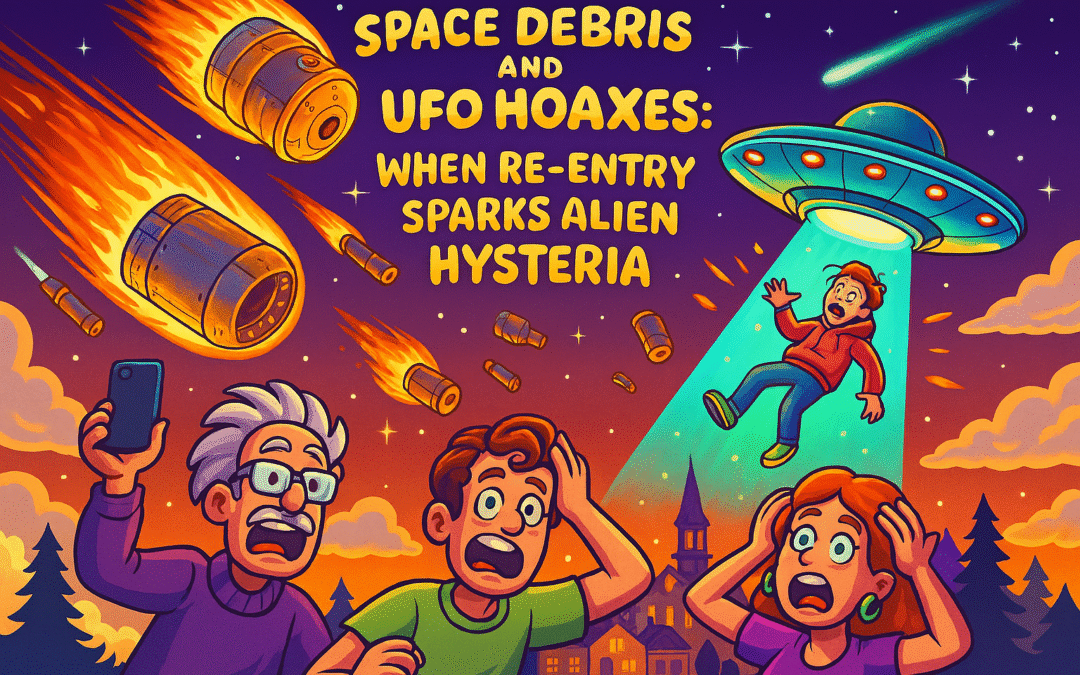
Introduction: Space Junk Meets the New UFO Craze
Picture this: It’s a clear night. You’re outside, gazing up at the stars, when suddenly a fiery streak blazes across the sky, breaking into glowing fragments. Your heart skips a beat. Is it a meteor? A secret military test? Or—cue the X-Files theme—a UFO? If you’ve ever wondered how so many “unidentified flying objects” end up being, well, very much identified, you’re not alone. In fact, a growing body of evidence suggests that many of the most spectacular UFO sightings are actually the dramatic re-entries of human-made space debris burning up in Earth’s atmosphere.
In this blog adventure, we’ll dive deep into the wild world of space junk, explore how its fiery demise can mimic the most convincing UFOs, and reveal why our crowded skies are only going to get more confusing. Along the way, we’ll meet startled witnesses, skeptical scientists, and a few disappointed alien hunters. Buckle up—this is the story of how our own technological leftovers have become the ultimate cosmic pranksters.
Space Debris by the Numbers: The 2025 Orbital Junkyard
Let’s start with the basics: Just how much stuff is floating above our heads? The answer, in 2025, is both staggering and a little alarming. According to the European Space Agency’s latest Space Debris Environment Report:
- Over 43,500 objects are actively tracked in Earth orbit, including satellites, rocket bodies, and fragments.
- More than 1.2 million pieces of debris larger than 1 cm are estimated to be up there—each one capable of destroying a satellite in a collision.
- An estimated 140 million objects between 1 mm and 1 cm are whizzing around, invisible to most radars but still dangerous.
- Total mass of all space objects in orbit: Over 15,100 tonnes (that’s more than 2,500 adult elephants, for those keeping score).
- Re-entries: In 2024, intact satellites or rocket bodies re-entered Earth’s atmosphere on average more than three times a day.
And the trend is only accelerating. The rise of “megaconstellations” like SpaceX’s Starlink means thousands of new satellites are being launched each year, with many designed to deorbit and burn up after just five years of service.
Table 1: Space Debris in Orbit (2025)
| Object Type | Number in Orbit | Estimated Mass (tonnes) |
|---|---|---|
| Tracked objects (>10cm) | 43,510 | 15,129.5 |
| Estimated 1–10cm | 1.2 million | — |
| Estimated 1mm–1cm | 140 million | — |
| Active satellites | ~12,900 | — |
| Rocket bodies | ~2,058 | — |
Source: ESA Space Debris Environment Report 2025
These numbers aren’t just trivia—they set the stage for a new era of spectacular re-entries, and, as we’ll see, a new golden age for UFO confusion.
What Does a Re-entering Space Object Look Like?
So, what happens when a piece of space junk finally succumbs to gravity and plunges back to Earth? The answer: a show worthy of any sci-fi blockbuster.
When a satellite or rocket body re-enters the atmosphere, it’s traveling at speeds of around 17,500 mph (28,000 km/h). The friction with the air causes it to heat up and glow, often breaking apart into multiple fragments. To the naked eye, this can look like:
- A slow-moving, bright fireball crossing the sky, sometimes lasting up to 90 seconds—much longer than a typical meteor.
- Multiple glowing fragments trailing behind the main object, each leaving a streak of light.
- Colorful displays: Depending on the materials, re-entries can glow white, yellow, green, or even blue.
- Sudden “explosions” or flares as pieces break off or fuel tanks rupture.
- Synchronized movement: Fragments often move in parallel, creating the illusion of a “formation” or “fleet.”
Compare this to meteors, which usually zip by in a flash lasting just a few seconds and often come from a single point in the sky (the “radiant” of a meteor shower). Human-made re-entries, by contrast, move more slowly and steadily, often from horizon to horizon.
Want to see for yourself? Check out this video of the ATV-1 spacecraft re-entering or SpaceX’s Falcon 9 second stage lighting up the Pacific Northwest in 2021.
Databases and Tools: Tracking Re-entries and Witness Reports
With so much stuff falling from the sky, how do scientists (and curious skywatchers) keep track? Enter the world of re-entry databases and citizen science.
- CORDS Reentry Database: The Center for Orbital and Reentry Debris Studies (CORDS) maintains a sortable database of all known re-entries since 2000, including object type, mission, and sighting reports.
- Jonathan’s Space Report: Jonathan McDowell’s catalog offers detailed stats on re-entries, disposal types, and risk assessments.
- NASA’s Orbital Debris Program Office: NASA’s reentry page explains the mechanics of breakup and survivability of debris.
- Public Sighting Reports: Many organizations, including CORDS and the National UFO Reporting Center, collect public reports of fireballs and “UFOs,” which are often cross-referenced with known re-entries.
These resources are invaluable for both debunkers and the genuinely curious. If you see a fireball, you can check recent re-entries and even submit your own sighting.
Notable Re-entry Events Mistaken for UFOs
Let’s get to the juicy part: real-life cases where spectacular re-entries sent UFO fever into overdrive—only to be explained by a little orbital mechanics.
The 2021 SpaceX Falcon 9 “Alien Armada” Over the Pacific Northwest
On March 25, 2021, residents from Oregon to Washington were treated to a jaw-dropping display: a slow-moving, fragmented fireball arcing across the night sky. Social media exploded with speculation—was it a meteor shower? A secret military test? Or a fleet of alien ships?
The truth: It was the second stage of a SpaceX Falcon 9 rocket, launched three weeks earlier, making an uncontrolled re-entry after failing to perform a deorbit burn. Videos showed dozens of glowing fragments moving in formation, prompting many to report a “UFO armada.” The event was so dramatic that even seasoned astronomers had to double-check the data.
Why the confusion? The slow speed, long duration, and multiple fragments were unlike typical meteors. The event was visible over a wide area, and the lack of advance warning added to the mystery.
The 2024–2025 Starlink Satellite Showers
With thousands of Starlink satellites now in orbit, their re-entries have become almost daily events. In 2024 alone, over 300 Starlink satellites re-entered, often creating spectacular fireballs. Many of these events have been mistaken for UFOs, especially when the satellites break up into multiple glowing pieces.
A particularly notable case occurred in May 2024, when a geomagnetic storm caused dozens of Starlink satellites to decay and re-enter prematurely, lighting up skies around the world.
The 2025 Poland Incident
In February 2025, debris from a failed SpaceX Falcon 9 second stage re-entry landed in rural Poland, prompting local farmers to wonder if they’d been visited by extraterrestrials—or at least by Elon Musk’s leftovers. While no one was hurt, the incident highlighted the risks of uncontrolled re-entries and the potential for confusion on the ground.
Historical Hits: Skylab, Kosmos 954, and More
- Skylab (1979): When NASA’s first space station re-entered over Australia, locals were treated to a fiery display—and a $400 fine for NASA for “littering”.
- Kosmos 954 (1978): This Soviet satellite scattered radioactive debris over Canada, sparking international concern and the only invocation of the 1972 Liability Convention for space debris.
- Long March 5B (2021): The uncontrolled re-entry of a massive Chinese rocket stage caused global anxiety and a flurry of UFO reports before it splashed down in the Indian Ocean.
How Re-entries Mimic UFO Behavior: Lights, Maneuvers, and Fragmentation
Why are re-entries so often mistaken for UFOs? The answer lies in the spectacular and sometimes bizarre visual effects they produce.
1. Lighting Effects
- Brightness: Re-entering objects can outshine Venus, the brightest planet, and are often visible even in urban areas.
- Color Changes: As different materials burn, they emit different colors—aluminum glows white, copper green, and so on.
- Flares and “Explosions”: Fuel tanks or batteries can rupture, causing sudden bright flashes.
2. Maneuvers and “Intelligent” Movement
- Fragmentation: As objects break up, fragments can appear to change direction, slow down, or speed up.
- Parallel Paths: Multiple fragments moving together can look like a “fleet” or “formation,” fueling speculation about intelligent control.
- Sudden Turns: Perspective effects can make fragments appear to make sharp turns or zig-zag, especially when viewed from different angles.
3. Duration and Speed
- Slow Crossings: Unlike meteors, which last a few seconds, re-entries can take up to 90 seconds to cross the sky, giving witnesses time to grab cameras and call the neighbors.
- Steady Motion: The slow, steady movement is often described as “unnatural” compared to the quick flash of a meteor.
4. Sound and Aftermath
- Delayed Booms: Large re-entries can produce sonic booms minutes after the visual display, adding to the mystery.
- Falling Debris: In rare cases, fragments survive to the ground, sometimes causing property damage or, in one case, hitting a woman in Oklahoma (she was unharmed).
Sensor Artifacts and Camera Illusions: When Technology Tricks Us
It’s not just the naked eye that gets fooled. Many famous UFO videos—especially those from military or scientific sensors—have turned out to be the result of camera artifacts, lens flares, or sensor glitches.
The “Gimbal” UFO: Just a Camera Glare?
One of the most famous modern UFO videos, captured by a Navy jet and dubbed “Gimbal,” shows a glowing object rotating in the sky. For years, it was touted as evidence of advanced technology. But detailed analysis by debunkers like Mick West revealed that the apparent rotation was actually a camera artifact—an infrared glare that rotated as the camera’s gimbal system moved.
Lens Flares and Orbs
Many “orb” sightings in photos and videos are caused by lens flares—reflections of bright lights inside the camera lens. These can appear as glowing disks, rings, or even “flying saucers,” especially when shooting toward the sun or a bright light source.
Parallax and Optical Illusions
Our brains are wired to interpret moving lights in the sky as distant, fast-moving objects. But without reference points, it’s easy to misjudge speed, distance, and direction. This can make a slow-moving satellite or re-entry appear to make impossible maneuvers.
Scientific Investigations and the Rise of Debunking Communities
As UFO sightings have surged in the era of smartphones and social media, so too has the community of scientific sleuths dedicated to separating fact from fiction.
The All-domain Anomaly Resolution Office (AARO)
The U.S. Department of Defense’s AARO now investigates hundreds of UAP (Unidentified Anomalous Phenomena) reports each year. Their latest report found that most cases could be explained by ordinary objects—aircraft, drones, balloons, satellites, and, yes, re-entering space debris.
NASA’s UAP Study
In 2022, NASA commissioned an independent study to bring scientific rigor to the UAP debate. Their conclusion: Most sightings are likely misidentified natural or human-made phenomena, and better data collection is needed.
Citizen Science and Online Debunkers
Websites like Metabunk and UFO of Interest have become hubs for crowdsourced investigations. Using flight data, satellite tracking, and image analysis, these communities have solved many high-profile cases—often revealing a mundane explanation behind the mystery.
Atmospheric and Environmental Effects: When Space Junk Pollutes
It’s not just our imaginations that are affected by re-entering space debris—there are real environmental consequences, too.
Pollution in the Stratosphere
Recent studies have found that metals from burning satellites and rocket stages are accumulating in the stratosphere, the layer of the atmosphere that houses the ozone layer. Using high-altitude aircraft, scientists detected aluminum, copper, lithium, and even rare metals like niobium and hafnium in stratospheric aerosol particles. These metals match the alloys used in spacecraft, confirming their source.
Why does this matter? Aluminum oxide, a byproduct of burning satellites, can destroy ozone and alter Earth’s ability to reflect sunlight. With thousands of satellites now burning up each year, scientists warn that we could be entering “uncharted territory” for atmospheric chemistry.
The Megaconstellation Era: A New Challenge
SpaceX’s Starlink satellites now account for about 40% of all re-entering satellites, with hundreds burning up each year. As more companies launch megaconstellations, the rate of re-entries—and the associated pollution—will only increase.
Fun fact (or not-so-fun): By 2023, 10% of stratospheric aerosols already contained metals from rocket and satellite re-entries. That number could rise to 50% or more in the coming decade.
Legal, Safety, and Policy Implications: Who’s Responsible for Space Junk?
With so much debris falling from the sky, who’s on the hook when something goes wrong? The answer is… complicated.
International Treaties and Liability
The 1972 Liability Convention holds launching states liable for damage caused by their space objects, whether in space or on the ground. But enforcement is tricky, especially as private companies take the lead in space operations.
Recent Incidents
- Poland (2025): After SpaceX debris landed in a farmer’s field, locals struggled to figure out how to claim compensation.
- Saskatchewan, Canada (2024): Farmers found Starlink debris on their land and had to navigate international space law to seek redress.
- India (2022): Falling debris from a Chinese rocket killed livestock and damaged property, prompting investigations by the Indian Space Research Organisation.
The Push for Stricter Standards
With the rise of megaconstellations, agencies like ESA are pushing for stricter debris mitigation guidelines, including requirements for controlled re-entries and active debris removal. The goal: prevent a runaway chain reaction of collisions (the dreaded “Kessler Syndrome”) that could render parts of orbit unusable.
Public Perception: Why Do We See UFOs Instead of Space Junk?
Despite all the science, the public’s fascination with UFOs remains as strong as ever. Why are we so quick to interpret a fiery re-entry as an alien visitation?
The Psychology of UFO Reporting
Studies show that people who report UFOs aren’t necessarily delusional or attention-seeking. Instead, they tend to have vivid imaginations and a high degree of “openness” to new experiences. Our brains are wired to seek patterns and explanations for the unexplained, and a dramatic light show in the sky is the perfect canvas for our imaginations.
Cultural Influences
From the Roswell incident to Hollywood blockbusters, our culture primes us to interpret mysterious lights as evidence of extraterrestrial life. Social media amplifies this effect, spreading rumors and speculation at the speed of light.
The Role of Surprise and Uncertainty
When a re-entry occurs unexpectedly—especially at night, over populated areas—it catches people off guard. The lack of immediate explanation fuels speculation and, sometimes, conspiracy theories.
Case Studies: Recent 2023–2025 Re-entries and Public Reactions
Let’s look at a few recent examples that illustrate the ongoing dance between space debris and UFO sightings.
May 2024: Starlink Storm
A powerful geomagnetic storm caused dozens of Starlink satellites to re-enter prematurely, creating a series of fireballs seen from North America to Europe. Social media lit up with UFO reports, but satellite trackers quickly identified the cause.
February 2025: Poland’s SpaceX Surprise
After a failed deorbit burn, a Falcon 9 second stage re-entered over Poland, scattering debris across rural areas. Local news outlets speculated about UFOs before experts traced the fragments to the SpaceX mission.
Ongoing: Starlink “Trains” and Flares
Even when not re-entering, newly launched Starlink satellites often appear as bright “trains” of lights moving across the sky, prompting waves of UFO reports. The Pentagon’s AARO office now routinely attributes many UAP sightings to Starlink flares.
Tools and Methods: How to Identify a Re-entry from the Ground
Want to become a sky detective? Here’s how experts distinguish re-entries from other phenomena:
- Duration: Re-entries last much longer (20–90 seconds) than meteors (a few seconds).
- Speed: Re-entries move at a steady, aircraft-like pace, while meteors streak by rapidly.
- Fragmentation: Multiple glowing fragments moving together are a hallmark of re-entries.
- Direction: Re-entries often move parallel to the horizon, while meteors can come from any angle.
- Databases: Check recent re-entries in the CORDS database or Jonathan’s Space Report.
- Satellite Trackers: Use apps or websites to track satellite passes and predict when re-entries might occur.
If you see something strange, don’t panic—check the data before calling the Men in Black.
Notable UFO Sightings with Official Explanations Involving Space Junk
Some of the most famous UFO cases have turned out to be re-entering space debris:
- STS-48 Shuttle Mission (1991): Video showed mysterious objects changing direction in space. NASA explained them as ice particles disturbed by thruster firings, but the debate continues.
- STS-75 “Tether Incident” (1996): Glowing objects swarmed a broken tether. NASA said it was space debris illuminated by sunlight, but UFO enthusiasts remain unconvinced.
- STS-80 (1996): Disk-like objects and fast-moving streaks were captured on video. Analysis suggested they were likely shuttle debris and atmospheric phenomena, not alien craft.
- Roswell (1947): The original “flying saucer” crash was later revealed to be a secret military balloon (Project Mogul).
Visual Media: Videos and Photos of Re-entries and Misidentified UFOs
The internet is awash with dramatic footage of re-entries mistaken for UFOs. Some highlights:
- ATV-1 Re-entry (ESA/NASA): A spectacular, multi-fragment fireball over the Pacific.
- SpaceX Falcon 9 Over Washington (2021): Dozens of glowing fragments lighting up the night.
- Starlink “Trains”: Bright, moving lines of satellites mistaken for UFO fleets.
These videos are both awe-inspiring and a reminder of how easily our senses can be fooled.
Future Trends: Megaconstellations and the Coming Storm of Re-entries
The next decade promises even more confusion—and more spectacular sky shows.
- Megaconstellations: With tens of thousands of satellites planned by SpaceX, Amazon, and others, re-entries will become a daily occurrence.
- Increased Pollution: Scientists warn that the cumulative effect of burning satellites could alter the chemistry of the stratosphere, with unknown consequences for climate and ozone.
- Policy Challenges: Regulators are scrambling to update liability laws and debris mitigation standards to keep pace with the new space race.
- Public Awareness: As more people witness re-entries, education and outreach will be key to preventing panic and misinformation.
Conclusion:
So, the next time you see a mysterious light blazing across the night sky, remember: It’s probably not aliens. It’s more likely a piece of yesterday’s technology making a fiery return to Earth. Space debris has become the ultimate cosmic prankster, dazzling us with its final act and keeping UFO enthusiasts—and scientists—on their toes.
But behind the spectacle lies a serious challenge. As we fill the skies with satellites and rockets, we’re not just cluttering up orbit—we’re creating a new source of environmental risk and public confusion. The line between science fiction and science fact has never been blurrier.
So keep watching the skies—but maybe keep a satellite tracker handy, too. The truth is out there, and sometimes, it’s just a piece of space junk burning up in style.
Further Reading and Smart Links:
- ESA Space Debris Environment Report 2025
- CORDS Reentry Database
- NASA’s Orbital Debris Program Office
- NOAA: Stratosphere Littered With Tiny Bits Of Space Junk
- Frontiers in Astronomy: Tracking Starlink Reentries
- Metabunk: Debunking UFO Videos
- NASA UAP Study
- AARO UAP Reports
System Ent Corp Sponsored Spotify Music Playlists:
https://systementcorp.com/matchfy
Other Websites:
https://discord.gg/eyeofunity
https://opensea.io/eyeofunity/galleries
https://rarible.com/eyeofunity
https://magiceden.io/u/eyeofunity
https://suno.com/@eyeofunity
https://oncyber.io/eyeofunity
https://meteyeverse.com
https://00arcade.com
https://0arcade.com