Introduction: The Allure of Heraldry and The Kemble Tale
Heraldry! The very word conjures visions of glistening armor, bold banners streaming across the fields, and crests that whisper secrets of centuries past. In the colorful realm where genealogy, artistry, and the drama of human history intertwine, family coats of arms stand as ornate signposts to the stories of our ancestors. One such armorial tale—rich in symbolism and steeped in both Old World and New World history—is the Kemble Coat of Arms, most notably associated with Peter Kemble, 18th-century colonial merchant and political mover in New Jersey.
But what makes the Kemble arms by Peter Kemble such a must-see marvel in the tapestry of heraldry? To answer that, we’ll embark on a journey: from the heraldic language of blazons to the symbolism of leopards and boars, from the genealogy of the Kemble family to their cultural impact stretching from Saxon England to the American colonies. By the end, we’ll not only understand the Kemble arms’ historical roots and symbols but may even feel the urge to create our own “mark of valor.” Along the way, you’ll find direct links and sources to further explore.
Let’s hoist the banner and dive into the world of the Kemble Coat of Arms by Peter Kemble—a heraldic adventure awaits!
The Heraldic Blazon of Peter Kemble’s Coat of Arms: Reading Armorial Language With Style
Before we analyze the colors and creatures, let’s get fluent in heraldic blazon—that special language as vibrant as a red doublet, invented so any heraldic artist could accurately recreate a coat of arms simply by “reading” its description.
The Blazon for Peter Kemble’s Arms
According to Bolton’s American Armory and subsequent armorial records, the basic blazon runs:
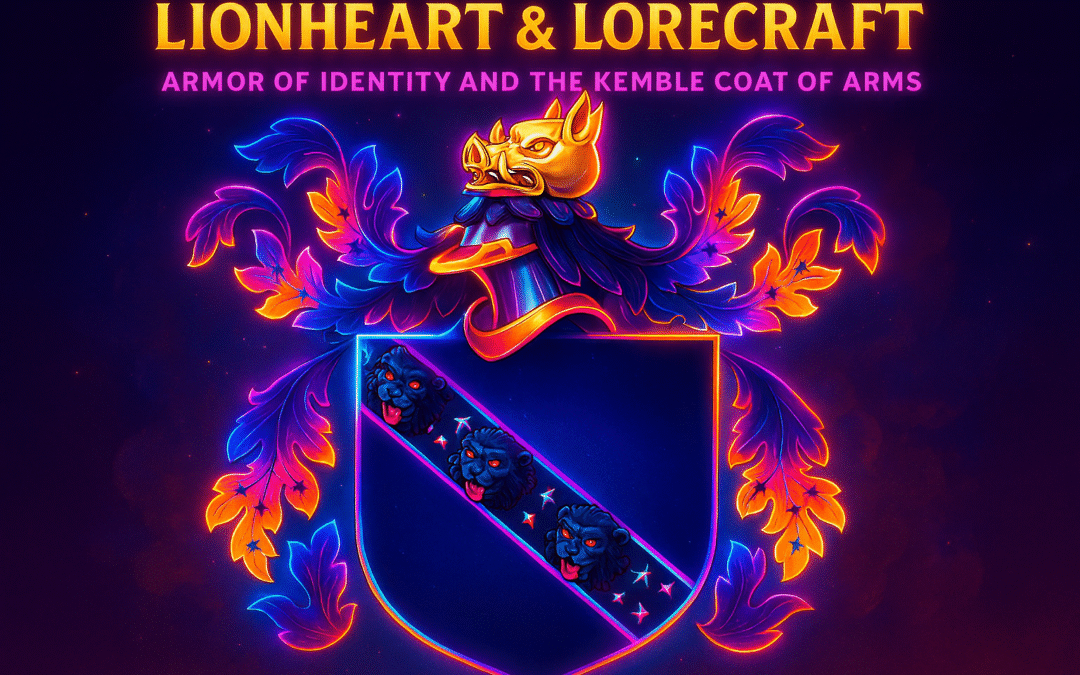
“Sable on a bend Ermine three leopards’ faces Sable. Crest: A boar’s head couped Or.”
Let’s translate:
- Sable: black (the field or background color of the shield).
- Bend: a wide, diagonal stripe from the upper left (from the viewer’s point) to the lower right.
- Ermine: a heraldic fur, white with black spots, symbolizing purity or nobility.
- Three leopards’ faces Sable: three black leopards’ faces arranged along the bend.
- Crest: a boar’s head couped (cleanly cut off, showing the neck) in gold (Or).
Visualize it: The coat features a bold black shield with a stark white diagonal (ermine), upon which three fierce black leopard faces glare out. Above the shield, in classic crest position, gleams a golden boar’s head. For a crisp visual, visit the official SVG rendering.
Why So Specific?
The blazon is not just for record-keeping; it’s the “recipe” for each unique coat of arms. Every element, from color (tincture) to animal posture, matters. For historic arms like Kemble’s, these were heraldic “fingerprints”—a unique, portable identity on the battlefield, marriage record, or legal document.
Symbolism in Heraldry: Colors, Furs, and the Rule of Tincture
Now that we “read” the blazon, what does it mean? Heraldry is never just decorative—every hue and shape pulses with symbolic energy!
Tinctures: Colorful Codes of Meaning
Heraldic tincture consists of metals, colors, and furs, each loaded with meaning.
| Tincture | Heraldic Color | Symbolic Meaning |
|---|---|---|
| Sable | Black | Constancy, wisdom, or grief |
| Or | Gold/Yellow | Generosity, honor, elevation |
| Ermine | White with black | Purity, dignity, innocence |
Sable grounds the shield in enduring fortitude and seriousness, a color often chosen for powerful families or those marked by challenges. Ermine, a fur derived from the white winter coat of the stoat, is a classic marker for purity and high birth—think of the regalia of monarchs. Or (gold) blazes with generosity and nobility, reserved for the most honored of crests.
This color scheme is anything but random; it shouts both the family’s ambitions and their virtues.
The Rule of Tincture
In heraldry, colors (like sable) are not placed on other colors, nor metals (like Or) on metals, to preserve contrast and visibility. The striking black-on-white (sable on ermine) of the Kemble arms follows this for clarity, just as it was intended for easy recognition—even in the chaos of battle.
The Charges: Animals With Attitude! Leopards’ Faces and Boar’s Head
Heraldry comes alive with its charges—those snorting, glaring, or dignified creatures emblazoned to represent character and legacy.
Leopards’ Faces (Sable) on a Bend Ermine
Three leopards’ faces, peering straight out at the viewer, are scattered along the white ermine bend.
- Leopard in Heraldry: In English arms, a “leopard’s face” is essentially a lion’s face affronté (full frontal), often interpreted as a sign of valiant courage, strength, and unwavering daring in battle. Historically, the leopard’s face was a marker of royalty or someone knightly, echoing legends of the lion’s cousin: fierce, yet cunning and alert.
- Why Three? A set of three often denotes tenacity, triple strength, and a design “in perpetuity” (as three is a traditional symbol of completeness or luck in heraldry).
Crest: A Boar’s Head Couped Or
Above the shield sits a boar’s head couped Or (golden, cleanly severed).
- Boar in Heraldry: The boar is one of the most dynamic and fearless charges in the armorial bestiary. It charges without retreat, symbolizing fierce courage, hospitality (the boar’s head was a centerpiece at feasts), and, sometimes, resilience in the face of impossible odds.
- Why Coupled With Kemble? The boar’s head is also a subtle reference to hunting prowess and noble feasts—signs of status in medieval (and colonial) society.
This combination—bold black leopards and a golden boar—portrays the house of Kemble as both watchful and dauntless.
Artistic Elements and Design: A Colonial Armory with Classical Flair
Heraldic art is both constrained by tradition and open to stylistic wiggle room. The Kemble Coat of Arms stands apart by how it balances clarity and flourish.
1. Simplicity of Composition
Like the best arms of the Middle Ages, Kemble’s shield is not overloaded. The black field provides a strong contrast to the white ermine bend. The bend itself not only divides the shield but draws the eye diagonally across, lending a sense of movement and action—a subtle nod to the family’s forward drive.
2. Heraldic Animals as Portraits of Virtue
The faces of the leopards are not side-profiled but affronté—gazing at the observer, as if to say, “Face us if you dare.” The boar’s head in gold is more than mere ornamentation; displayed as a crest above the helmet, it would have identified the Kemble family even from a distance, during parades, ceremonies, or in artwork.
3. Harmony of Field, Charges, and Crest
In truly ingenious heraldic design, the charges and crest are not picked at random. Here, the black field, the purity of ermine, and the gold of the boar’s head come together to tell a story of power, virtue, and undaunted energy. It’s a composition that balances gravitas with a touch of bold drama—Peter Kemble’s life in visual shorthand.
The Kemble Family: Genealogy From Saxons to Colonial Elites
The arms would mean little without the family behind them—a lineage both vibrant and complex.
Kemble Family Origins: Saxon Roots and the Meaning Behind the Name
Scholarship traces the Kemble surname to several sources:
- Most agree it is Anglo-Saxon, with origins in places like Great and Little Kimble in Buckinghamshire. The name evolves from “cyne” (kin, royal) + “bell” (hill): “royal bell-shaped hill”.
- Some etymologists suggest roots in the Old English personal name “Cynibil” (“bold kin”), hinting at a family proud of its enduring kinship and, perhaps, martial achievements.
- Alternative theories suggest Celtic or Welsh beginnings, from “cambel” (“crooked mouth”). Regional dialects and migration added variations: Kemble, Kembel, Kimble, Kimbel, Kemball.
By the 12th and 13th centuries, Kembles appear in English records across Wiltshire, Huntingdonshire, and elsewhere, including Turbet filius Chembel (Pipe Rolls, 1130) and Richard de Kinebell (Buckinghamshire, 1273).
Migration to America and the Rise of Peter Kemble
Like many English surnames, the Kembles crossed the Atlantic, taking root in colonial America. Families spread from the mid-Atlantic to New England and the Carolinas, sometimes bearing different forms of the surname and adapting to local dialects.
The arms we focus on today, however, are tied to Peter Kemble (1704–1789)—an indomitable merchant, landowner, and politician, who helpfully embodied the dynamic, sometimes contradictory, energies of the colonial era.
Peter Kemble: A Life at the Crossroads of Empire
If history had casting directors, Peter Kemble would win the role of “Merchant-Prince-at-the-Eye-of-the-Storm.” His arms were as much a marker of personal identity as family honor.
Early Life: East to West, Old World to New World
- Born in İzmir, Ottoman Empire (modern Turkey), Peter was the son of Richard Kemble, an Englishman involved in the Levant mercantile trade, and his Greek-born wife from the Mavrokordatos family.
- Schooled in England, he learned the mercantile art in Rotterdam before setting off to London and, ultimately, the North American colonies circa 1730.
Colonial Success and Social Clout
- Kemble married Gertrude Bayard, aligning himself with the New York and New Jersey colonial elite.
- He built “Mount Kemble,” a substantial estate in New Jersey, and rose quickly in business and society.
- Appointed to the New Jersey Provincial Council in 1745, Kemble eventually became president of the council, wielding power until the eve of the American Revolution.
Loyalist, Survivor, and Armiger
- Kemble’s loyalty to the British crown during the American Revolution placed him in a precarious political position—his life and property at risk, while many of his children and in-laws became prominent patriots or British army officers.
- Through diplomatic finesse, family alliances, and a certain pragmatic adaptation (with some children declaring for the Revolution, others for Britain), Kemble survived, retained his lands, and died respected if somewhat isolated—a figure out of both a Jane Austen novel and a David McCullough epic.
Kemble Arms in Colonial America: Heraldry’s Second Act
The New World presented both opportunity and challenge for the ancient tradition of arms.
Heraldry’s Role in Colonial Society
- In colonial America, coats of arms were symbols of distinction and, to some, lingering ties to the older social hierarchies of Europe. Families like the Kembles used arms for identification, property marking, and a sense of continuity across generations—a visual link to the old order in an emerging world.
- While the use of arms was less strictly regulated than in Britain, armigerous families regarded their arms with pride, even adapting them to local tastes or new family branches. Peter Kemble’s coat is a rare instance of authentic Old World arms flourishing in the New World.
Modern Reproductions and Documentation
- The authoritative rendering of Peter Kemble’s arms appears in Bolton’s American Armory (1927), which catalogs genuine coats of arms used within the United States.
- Digital high-quality vector files and prints of the Kemble arms (and many others) are available for research, genealogy, or even for hanging in your own “great hall”.
The Cultural and Genealogical Importance of the Kemble Coat of Arms
What makes the Kemble arms so much more than a pretty family logo?
A Living Record of Identity
- Every element in the arms—color, creature, arrangement—is both an artistic choice and a genetic record. For descendants, the arms record not only family pride but serve as a mnemonic for values: constancy (black), generosity (gold), courage and wisdom (boar, leopards), and noble striving (ermine).
- Descendants and genealogists use arms like Kemble’s to trace not only blood but the history of migration, assimilation, and adaptation.
Social Signal and Legacy
Arms like those of the Kembles weren’t mere vanity pieces; they marked property, sealed documents, and, in the age before ID cards, authenticated the bearer’s right to land, trade, or status. In ceremonial contexts, the arms were emblazoned on silverware, gravestones, and the great entrance halls—reminding all who entered of the family’s journey from Saxon soil to American promise.
A Source of Artistic Inspiration
The style of the Kemble arms has inspired not only family reproductions but also modern printmakers, digital artists, and genealogists who see in classic heraldry an invitation to combine tradition with personal creativity. Even today, commissioning a version of the family arms remains a gesture of continuity—an heirloom for generations yet unborn.
Modern Variations and the Ongoing Life of the Kemble Name
Time never stands still, least of all for surnames! The Kemble name has flourished, evolved, and inspired.
Name Variations and Family Branches
- Over centuries, the Kemble name morphed: Kembel, Kimble, Kimbel, Kemball.
- As the family migrated, dialect and local custom “tweaked” the spelling, but the connection remained visible through arms and shared oral histories.
- Genealogical research into the Kembles finds them not only in England and America but spread worldwide, often still using arms or crests in some form—reproduced on everything from family Bibles to mugs and banners.
The Kemble Coat of Arms in the Digital Age
- Online heraldic databases now let you view, order, and even digitally render the Kemble arms for your own records or events.
- Descendants and enthusiasts can connect with armorial and genealogical societies to verify rights to the arms or commission new artwork based on classic blazon.
Whether flying as a banner at a family reunion or appearing in genealogical reports, the Kemble arms remain vibrant and deeply meaningful in the 21st century.
Why the Kemble Coat of Arms Endures: Artistry, Story, and the Call to Adventure
What sustains the allure of the Kemble arms—and heraldry itself?
- It’s a living art: Combining strict rules (so a 13th-century knight could “read” the shield) with personal or family flair.
- It’s democratic and noble: While historically reserved for knights or gentry, today’s heraldry is open; anyone can create or claim arms to represent their identity, values, or achievements (although official grants still exist in the UK and parts of Europe).
- It’s an invitation: The arms invite descendants and friends to dig deeper—discovering family stories that span continents, revolutions, and cultural epoch shifts.
The Kemble arms, with their leopards, boar’s head, and marriage of boldness and dignity, are an irresistible call to explore heritage, affirm values, and contribute a new chapter to the annals of family history.
Want to See for Yourself? Dig Into These Resources
- View and share the Kemble Coat of Arms by Peter Kemble for a detailed, zoomable image.
- Explore Bolton’s American Armory (1927) for more on armorial families in the United States.
- For a deep-dive into heraldic symbolism, check out Crests & Arms and Study of Symbols.
Conclusion: Heraldry as a Living Adventure
So, whether you’re a passionate genealogist, an art lover, or a story-chaser drawn to bold animals and ancient symbols, the Kemble Coat of Arms by Peter Kemble is a dazzling prism through which to explore the entwined threads of family, culture, and artistry.
From the battlefields of Europe to the plantations of New Jersey, from ancient “bell-shaped hills” to the creative studios of today, the leopards and golden boar beckon: discover, create, and celebrate your own place in the saga of history.
What symbols would you choose for your own arms? If the Kembles faced their world—and all of us—with courage, wisdom, and generosity, why not pick up the banner and join the parade?
Heraldry endures—and so does the adventure.
Go forth, noble reader, and may your heraldic journey be as lively, enchanting, and meaningful as the Kemble arms!
Sponsored Spotify Music Playlists:
https://systementcorp.com/power – Psytrance
https://systementcorp.com/90-degrees – Pop EDM
https://systementcorp.com/my-music – New Underground Rap
https://systementcorp.com/ai-music – AI Psytrance
https://discord.gg/4KeKwkqeeF
https://opensea.io/eyeofunity/galleries
https://rarible.com/eyeofunity
https://magiceden.io/u/eyeofunity
https://suno.com/@eyeofunity
https://oncyber.io/eyeofunity
https://meteyeverse.com
https://00arcade.com