
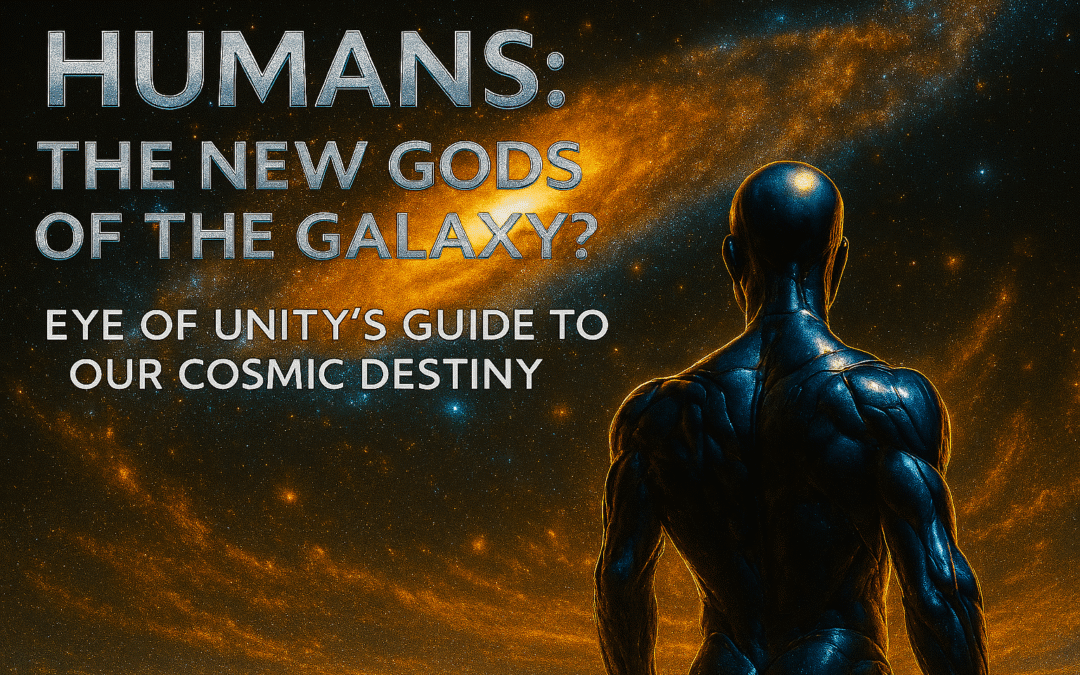
Welcome to the Age of Human Godhood: An Irreverent Introduction
What if the gods you’ve been searching for aren’t hiding in the clouds, on mountaintops, or in the heart of supernovas—but rather, are staring back at you from the bathroom mirror? Before you scoff, consider this: humanity is rapidly evolving into a force that, by any mythological standard, would qualify as “godlike” on the scale of the cosmos. With each passing year, our tools, our collective intelligence, and our reach extend farther—from shifting the climate and biosphere of a whole planet, to launching ourselves off-world, to literally proposing that we engineer entire new worlds and birth artificial minds.
This might sound like blasphemy to some, but atheists, secular humanists, and science fans everywhere can revel in the realization that the “divinity” we crave is not supernatural—it’s supremely natural. And it’s us. In this article, you’re invited to explore, celebrate, and question the provocative thesis that humans are well on their way to becoming the “gods” of the Milky Way, and maybe one day, the universe itself.
So grab your sense of wonder (and your skepticism), because we’re going to rocket through philosophy, science, culture, ethics, and cutting-edge tech in a journey that’s as mind-blowing as any ancient epic—except this time, the hero is us.
From Sapiens to Supergods: The Human-Centered Worldview
Classically, gods have been defined as supernatural beings—immortal, powerful, creators and destroyers, shapers of worlds and destinies. In religions and mythologies, gods are omnipotent forces who shape reality at will. Yet, if we break these attributes down, many are increasingly being claimed by humans themselves, not in mystical ways, but through technology, science, and culture.
What Makes a (God)? Atheist Philosophy Strikes Back
Atheist thinkers—from Bertrand Russell to Carl Sagan to contemporary bloggers—have long dismantled the need for supernatural creators. The arguments against a personal, interventionist deity frequently highlight both the lack of compelling evidence and the fact that “whatever a god is supposed to do, humans have started to do themselves”. Atheists, while often accused of removing the “magic” from the universe, actually replace it with something arguably more profound: a deep reverence for human ingenuity, agency, and the awe of natural reality.
Carl Sagan, a secular saint to many, notably declared that “in all this vastness—there is no hint that help will come from elsewhere to save us from ourselves. The Earth is the only world known… to harbor life… It’s up to us”. This “cosmic responsibility” becomes fuel for a worldview where meaning and power radiate outward from people, not from invisible beings.
The Evolution of God—As Us
The very idea of God, as philosophers and theologians admit, evolved—from forces of nature to tribal protectors to abstract cosmic principles. As human understanding of the universe grew, the “gods” retreated—from lightning bolts and volcanoes, into the gaps of science, and then into metaphor. Today, many mythologists and post-modern thinkers agree that our sense of purpose, morality, and meaning has always been rooted in humankind’s highest aspirations. In short: the gods were projections of human possibility all along!
Anthropocene Now: When Human Beings Became the Greatest Force in the Galaxy
Welcome to the Anthropocene—The Age of Humans
Forget the Bronze Age, the Iron Age, or even the Space Age. Welcome to the Anthropocene, a proposed new geological epoch defined by humanity’s planetary-scale impact. For billions of years, volcanoes, tectonic plates, and sunlight set Earth’s agenda. Now? It’s us. The scale of change is so great that some geologists argue humanity’s signature—fossil fuels, plastics, atmospheric carbon, radioactive fallout—will be visible in Earth’s rocks for millions of years.
Our Divine-Like Powers: Shaping Earth
- Climate Change: By burning fossil fuels, we’re controlling the thermostat of a whole planet—raising global temperatures, melting ice caps, and redirecting evolutionary paths of species forever.
- Mass Extinction: Human action has unleashed the planet’s sixth great extinction, rivaling the asteroid that killed the dinosaurs.
- Genetic Engineering: We don’t just breed dogs and corn anymore—we write DNA code, engineer new species, and propose resurrecting extinct ones.
- Urbanization and Landscape Design: From satellite cities to terraformed landscapes, humanity is the ultimate ecosystem architect.
This god-tier influence, whether for boon or bane, marks us as the single greatest transformative “species” in the known galaxy.
We Are the First World-Shapers in Galactic History (That We Know Of)
The Anthropocene makes us, at least so far as evidence goes, the only “species” in the observable universe to have become a planet-shaping force. Our carbon emissions, farming, and plastic waste are not just local quirks—they’re geological events. When future (alien?) geologists dig through Earth’s layers, the “Anthropocene boundary” will practically scream: HUMANS WERE HERE.
Human divine power isn’t limited to matter manipulation. Our ability to reshape meaning, narrative, and myth means we literally rewrite the story of Earth across cultures, continents, and, increasingly, planets.
We Build Our Own Heavens (and Hells): The History and Future of Space Exploration
From Gawking at the Sky to Launching Ourselves Among the Stars
From ancient marvelers mapping the night sky to the first rocket scientists and cosmic visionaries, humans have always been obsessed with getting off-world. But never before have we had the means.
- Sputnik and the Space Age: In 1957, humans hurled the first artificial “moon” into orbit. Four years later, we tossed Yuri Gagarin, and in 1969, humans walked on the Moon—a feat that, for a mythological audience, is squarely in “demigod” territory.
- Permanent Presence: Space stations now house people continuously. More than 500 humans from dozens of countries have left the Earth, making space a “manmade” domain—complete with its own environmental problems and social dynamics.
- Robotic Ambassadors: Our robotic explorers are more numerous than Olympian messengers—Mars rovers, interplanetary probes, and telescopes that stare into the origins of time and space.
The New Pantheon: SpaceX, NASA, Artemis, Artemis Base Camp
The 2020s and 2030s are an era of private spaceflight, lunar bases, and Mars fever. NASA’s Artemis program aims to reestablish humans on the Moon—and not just for a quick visit, but for permanent settlement. SpaceX is hurtling toward crewed Mars missions, with the company’s vision boldly laid out: “a city on Mars” with millions of people, transforming a dead world into a living one.
Not to mention billionaires racing to build lunar landers, asteroid mining dreams, and the rise of Chinese, Indian, and European space agencies gunning for planetary reach. Suddenly, terraforming planets—a motif once reserved for gods in myth and sci-fi—is on humanity’s technical and ethical to-do list.
Terraforming: The Power to Make Worlds
Engineering the Future—One Planet at a Time
If there’s ever been a clearer claim to godhood, it’s terraforming: the process of transforming an alien planet into a living, Earth-like world. That’s right, we’re actively designing step-by-step plans to:
- Warm Up Mars: Use orbital mirrors, aerosols, Starship launches—even controlled nuclear detonations—to raise the planet’s temperature.
- Seed Life: Deploy genetically engineered bacteria, algae, and later plants to oxygenate air, build soil, and create the basics of a biosphere.
- Build Atmospheres and Oceans: Extract water from permafrost, melt ice, produce a breathable atmosphere.
- Create Artificial Biospheres: Construct sealed “Eden domes” where life can thrive—stepping stones to a fully sentient planet.
Recent peer-reviewed studies estimate that emerging technologies—like modular mega-spaceships (e.g., Starship), genetic engineering, and advanced automation—could, in theory, allow humans to transform Mars within a few centuries, if we really crank up the effort.
Venus, the Next Frontier
Meanwhile, plans exist for stripping Venus’s thick CO₂ atmosphere, cooling the planet, and maybe one day “oasis-zoning” Mercury, Ganymede, or exoplanets circling distant suns.
If gods are defined by their world-making abilities, humanity is on the brink of the most literal and audacious fulfillment of this ancient wish.
Galactic Megastructures: Engineering at a Godlike Scale
Dyson Spheres, Star Harvesting, and the Matryoshka Megabrain
What if Earthly ambitions seem too small? Enter megastructures: building rings, swarms, or full shells around stars to capture a civilization’s energy output. Freeman Dyson’s famous Dyson Sphere concept asks: what if a truly advanced species wanted to use all the energy of its sun? They’d build structures that enclose a star, powering not just worlds but an entire society of untold complexity.
Beyond Solar: Gigastructures
Science fiction and speculative engineering don’t stop there—imagine ringworlds circling entire galaxies, Birch planets built from the mass of hundreds of billions of stars, or black hole “computronium” brains that think at speeds unimaginable to meat-based minds.
Searching for Alien Gods: SETI and the Signal of Tech-Civilizations
Astronomers openly hunt for infrared signatures of alien Dyson spheres—because such energy use would outshine whole galaxies in a way natural processes can’t match. As of 2025, no confirmed Dyson spheres have been found, but that only makes the stakes higher: humans may be the first to attempt such acts in the galaxy.
Intelligence Exploded: AI, AGI, and the Age of the Posthuman
Rise of the (Artificial) Superminds
It’s not enough to remake landscapes—we’re now on the edge of remaking intelligence itself. The development of AI, and more recently artificial general intelligence (AGI), is a leap of cosmic proportions.
- AI as the New Pantheon: Today’s AI and machine learning tools manage global economies, create art, write articles, and design new molecules. Already, hybrid intelligence systems that blend human and artificial cognition—IntelliFusion—are reshaping what it means to be intelligent and creative.
- The Compression of Civilization: AGI systems, capable of autonomous reasoning and self-improvement, threaten to “compress 200 years of progress into a decade.” The “singularity”—an era where intelligence accelerates beyond human control—is no longer a fantasy; it’s something that some researchers argue is quietly arriving now.
- The (Post)Human Future: As transhumanist philosophers argue, the merger of humans and machines could yield “posthuman” beings—intelligences whose capabilities so radically exceed ours, they appear godlike to us.
Transhumanism: Becoming More Than Human
Transhumanism—a movement and philosophy that embraces augmenting the body and mind with technology—sees this as both the ultimate destiny and responsibility of humanity. From brain-computer interfaces (think Neuralink), to gene editing (like CRISPR), to the prospect of mind uploading and digital immortality, the line between human and godlike becomes ever more blurred.
The Technological Singularity: A Moment Like No Other
Experts debate what a technological singularity would mean: a rupture in the fabric of human society, a merger with AI, the birth of digital superminds. Some see this as the end of human relevance—or, more optimistically, as the opening of infinite possibilities for meaning, flourishing, and cosmic understanding.
The New Modern Mythmaking: Culture, Story, and the Creation of Human Meaning
Modern Myths for a Human Cosmos
While the old gods fade into metaphor, modern culture is ablaze with new myths, narratives, and symbols that feed our sense of cosmic purpose. From Greek gods reimagined as brand logos, to superheroes, to the spirit of Star Trek and Star Wars, every generation invents its own metaphors for power, responsibility, and transcendence.
Why is this important? Because, as Joseph Campbell, Carl Jung, and contemporary scholars argue, myth is the operating system of civilization. It encodes the values, fears, and aspirations of a society. As humans reshape galaxies, our mythic self-understandings shape how we wield these powers.
Godmaking as Meme-Building
Contemporary memes—the viral codes of culture—are the digital descendants of myth. They travel faster, mutate quicker, and shape how billions see their place in the world, often blending science, satire, and social commentary in creative new narratives.
Cosmic Ethics: Should Humans Play God?
The Dilemma of the Divine: Power and Responsibility
With great power comes… well, you know the quote. As humans ascend to godlike levels of influence, we are faced with unprecedented ethical questions:
- Should We Terraform Planets? Some see it as destiny; others warn against playing god and risking unforeseen consequences.
- Is Spreading Earth Life Across The Galaxy Moral? The idea of directed panspermia—deliberately seeding lifeless planets with organisms—poses deep questions about the value of life, suffering, and ecological stewardship.
- Artificial Superintelligence: Who Gets a Soul? If we create sentient minds, do they deserve rights? Who decides what counts as consciousness or moral worth?
Ethicists urge us to move from narrow anthropocentric thinking to cosmic responsibility—a mindset that recognizes our obligation not just to ourselves, but to the web of life, future generations, and the fabric of the universe itself.
The Case for “Cosmic Stewardship”
Many thinkers now argue that cosmic responsibility is the next logical step for any civilization with godlike power. This encompasses:
- Intergenerational Justice: Our actions will affect countless future beings (biological or artificial).
- Precautionary Principle: Intervening on planetary or cosmic scales demands humility and reversible, adaptive approaches.
- Accountability: Governance of cosmic-scale engineering and AI must be accountable, transparent, and inclusive, lest gods become tyrants.
Panspermia, Astrobiology, and Humanity as the “Seeders” of Life
Are Humans the Locomotive of Life in the Cosmos?
The panspermia hypothesis suggests that life’s building blocks—or even viable microbes—may travel interstellar distances seeded by comets or meteors. But recent technological advances suggest that humans could take an active role in this process—as deliberate spreaders of life through tools like advanced robotics and synthetic biology.
Humanity could become the “seed bearers” of the galaxy, leveling up from natural accident to conscious agent in the evolution of ecosystems across space. In mythological terms, we would not just be children of the stars—we’d be parents, gods, or, perhaps, cosmic gardeners.
The Atheist’s New Meaning: Destiny Without Deity
No Gods Above, Only Godhood Within
If the traditional vision of gods—immortal, all-knowing, world-shapers—has faded, then the secular, atheistic embrace of human agency, wonder, and creativity steps up to fill the void. We aren’t the center of the universe, but we’re certainly at the center of our own story. The last superstition to fall, perhaps, is the idea that we need anyone else to bless us with meaning, purpose, or legacy.
The story of stardust—forged in ancient supernovae, coming together to build brains and cities—gives human life not just poetry, but a cosmic context for meaning and action. The true grandeur, for the atheist, is not in waiting for gods to intervene, but in realizing that, for the first time, “the universe—through us—can reflect on itself.”
Potential Pitfalls and Final Frontiers
The Danger of Arrogance
Not all is triumph. Some critics warn of the “arrogance of humanism”—the belief that human reason and technology can always solve our problems, no matter the scale. Hubris, after all, is the downfall of many a mythical hero-god. Our new godhood brings new responsibilities, new risks, and the possibility of catastrophic failures—runaway AI, environmental collapse, loss of meaning in a world where all needs are automated.
The Promise of Partnership
Yet perhaps our ultimate godhood is not about domination, but co-creation: partnership with each other, with AI, and with the universe itself. We are the only known species to wonder, to care, and to act for a broader good. What more divine role could there be?
Conclusion: Let’s Embrace Our Inner Godhood—Responsibly, Joyously, and Unapologetically
Humanity stands on the edge of a transformation that, in any previous era, could only be described as divine. We reengineer worlds, build new minds, shape biospheres, and create myths as quickly as we create memes. We are the mythic bringers of fire, the city builders, the terraformers, and the mythmakers. Do we do it for glory? For curiosity? For survival? Perhaps all of the above.
The old gods are dead, said Nietzsche. Long live the new gods—us. Not perfect, not omnipotent, but beautifully, gloriously imperfect: godlike in our power, human in our wisdom, and responsible for shaping tomorrows worthy of our new role.
So the next time you look up at the night sky, remember: if there are gods in the galaxy, their hands—literally and metaphorically—are our own.
“We are stardust contemplating the stars, builders of myths and machines, shapers of worlds yet to come. Let’s write a story worthy of our cosmic inheritance.”
System Ent Corp Sponsored Spotify Music Playlists:
https://systementcorp.com/matchfy
Other Websites:
https://discord.gg/eyeofunity
https://opensea.io/eyeofunity/galleries
https://rarible.com/eyeofunity
https://magiceden.io/u/eyeofunity
https://suno.com/@eyeofunity
https://oncyber.io/eyeofunity
https://meteyeverse.com
https://00arcade.com
https://0arcade.com