Introduction: Spheres—Nature’s Ultimate Angle Masters
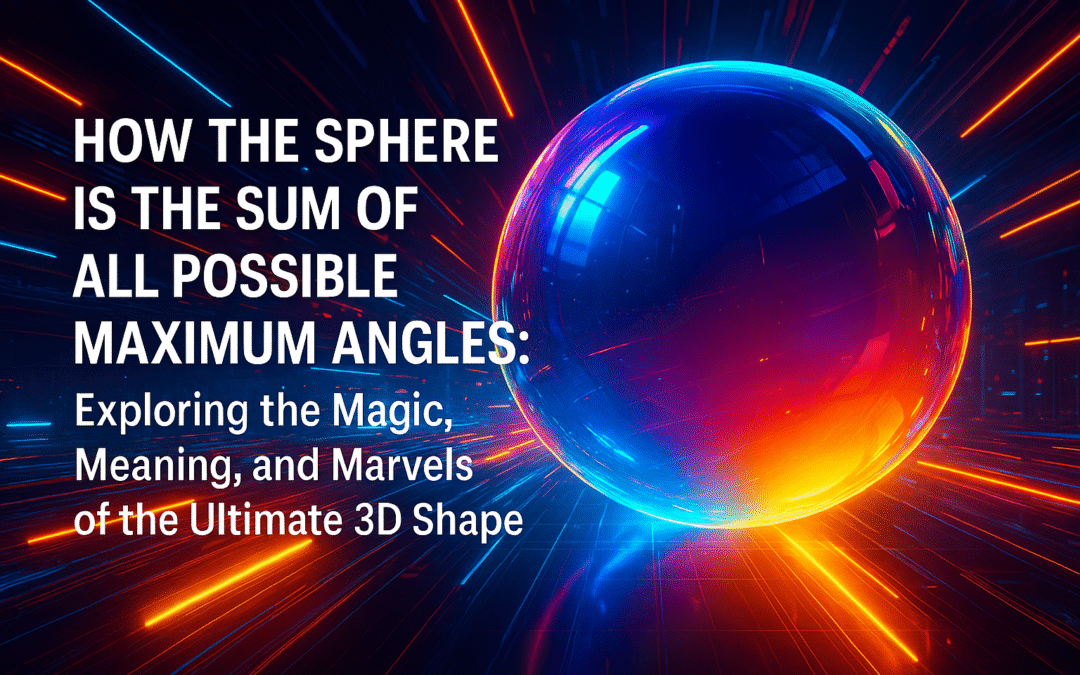
Imagine you’re floating in space, spinning a perfectly round basketball in your hands. No matter how you turn it, it looks the same—smooth, flawless, and somehow special. There are no edges, no corners, no preferred directions or “fronts” and “backs.” This magical uniformity isn’t just aesthetic: the sphere is geometry’s champion of maximum angles. But what does it mean to say a sphere is “equivalent to all maximum angles”? Why are spheres so omnipresent in nature, physics, art, and our imagination? How do they relate to ideas of completeness, balance, and infinite coverage?
Buckle up for an exhilarating, imaginative, and profound tour of spheres—from math class and soccer fields to cosmic expanses, Buckminster Fuller’s domes, and deep philosophical symbolism. We’ll blend geometry, physics, philosophy, and storytelling to uncover why the sphere reigns as the all-angle, all-coverage, all-unity shape.
The Building Blocks: What Is a Sphere Really?
Let’s start with the basics: a sphere is, at its heart, the set of all points in space that are equidistant from a central point—the center. Its essential features:
- Radius (r): The fixed distance from center to surface.
- Diameter (d = 2r): The longest straight line through the center and surface.
- Surface: No edges or vertices, just a perfectly smooth “skin.”
- Symmetry: Looks identical from every angle.
Mathematically, a sphere in 3D space with center (h, k, l) is described by the equation:
(x – h)² + (y – k)² + (z – l)² = r²
Every point (x, y, z) at distance r from the center lies on the sphere’s surface.
This absolute sameness in all directions isn’t a trivial quirk. It’s geometry’s most radical symmetry, where every viewpoint is privileged—an idea that explodes into both mathematical power and philosophical resonance.
Maximum Angles—Decoding the Spherical Superpower
So what do we mean when we say “a sphere is equivalent to all maximum angles”? It’s a poetic way to say: no matter where you stand on, in, or outside a sphere, your angular reach is maximized. Some highlights:
- Maximum Surface for a Given Volume: The sphere encloses the greatest volume for the least surface area—nature’s way of keeping everything as compact and “spread out” as possible.
- Maximum Angular Coverage: From the center, every direction is accessible—nothing is hidden. The sphere grants a full ( 4\pi ) steradians (the unit of solid angle) of angular coverage.
- Maximum Symmetry: Any rotation maps the sphere onto itself, making it the most symmetrical 3D object possible.
And for navigation or measurement, the sphere’s surface is where the concept of “angle” truly blossoms: polygons drawn on the sphere (using arcs of great circles) have their interior angles sum to values greater than their flat counterparts, meaning spherical triangles “contain more angle” than any planar triangles can achieve.
Spherical Geometry: Where Straight Lines Are Circles
The Marvelous World of Spherical Triangles
On a sphere, the straightest possible path between two points isn’t a line—it’s a segment of a great circle (a circle whose center matches the sphere’s center). The shortest distance? Not a straight “road” as on paper, but a curved arc:
- Great Circles: Spherical analogs of straight lines. All great circles on a sphere are “maximized” curves—each divides the sphere exactly in half.
When three great circles intersect, they create a spherical triangle. Here, the sphere’s magic becomes apparent: the sum of the interior angles always exceeds 180°, sometimes approaching 540°, depending on the triangle’s area. That extra angle is called the spherical excess.
What does this mean? The “angular room” for each triangle is expanded; there’s literally more “angle” to go around. In fact, in the limit as the triangle grows to cover the whole sphere, the sum approaches 540°. The sphere is the “maximum angle container.”
Spherical Law of Sines and Cosines
Spherical trigonometry expands our toolkit for measuring angles and distances on a sphere:
- Spherical Law of Sines:
( \frac{\sin a}{\sin A} = \frac{\sin b}{\sin B} = \frac{\sin c}{\sin C} ) - Spherical Law of Cosines: ( \cos a = \cos b \cos c + \sin b \sin c \cos A )
Where a, b, c are side lengths (in angular radians), and A, B, C are the corresponding vertex angles.
Great Circles and Longest Angles
Every pair of points on a sphere lies on a unique great circle, and the great circle distance is the sphere’s version of a straight line—the shortest path over the surface. If the points are exactly opposite each other (antipodal), every great circle through them divides the sphere perfectly in half.
In this sense, the sphere delivers “maximum angle” between points—its geometry forces the utmost angular separation and coverage.
The Sphere’s Symphony of Symmetry
Spherical Symmetry: Rotation and Reflection Masterclass
A sphere’s claim to maximal angles is inseparable from its magical symmetry:
- Continuous Rotational Symmetry: A sphere looks the same after any rotation about its center.
- Mirror Symmetry: Every pairing or reflection through the center maps the sphere onto itself.
- Homogeneity: No point on the surface is special; everywhere is “equally angled.”
This property gives the sphere the mathematical group ( O(3) ) symmetry—meaning both proper (rotations) and improper (rotations + reflections) symmetries. All regular polyhedra (Platonic solids) have spherical symmetries as subgroups, but only the sphere itself boasts the full, uninterrupted range.
Spherical Harmonics: Sound and Light Everywhere
Because of this symmetry, many physical and mathematical phenomena expand most naturally on the sphere. For example, spherical harmonics (functions defining “waves” on a sphere’s surface) are used in quantum mechanics, acoustics, and even in 3D rendering and simulation.
The sphere’s symmetry allows systems to radiate or react “omnidirectionally.” In other words: what you do at the center propagates equally in all angular directions.
Isoperimetric Wonders: The Sphere as Nature’s Optimization Expert
Maximum Volume, Minimum Surface: A Spherical Law of Nature
Among all shapes with the same surface area, the sphere encloses the most volume. Conversely, for a given volume, the sphere uses the least possible surface area. This “isoperimetric” property is why:
- Soap bubbles and water droplets naturally round out;
- Planets and stars become nearly perfect spheres as their gravity “minimizes” surface area;
- Even living cells and viruses frequently assume spherical shapes, optimizing energy and resource storage.
Mathematically, this principle is reflected in the isoperimetric inequality, elegantly connecting geometry to nature’s tendency toward balance and efficiency.
Spheres in Coordinate Systems: Covering All Directions
Spherical Coordinates: From Points to Angles
To navigate the world—and the universe!—we often use spherical coordinates:
- Radial Distance (r): Distance from the origin.
- Polar/Inclination Angle (θ): Angle from the “vertical” axis (often z).
- Azimuthal Angle (φ): The “sweep” around the equator.
For a fixed r (the sphere’s surface), the points (θ, φ) cover every possible direction. The sphere is the mathematical foundation for covering all maximum angles in space: spherical coordinates let us specify every direction possible, a vital tool in physics, astronomy, and engineering.
Field of View: Maximum Coverage for Observers
A sphere isn’t just about symmetry; it’s about vision! Standing at the sphere’s center, you see all directions—every angle possible spans the full ( 4\pi ) steradians.
This property isn’t just theoretical. Satellite coverage, omnidirectional microphones and speakers, and even the human eye (as a roughly spherical organ) exploit the sphere’s maximum angular coverage properties.
Satellites in orbit, for instance, sweep out “spherical caps” on Earth’s surface as their fields of view—each cap’s angular size is dictated by the satellite’s height and sensor angle, with coverage maximized when the cap angle is largest.
Life Imitates the Sphere: Natural, Everyday, and Artistic Spheres
Spheres in Nature: From Atoms to Planets
You already know the classic examples (balls, bubbles, even peas!), but the story gets wilder:
- Atoms and Planets: On the atomic level, electron “orbitals” are spheres. On the cosmic scale, gravity molds planets, stars, and even galaxies toward spheroidal shapes.
- Biological Cells and Viruses: Many cells are roughly spherical, maximizing volume and minimizing surface area for metabolism.
- Eyes and Pearls: The eyeball gives us panoramic vision; pearls are the prized product of natural spherical growth.
In Real Life: Spheres in Daily Objects
- Balls: From footballs to marbles, spheres are everywhere in play and engineering.
- Bubbles and Droplets: Surface tension creates spherical soap bubbles and raindrops.
- Oranges, Globes, Christmas ornaments: You pick up spheres every day—it’s nature’s favorite shape for covering all angles, rolling anywhere, and blending symmetry with practicality.
Spheres in Art, Design, and Architecture
Artists and architects adore the sphere’s simplicity and perfection:
- Geodesic Domes: Buckminster Fuller’s iconic domes harness the strength and symmetry of spherical geometry for efficient, beautiful structures.
- Domes and Orbs: Classical and modern domes (Pantheon, Sagrada Familia) use spheres to create awe-inspiring, unifying spaces.
- Digital Design: The sphere is the basis for CGI modeling, lighting, and panoramic visualizations—capturing all angles with elegance.
Deep Thoughts: Philosophical, Symbolic, and Spiritual Spheres
The Sphere as a Metaphor for Wholeness, Unity, and Infinity
Plato considered the sphere the “ideal form”—the purest expression of completeness and perfection, representing totality and the unity of all things.
Symbolic associations:
- Unity and Interconnectedness: Every point is equidistant from the center, symbolizing equality and connection.
- Infinity and Completeness: No beginning or end, the sphere is timeless and continuous.
- Cycles and Eternity: The endless roundness mirrors cycles of life, celestial paths, and rebirth.
Religious and spiritual traditions also look to the sphere as a symbol of the soul, the cosmos, or the divine presence—embodying harmony and perfect balance.
The Sphere in Cognitive and Metaphysical Thought
Philosophers and mystics see the sphere as an emblem for the mind’s search for wholeness. For example, crystal balls in divination represent the infinite possibilities within, and visualizations in meditation often use spheres as symbols of centeredness and protection.
Higher Dimensions: Spheres Beyond Everyday Reality
If you can dream of a circle spun into 3D space, imagine spinning a sphere into even higher dimensions:
- n-Spheres: For any n, an n-sphere (Sⁿ) is the set of points equidistant from a center in (n+1)-dimensional space.
- S¹ = circle,
- S² = ordinary sphere,
- S³ = “hypersphere” in 4D,
- S⁰ = two points.
As we step beyond our intuition, spheres connect topology, algebra, and geometry in the wild realm of mathematical abstraction—always maintaining that essential property: all points equidistant, all directions equivalent, all angles maximized within their geometry.
Spheres and Data: Visualizing All Directions
Spherical Projections: Mapping the Round World
Projecting the globe onto a flat map? You’re entering the territory of spherical geometry meets angle management. Any projection must trade off area, distance, and angle preservation—a sphere can’t be spread flat without some distortion.
- Stereographic Projection: Preserves angles perfectly but distorts areas. Essential for navigation, geology, cartography, and galaxy mapping. “Stereographic projection is conformal, meaning it preserves angles… It’s neither isometric (distance-preserving) nor area-preserving. No map from the sphere to the plane can be both conformal and area-preserving.”
- Azimuthal, Cylindrical, and Equal Area Projections: Each sacrifices and preserves different geometric properties in the battle to project the sphere’s maximum angle field onto a plane.
Data Visualization: Why 3D Spheres Rock
Modern data visualization, especially of complex networks (think planet-scale social graphs or navigation systems), benefits from mapping data on or to spheres:
- Full Context: Spheres offer a “focus + context” view with the ability to rotate perspective—always with maximum angular context available.
- Unbiased Centering: With no natural “edge” or “side,” spheres allow for equal treatment of all nodes or data points.
- Graph Layout Algorithms: Methods like Multi-Dimensional Scaling (MDS) and force-directed layouts have been generalized to spheres to better capture relationships in round-world data.
The Sphere: A Universal Lesson in Geometry and Life
To say “a sphere is equivalent to all maximum angles” is to say the sphere is the very embodiment of maximal angular symmetry, maximal coverage, maximal wholeness, and infinite possibility. From its geometric perfection to its metaphysical allure, the sphere:
- Connects every direction and every point via the shortest, most balanced routes (great circles).
- Offers the largest possible “window”—maximum field of view from any point inside, on, or outside.
- Is the purest solution to nature’s optimization challenges.
- Inspires awe as a symbol of the universe’s unity and endlessness.
Mathematicians cherish it, engineers utilize it, artists are enchanted by it, and nature consistently prefers it. The next time you roll a ball, marvel at a bubble, look through a lens, or gaze at a planet in the night sky, remember: you’re witnessing the tangible magic of geometry’s ultimate angle master.
For Further Fun and Deeper Dives
If this sphere-tacular adventure lit up your curiosity, journey onward:
- Cuemath: Sphere – Definition, Formulas & Properties
- Wikipedia: Spherical Geometry
- Brilliant: Spherical Geometry
- Wikipedia: Spherical Coordinate System
- Symbolism of the Sphere
- Geodesic Domes and Buckminster Fuller
- Visualize Spherical Data
System Ent Corp Spotify Music Playlists:
https://systementcorp.com/matchfy
Other Websites:
https://discord.gg/4KeKwkqeeF
https://opensea.io/eyeofunity/galleries
https://rarible.com/eyeofunity
https://magiceden.io/u/eyeofunity
https://suno.com/@eyeofunity
https://oncyber.io/eyeofunity
https://meteyeverse.com
https://00arcade.com