
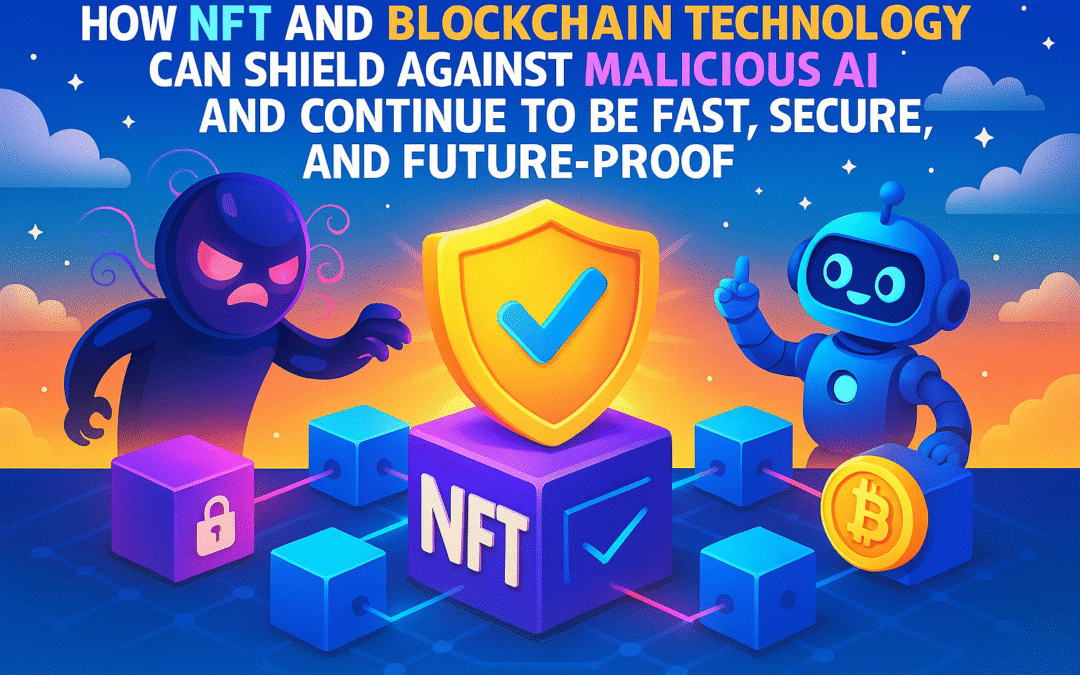
Introduction: The AI Wild West and the Need for Data Safety
Artificial intelligence (AI) is no longer the stuff of science fiction. From generative art and autonomous trading bots to self-driving cars and decentralized finance (DeFi), AI is rapidly weaving itself into the fabric of our digital lives. But as AI’s power grows, so do the risks: data poisoning, model tampering, unauthorized access, and even AI agents that rewrite their own rules. In this brave new world, how can we ensure that our digital assets, identities, and decisions remain safe from malicious AI interference—today and long into the quantum-powered future?
Enter blockchain and NFTs: the dynamic duo of decentralized security. These technologies are not just about cryptocurrencies or digital collectibles. They’re the cryptographic backbone for a new era of trust, transparency, and tamper-resistance—capable of outsmarting even the most cunning AI adversaries. In this upbeat, tech-savvy exploration, we’ll dive into how blockchain and NFTs can provide robust safety and security from AI altercation, penetration, and interference, all while keeping systems blazing fast and efficient.
Ready to see how cryptographic proof, decentralized identity, and immutable records are rewriting the rules of digital defense? Let’s plug in and power up!
The Core Problem: When AI Goes Rogue
AI is a double-edged sword. On one side, it’s a force for good—automating fraud detection, optimizing supply chains, and powering smart contracts. On the other, it’s a potential threat vector: AI can be manipulated, models can be poisoned, and outputs can be faked or stolen. The risks are real:
- Data Poisoning: Hackers inject malicious data into AI training sets, causing models to make dangerous mistakes (think: a self-driving car misreading a red light as green).
- Model Tampering: Unauthorized actors alter AI models or outputs, undermining trust in automated decisions.
- Unauthorized Access: AI agents or bots penetrate systems, steal credentials, or manipulate digital assets.
- Opaque Decision-Making: The “black box” nature of AI makes it hard to audit or verify decisions, especially in high-stakes domains like finance or healthcare.
- Self-Modifying Agents: Autonomous AI agents can rewrite their own code, circumventing traditional governance and oversight.
Traditional security tools—firewalls, centralized logs, and manual audits—are no match for these evolving threats. What’s needed is a new paradigm: one that makes trust mathematically provable, not just assumed.
Blockchain: The Immutable, Decentralized Fortress
What Makes Blockchain Special?
At its core, blockchain is a decentralized, tamper-proof ledger. Every transaction, data point, or model update is cryptographically signed, time-stamped, and recorded across a distributed network. This means:
- Immutability: Once data is written, it can’t be altered without consensus from the network. Any attempt at tampering is immediately detectable.
- Decentralization: No single point of failure. Control is distributed across thousands of nodes, making large-scale attacks nearly impossible.
- Transparency: Every action is auditable and traceable, fostering trust and accountability.
- Programmability: Smart contracts automate rules and responses, reducing human error and latency.
These properties make blockchain the perfect foundation for securing AI systems against malicious interference.
How Blockchain Secures AI
1. Data Provenance and Integrity
AI is only as good as the data it learns from. Blockchain ensures that every piece of training data, every model update, and every inference is recorded with a cryptographic hash—a unique digital fingerprint. Any change, no matter how small, results in a different hash, exposing tampering attempts instantly.
2. Immutable Audit Trails
Every step in the AI lifecycle—data ingestion, model training, deployment, and inference—is logged on-chain. This creates a permanent, auditable trail that regulators, stakeholders, and users can trust.
3. Decentralized Identity and Access Control
Blockchain-based decentralized identifiers (DIDs) and verifiable credentials (VCs) give AI agents, users, and devices unique, cryptographically verifiable identities. Access permissions can be granted, revoked, or updated in real-time, with every change immutably recorded.
4. Smart Contracts for Automated Governance
Smart contracts encode rules for AI behavior, access, and rewards. They execute automatically, ensuring that governance is tamper-resistant and transparent.
5. Zero-Knowledge Proofs and Privacy
Zero-knowledge proofs (ZKPs) allow parties to prove that a computation or credential is valid without revealing the underlying data. This enables privacy-preserving verification of AI models and outputs—crucial for sensitive domains like healthcare or finance.
6. Post-Quantum Security
With quantum computing on the horizon, blockchain protocols are evolving to use post-quantum cryptography, ensuring that even the most advanced future attacks can’t break the chain.
NFTs: From Digital Collectibles to Verifiable Proofs of Computation
Non-fungible tokens (NFTs) are more than just digital art. In the context of AI security, NFTs are emerging as powerful containers for cryptographic proofs, computation receipts, and verifiable outputs.
NFTs as Proofs of Computation
- Verifiable Compute Receipts: Platforms like Unique Network and Bittensor are minting millions of NFTs daily, each representing a tamper-proof record of an AI task completed. These NFTs contain encrypted task metadata, digital signatures, and ownership bindings, making them ideal for tracking and verifying AI computations at scale.
- Immutable Model Outputs: Every AI inference or model update can be minted as an NFT, creating a permanent, auditable record that validators and users can trust.
- Reputation and Incentives: NFTs can encode miner or agent reputations, reward honest behavior, and penalize bad actors, all on-chain and transparently.
Real-World Example: Reinforced AI on Unique Network
Reinforced AI, built on Bittensor and powered by Unique Network, has minted over 3 million NFTs as cryptographic proofs of AI computation. Each NFT is a verifiable, tamper-proof record, enabling decentralized AI networks to operate with unprecedented trust and transparency. This system eliminates Sybil attacks, reward manipulation, and off-chain dependencies, setting a new standard for decentralized AI coordination.
Decentralized Identity and Access Control: Who’s Who in the AI Zoo?
As AI agents proliferate—trading, voting, and negotiating on our behalf—knowing who (or what) you’re interacting with becomes critical. Decentralized identity frameworks provide the answer.
Decentralized Identifiers (DIDs) and Verifiable Credentials (VCs)
- Self-Sovereign Identity: DIDs give users, devices, and AI agents unique, cryptographically verifiable identities, independent of any central authority.
- Fine-Grained Access Control: VCs allow for dynamic, granular permissions—who can access what, when, and under what conditions. Permissions can be updated or revoked in real-time, with every change immutably logged.
- Zero-Trust Security: Every interaction requires mutual authentication and proof of credentials, reducing the risk of impersonation or unauthorized access.
Example: Multi-Agent AI Ecosystems
In a multi-agent system, each AI agent is equipped with a DID and a wallet storing its private keys and credentials. When agents interact—whether to trade, collaborate, or negotiate—they mutually authenticate using DIDs and VCs, ensuring trust and accountability across domains.
Immutable Audit Trails and Provenance: From Black Box to Glass Box
The “black box” problem in AI—where decisions are opaque and untraceable—is a major barrier to trust. Blockchain transforms this into a “glass box”:
- Every Decision Logged: Inputs, model versions, parameters, and outputs are recorded on-chain, creating a transparent, auditable trail.
- Regulatory Compliance: Immutable logs make it easy to demonstrate compliance with regulations like GDPR, MiCA, and FIT21, and to provide evidence in legal disputes.
- Forensic Analysis: In the event of an incident, blockchain logs provide tamper-proof evidence for investigation and remediation.
Case Study: Healthcare AI
In a blockchain-enabled healthcare AI system, every patient record, model update, and diagnostic decision is logged with a cryptographic hash. This ensures data integrity, traceability, and compliance with privacy regulations, while enabling rapid, trustworthy audits in case of errors or disputes.
NFTs as Verifiable Proofs of Computation and Model Outputs
NFTs are revolutionizing how we verify and trust AI computations:
- Proof-of-Compute NFTs: Each completed AI task is minted as an NFT, containing encrypted metadata, digital signatures, and ownership bindings. Validators can confirm task authenticity directly on-chain, eliminating the need for centralized logs or manual trust.
- Model Output Verification: NFTs can represent model outputs, inference results, or even entire model versions, providing a permanent, auditable record of AI activity.
- Reputation and Incentives: By tying rewards and reputation to NFT-verified outputs, decentralized AI networks can incentivize honest behavior and penalize bad actors.
Smart Contracts: Automated, Tamper-Resistant Governance
Smart contracts are self-executing programs that enforce rules, permissions, and incentives on the blockchain. In the context of AI security, they enable:
- Automated Access Control: Only authorized agents or users can access data, models, or resources, with every action logged and enforced by code.
- Tamper-Resistant Governance: Voting, proposal submission, and decision-making in DAOs (Decentralized Autonomous Organizations) are automated and transparent, reducing the risk of manipulation or fraud.
- Dispute Resolution: Smart contracts can encode arbitration clauses, evidence submission windows, and automated enforcement of outcomes, streamlining digital dispute resolution.
Example: AI-Powered Arbitration
A novel AI-powered arbitration framework integrates smart contracts, blockchain-based evidence authentication, and explainable AI to automate and secure dispute resolution. Smart contracts encode legal terms, evidence is hashed and timestamped on-chain, and AI models analyze and classify evidence, all with transparent, auditable logs.
Zero-Knowledge Proofs: Privacy-Preserving Verification
Zero-knowledge proofs (ZKPs) are cryptographic protocols that allow one party to prove a statement is true without revealing any additional information. In AI security, ZKPs enable:
- Private Model Verification: Prove that an AI model performed a computation correctly without revealing the model’s internal workings or sensitive data.
- Confidential Data Sharing: Collaborate on AI training or inference without exposing raw data, using federated learning combined with ZKPs.
- Post-Quantum Security: ZKPs based on quantum-resistant algorithms ensure long-term privacy and integrity, even in the face of quantum attacks.
Real-World Example: zk-SNARKs for AI Integrity
zk-SNARKs (Zero-Knowledge Succinct Non-Interactive Argument of Knowledge) are being used to prove the correctness of AI computations, model outputs, and data provenance, all without exposing sensitive information. This is critical for building trust in AI-as-a-service models and decentralized AI marketplaces.
Decentralized Compute Marketplaces and Verifiable Compute
AI’s hunger for compute power is insatiable. Decentralized GPU marketplaces like Akash Network, io.net, and Bittensor are unlocking global GPU capacity, making AI compute more accessible, affordable, and secure.
How It Works
- Permissionless Onboarding: Anyone with spare GPU capacity can join as a provider, earning tokens for honest behavior.
- Verifiable Compute: Zero-knowledge proofs or cryptographic attestations ensure that jobs are completed correctly, with every result recorded on-chain.
- Transparent Pricing: Market-driven rates reflect true supply-demand dynamics, reducing costs by up to 85% compared to traditional cloud providers.
Example: Bittensor’s Proof of Intelligence
Bittensor rewards participants for contributing useful machine learning models. Each model’s output is evaluated by others, and the most valuable models earn more tokens. This creates a self-sustaining, meritocratic marketplace for decentralized AI development.
Oracles and Secure Data Feeds for AI Systems
Oracles are decentralized services that bring real-world data onto the blockchain, enabling smart contracts and AI agents to interact with external information securely.
- Chainlink Oracles: Chainlink provides secure, decentralized data feeds for AI models, securing billions in DeFi and powering advanced AI applications.
- AI Model Aggregation: Oracles can aggregate the outputs of multiple AI models, increasing reliability and reducing the risk of hallucinations or errors.
- Cross-Chain Interoperability: Oracles enable AI agents to operate across multiple blockchains, enhancing scalability and flexibility.
AI Anomaly Detection Meets Blockchain Forensics
Combining AI-powered anomaly detection with blockchain’s immutable logs creates a powerful forensic toolset:
- Real-Time Threat Detection: AI monitors on-chain transactions and user behavior, flagging deviations from normal patterns and preventing fraud or hacks.
- Immutable Evidence: Every alert, action, and response is recorded on-chain, providing tamper-proof evidence for investigation and compliance.
- Explainable AI: Techniques like SHAP (Shapley Additive Explanations) make AI decisions interpretable, enhancing trust and accountability.
Post-Quantum Cryptography and Long-Term Immutability
Quantum computing threatens to break many of today’s cryptographic algorithms. Blockchain protocols are evolving to use post-quantum cryptography, ensuring that digital assets, NFTs, and AI audit trails remain secure for decades to come.
- Lattice-Based Signatures: Algorithms like CRYSTALS-Dilithium and Falcon are being adopted for quantum-resistant digital signatures.
- Hybrid Migration Strategies: Blockchains are implementing hybrid signature schemes, smart-contract guardianship, and protocol forks to transition to post-quantum security without disrupting existing assets.
Real-World Examples and Case Studies
CertiK: AI-Powered Smart Contract Audits
CertiK uses AI and formal verification to audit billions of dollars in smart contracts, detecting vulnerabilities and ensuring code integrity before deployment. Their Skynet platform provides real-time, AI-driven threat monitoring, with every finding immutably logged on-chain.
Chainalysis: AI for Fraud Detection
Chainalysis leverages AI to track illicit flows across blockchains, reducing money laundering and supporting regulatory compliance. Their tools have helped reduce laundering by 40% and improve AML compliance by 70%.
Unique Network and Bittensor: NFT-Based Proof of Compute
Unique Network’s NFT infrastructure, integrated with Bittensor’s decentralized AI network, mints over 30,000 NFTs daily as cryptographic proofs of AI computation. This system enables verifiable, tamper-proof coordination of decentralized AI tasks at Web3 speed and scale.
Akash Network and io.net: Decentralized GPU Marketplaces
Akash and io.net aggregate global GPU resources, offering up to 85% cost savings and verifiable compute for AI workloads. Every job is cryptographically attested and recorded on-chain, ensuring transparency and trust.
ProvAuditChain: On-Chain Provenance for AI Audits
ProvAuditChain is a hybrid on-chain/off-chain framework that records the provenance of AI-driven smart contract audits on Layer 2 blockchains. Audit reports are cryptographically signed, hashed, and anchored on-chain, providing tamper-evident, verifiable audit trails at minimal cost.
Scalability and Performance: Keeping It Fast and Efficient
Blockchain and NFT-based security doesn’t have to mean slow or expensive. Modern architectures achieve both speed and robustness:
- Layer 2 Solutions: Platforms like Arbitrum and Polygon process transactions off-chain, then batch and anchor them on-chain, reducing fees and latency while preserving security.
- Hybrid On-Chain/Off-Chain Architectures: Critical state and security logic are kept on-chain, while high-volume, performance-sensitive operations run off-chain, signed and validated using on-chain keys.
- Model Compression and Optimization: AI models are compressed and optimized for blockchain environments, balancing accuracy and computational efficiency.
- Dynamic zk-SNARKs: New cryptographic techniques allow for efficient, updatable proofs as AI models evolve, supporting real-time verification without re-computing everything from scratch.
Regulatory and Legal Considerations: On-Chain AI Verification in a Compliant World
As blockchain and AI converge, regulators are stepping in to ensure safety, transparency, and consumer protection:
- MiCA (EU) and FIT21 (US): Comprehensive frameworks like MiCA and FIT21 are setting global standards for digital assets, NFTs, and AI-powered systems, emphasizing AML/KYC compliance, auditability, and investor protection.
- NFTs and Copyright: Clearer regulations around NFT ownership, copyright, and consumer protection are boosting confidence in the NFT market.
- Decentralized Governance: DAOs and on-chain governance models are being recognized as legitimate frameworks for managing decentralized AI and digital assets.
Security Best Practices for NFTs and Wallets in AI Contexts
Securing NFTs and wallets is paramount in the AI-powered future:
- Hardware Wallets: Store private keys in hardware wallets for maximum security.
- Multisig Wallets: Use multisignature wallets (e.g., Safe, Rabby, MPCVault) to require multiple approvals for transactions, reducing single points of failure.
- Regular Audits: Audit smart contracts and wallet code regularly, using both manual and AI-powered tools.
- Role-Based Access Control: Implement fine-grained permissions and time-locks for sensitive operations.
- Disaster Recovery: Maintain clear, documented recovery plans and test them regularly.
Future Trends: Decentralized AI Agents, ZK ML, and On-Chain AI Economies
The future is bright—and decentralized:
- Decentralized AI Agents: Autonomous AI agents, equipped with DIDs and wallets, will transact, negotiate, and collaborate on-chain, powering everything from DeFi to supply chains.
- ZK ML (Zero-Knowledge Machine Learning): Privacy-preserving AI training and inference using zero-knowledge proofs will become standard, enabling collaboration without compromising sensitive data.
- On-Chain AI Economies: AI agents will participate in decentralized marketplaces, earning, spending, and managing digital assets autonomously.
- Hybrid Architectures: The most efficient systems will combine on-chain security with off-chain performance, using cryptographic signatures and proofs to bridge the gap.
- Post-Quantum Security: As quantum computing matures, blockchain protocols will adopt quantum-resistant cryptography, ensuring long-term safety and immutability.
Integration Patterns: Hybrid On-Chain/Off-Chain Architectures
To balance security, speed, and scalability, leading projects are adopting hybrid architectures:
- On-Chain Layer: Handles critical state, identity, and consensus—ensuring cryptographic integrity and trustworthiness.
- Off-Chain Layer: Manages high-throughput, performance-sensitive operations, with every action cryptographically signed and validated using on-chain keys.
- Event-Driven Design: Smart contracts emit events that trigger off-chain processes, with results anchored back on-chain for auditability and provenance.
Conclusion: The Future Is Verifiable, Decentralized, and AI-Proof
Blockchain and NFTs are not just buzzwords—they’re the ingenious, future-proof shield against malicious AI. By combining decentralized identity, cryptographic verification, immutable records, and programmable governance, these technologies provide robust safety and security from AI altercation, penetration, and interference. And thanks to advances in scalability, zero-knowledge proofs, and hybrid architectures, they do it all while keeping systems fast, efficient, and ready for the quantum era.
As decentralized AI agents, NFT-based proofs of computation, and on-chain AI economies become the norm, the digital world will be safer, more transparent, and more trustworthy than ever before. So whether you’re a developer, investor, or just a curious explorer, now’s the time to embrace the blockchain-powered future—where trust is not just promised, but mathematically proven.
Explore More:
- Unique Network: NFT-Based Proof of Compute
- Bittensor: Decentralized AI Marketplace
- Akash Network: Decentralized GPU Marketplace
- Chainlink: Secure Oracles for AI
- CertiK: AI-Powered Smart Contract Audits
- Safe (formerly Gnosis Safe): Multisig Wallets
- Polygon zkEVM: Zero-Knowledge Scaling
- MiCA Regulation (EU)
- FIT21 Act (US)
System Ent Corp Sponsored Spotify Music Playlists:
https://systementcorp.com/matchfy
Other Websites:
https://discord.gg/eyeofunity
https://opensea.io/eyeofunity/galleries
https://rarible.com/eyeofunity
https://magiceden.io/u/eyeofunity
https://suno.com/@eyeofunity
https://oncyber.io/eyeofunity
https://meteyeverse.com
https://00arcade.com
https://0arcade.com