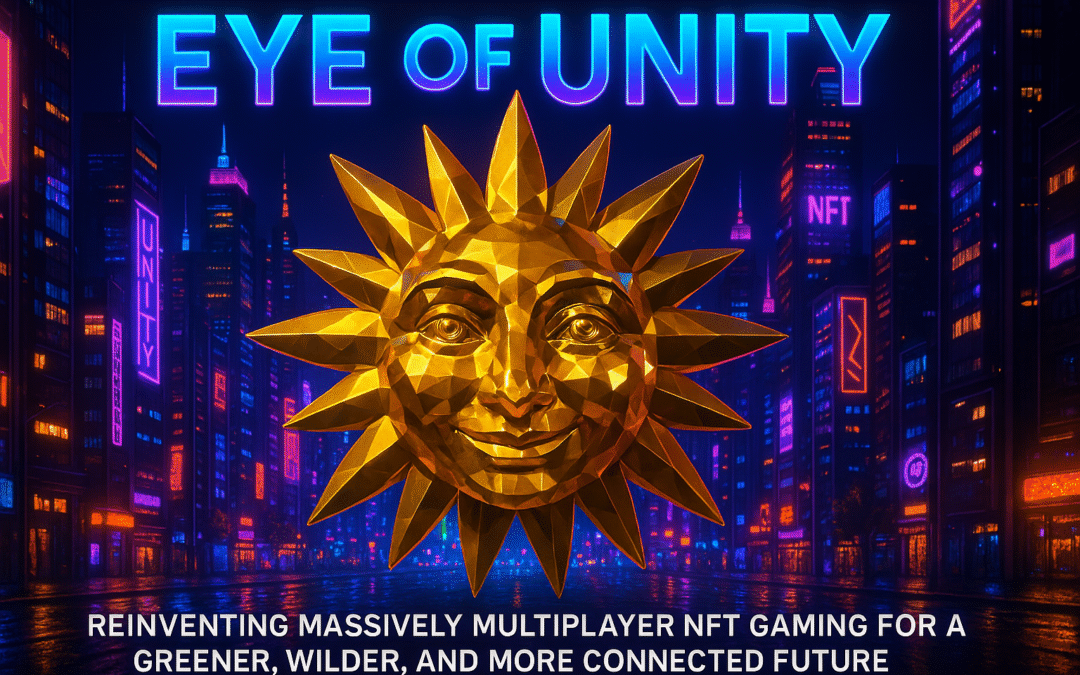
The Next Level of NFT Fun: Welcome to the Eye of Unity Universe
Imagine a gaming universe so colossal it encompasses half a million unique NFTs, a playground where every NFT isn’t just a digital trinket, but a door to living, breathing, ever-changing adventures. Now, picture this massive world pulsing with life—thousands of players collaborating, clashing, and crafting, without burning a black hole of energy. Welcome to the exhilarating cosmos of Eye of Unity: a game platform, DAO-powered experiment, and NFT wonderland, rearchitected from the ground up to be wild, participatory, and eco-friendly.
This is not just another “play-to-earn” grind or a flashy cash grab. We’re talking about a revolution in ownership, social impact, and sustainable digital gaming—a project where every in-game victory can ripple out, funding schools, planting trees, or launching the next great story-driven quest. If you’ve ever lost sleep on the promise (and pitfalls) of NFT gaming—big gas fees, rampant speculation, or energy overkill—the Eye of Unity just might be your antidote.
Join us for an optimistic deep dive through its architecture, multiplayer tech, frictionless NFT indexing, energy-saving wizardry, inventive play mechanics, and the social glue that turns crypto collecting into a true community effort.
Eye of Unity Project Overview: Not Your Average NFT Game
Eye of Unity doesn’t just sit at the vanguard of NFT game concepts—it torches the script and rewrites it from the grassroots up:
- Radically Open, Community-First: Eye of Unity is a nonprofit blockchain foundation. No venture capital overlords, no private-ownership shenanigans. Every dollar of surplus, from NFT trading fees to game revenues, is cycled straight back into the community: game rewards, creative grants, or even funding philanthropic projects.
- DAO-Powered Governance: Decisions, big and small, are voted on by the community through a purpose-built DAO. NFT collectors, token stakers, and everyday players have genuine power to shape the future—whether it’s approving a killer new game mode or launching the next charity collaboration.
- Cross-Chain and Cross-Culture: Eye of Unity is blockchain-agnostic, rolling out NFTs and rewards on Ethereum (now green thanks to Proof of Stake!), Polygon, Solana, and more, with seamless bridges. The platform welcomes crypto novices and experts from every corner of the world.
- Art, Lore, and Social Impact: More than pixels or collectibles, each NFT is steeped in story, meta-commentary, or interactive lore. Many game victories even trigger real-world charitable donations—think blockchain gaming meets radical transparency meets do-gooder adventure.
If you want to see this model in action, check out Eye of Unity’s DAO mechanics and community grant programs.
NFT Indexing: The Secret Sauce for Scalable, Low-Energy Multiplayer Fun
When you’re managing 500,000 NFTs and a global user base, you need next-gen tech, not 1990s database thinking. Eye of Unity achieves both scale and energy efficiency by shifting its focus from “always-on” transactional horsepower to fast, smart indexing.
How It Works
- Batch-Indexing Starts Everything off-Chain: Rather than hammering the blockchain with every move or player action, Eye of Unity uses advanced NFT indexing frameworks and event listeners (e.g., Ponder, GoldRush) to collate activity into digestible, queryable chunks.
- Asynchronous, Event-Driven Game Loops: Players can take actions independently—their moves, trades, or adventure logs are indexed, then batch-updated to the blockchain at calculation-friendly intervals. This minimizes simultaneous on-chain action, slashing gas usage.
- API-First, Multichain Data Availability: With unified APIs covering ERC-721/ERC-1155 standards across EVM and non-EVM chains, and “ownership gating” endpoints, the Eye of Unity lets devs and player clients verify assets instantly—no million-dollar cloud bills required.
Want to create your own data-rich marketplace or leaderboard? Tools like GoldRush or The Graph make it easy to surface indexed NFT data to whatever front-end your game uses.
Result: Massive multiplayer game states, sky-high NFT populations, and low-latency interactive experiences—all without grinding the environment through inefficient blockchain thrashing.
Lower Energy Consumption: Proof of Stake, Layer-2s, and Asynchrony Everywhere
Tired of the “NFTs are melting the ice caps” critique? Eye of Unity’s technical stack was designed during the greenest phase of blockchain’s evolution.
Key Ingredients for Energy Efficiency
1. Proof of Stake Over Proof of Work
- Ethereum’s recent “Merge” means it now consumes over 99.9% less electricity than its mining days—just 0.0026 terawatt-hours per year, a drop from the era when Ethereum rivaled small countries in power use.
- Solana and Polygon go further, supporting blisteringly fast NFT transactions with energy footprints per transaction less than a Google search.
2. Layer-2 Scaling Solutions
- Eye of Unity leverages Polygon and Arbitrum for “roll-ups” and batch settlements, processing transactions off-chain and submitting bundled data at intervals to Ethereum’s mainnet. Gas costs shrink, carbon output plummets.
- EVM compatibility guarantees that developers can port logic and assets cross-chain as the ecosystem expands.
3. Frictionless Indexing (Batch/Async Instead of Always-On)
- By indexing and updating only the essentials—ownership changes, important scores, NFT upgrades—Eye of Unity avoids the “always-on always burning” trap. It’s like letting players move at their own tempo, as opposed to hosting everyone’s every breath in a costly real-time server process.
- See how contemporary research like Challenger: A Blockchain-based MMO Architecture supports this model for narrative, slower-paced, or asynchronous games.
4. Carbon-Neutral Projects and Green Blockchain Initiatives
- Solar-powered NFT ATMs and server infrastructure further reduce the foundation’s carbon footprint.
- Eye of Unity partners with NGOs and uses on-chain programmable royalties to fund solar, green, and reforestation projects.
Direct Benefits
| Technology/Practice | Energy Result |
|---|---|
| Ethereum PoW → PoS switch | >99.9% reduction in energy usage |
| Polygon, Solana, Hedera, Flow | <0.0002 kWh per transaction |
| Layer-2 batch/rollup settlements | Reduces mainnet writes by 95+% |
| NFT async/event indexing | Spreads load, avoids “simultaneous spike” |
| Green sidechains/solar infra | <0.01% of PoW chain carbon footprint |
Takeaway: Eye of Unity doesn’t just promise green gaming. It delivers it—making MMO-scale NFT worlds viable for a climate-conscious future.
Scalable Massively Multiplayer Interaction: The Power of Indexing and Asynchrony
How on earth does a multiplayer NFT game host hundreds of thousands of users without setting fire to the grid?
The answer: asynchronous multiplayer, event-based mechanics, and progressive batch updates. Let’s break down how the Eye of Unity achieves its magic:
- Scalable Architecture: By using a hybrid architecture inspired by P2P and client-server models—with rare, critical updates stored on-chain and the majority of play happening via efficient, off-chain state channels—the system is both secure and elastic.
- Asynchronous Game Loops: Most gameplay happens “when you log in”—not in a frantic, real-time always-on race. You can raid a dungeon or develop your territory solo, with periodic sync-ups to the chain. Leaderboards, asset ownership, and crucial events are always verifiable but not always synchronous.
- Concurrent Safe, Energy-Efficient: By tightly controlling when the blockchain is called for settlement, Eye of Unity keeps costs and environmental wear low while supporting tens of thousands of parallel adventures.
- Heat Map Sharding and Local State Management: To keep things speedy, the platform uses region-based sharding—players in one “zone” or shard act semi-independently, with cross-region actions periodically reconciled.
- Event Sourcing + Permanent Records: Every meaningful player action (battle, discovery, trade, mint) is event-logged off-chain, with critical results written back to the blockchain for transparency, provenance, and asset protection.
In plain English: Eye of Unity combines the best of leaderboards, guild wars, and MMO raiding with the scalability of Web3—without forcing everyone online at once or maxing out their GPUs.
Asynchronous Multiplayer Gameplay: Gaming on Your Schedule
Asynchronous play is a game-changer for NFT-enabled multiplayer, and the Eye of Unity builds this concept into its bones.
Why Asynchronicity Matters
- No Need for 24/7 Online Sessions: Players can contribute to guild challenges, craft NFTs, or defend their realms while they sleep. Come back the next day and see how the world’s changed.
- Meaningful Social Play Without Synchronization: Think of leaderboards, time-based tournaments, or turn-based PvP duels. Each participant’s async moves are checked, indexed, and settled in sequence. (Just like Death Stranding or Dark Souls’s message-leaving mechanics).
- Dynamic Event Generation: AI and procedural algorithms create fresh challenges, lore expansions, or world events based on global activity (more on this in Dynamic Content Generation).
Examples from Live Games:
- Civ IV’s Pitboss server, where 32-player games could unfold over weeks, each player logging in to make strategic moves at their own pace.
- Axie Infinity and Decentraland’s housing and farming mechanics, where players might trigger events, craft, or harvest asynchronously before market syncs.
Takeaway: Asynchronous play empowers “casual” and “hardcore” users alike, makes large-scale games manageable, and dovetails perfectly with low-energy, indexer-benefiting blockchain operations.
Dynamic Content Generation in NFT Games: From Procedural to Interactive Storytelling
Static is out. Dynamic, AI-driven, and community-influenced worlds are in. Eye of Unity unlocks creative dynamism at both the platform and player level:
- Procedural World/Level Generation: Infinite worlds, dungeons, or landscapes can be generated on the fly—using seeded algorithms tied to NFT traits, rarity, or special events.
- Composable, Evolvable NFTs: NFTs don’t remain “dead.” Thanks to dynamic metadata and upgradeable smart contracts, owner actions (winning a hard fight, completing a quest, holding for a year) can permanently evolve NFTs and their in-game powers, affecting both gameplay and secondary market value.
- AI-Narrated, Branching Storylines: Player actions as individuals or collectives can alter the lore, trigger world events, or even unlock limited narrative NFTs. This approach is inspired by narrative MMOs and augmented by blockchain-powered voting and persistent upgrades.
- Community-Authored Content: Invite players to design levels, mini-games, or even launch “quests” or “story arcs,” with NFTs representing ownership of major creative contributions.
Example: Eye of Unity’s “Temporal Gateways”—time-locked NFTs that only evolve or unlock their full use after real-world or blockchain events, like an asteroid passing Earth or collaborative lore-building.
Real-World Case Studies: Large-Scale NFT Gaming at Work
While Eye of Unity is pioneering new ground, it stands on the shoulders of some powerful examples:
CryptoKitties and Axie Infinity
- Each player “breeds” and trades NFTs; anyone can verify rarity, parentage, or transaction history. With scaled Layer-2s and PoS chains, new models now avoid the traffic jams and high fees that once plagued early NFT games.
Decentraland/Sandbox Open Worlds
- Tens of thousands of land parcels represented as NFTs, cross-compatible avatars, and a “build what you want” approach to game loops, all living on low-power Ethereum (post-Merge), Polygon, and more.
GoldeFy and Chunked MMO Case Studies
- Real-time, NFT-driven idle mining and social PvP—the backend is modular, indexed, and scalable to tens of thousands without peer-to-peer overkill.
- In Chunked, on-chain movement and resource events are indexed via modular ERC-1155 contracts, allowing player-driven expansion, remixing, and marketplace extension—all with minimal energy use.
Challenger Middleware for Blockchain MMOs
- Peer-reviewed, blockchain-agnostic architectures show how narrative MMOs (investigative or “strand” games) can thrive on event-based, indexed state syncs—demonstrating the academic roots of Eye of Unity’s design.
Low-Energy Consensus Mechanisms and Layer-2 Nuggets
If you want to truly scale NFT games—with hundreds of thousands or millions of assets—energy-friendly consensus is mission-critical.
- Proof of Stake (PoS): The foundation of Ethereum, Polygon, Solana after 2022—validates with orders of magnitude less computational waste.
- Zero-Knowledge Rollups and Validium: Off-chain computations submitted in batches, with on-chain proofs—security and efficiency balanced.
- Sidechains and Modular Bridge Protocols: For conquest games, collectathons, or evolving worlds, these techs reduce cross-chain headaches, empower composability, and avoid “stuck” assets.
Tokenomics and Incentives: A Sustainable Flywheel
Eye of Unity’s tokenomics signal a major leap beyond speculation-driven models:
- Active, Perpetual Royalties: All NFT trades (5-10%) fund a community treasury, recurring game rewards, and “growth airdrops”—expanding the pie for every active participant.
- Staked Governance and Play-to-Earn-for-Good: Every competitive ladder, championship, or quest funnels some rewards to individual players, but also to social good—DAO votes decide how much gets reinvested.
- Anti-Inflation and “Burn” Mechanisms: To avoid runaway inflation and value collapse, NFT supplies are strictly limited (500,000), and in-game tokens incorporate utility “burning” (i.e., buying upgrades, entering tours), keeping demand healthy.
- Creator and UGC-Boosted Revenues: Smart contracts split revenues with designers, modders, or community event creators automatically.
- DAO Voting: Governance tokens allow players to propose, debate, and decide on economic tweaks—reward pools, grant programs, or even the next narrative expansion.
Developer Tooling: Unity, APIs, and Dreamkit for Massively Multiplayer NFT Experiments
Eye of Unity stands out for a commitment to open-source, battle-tested developer tooling:
- Unity and WebGL: The game engine backbone supports 2D/3D, VR/AR, and browser play—ideal for fast social games and deep metaverse experiences.
- API Bundles for Multichain NFT Management: Devs can query, mint, trade, and index assets across Ethereum, Solana, Polygon from a single kit. Major endpoints cover collection indexing, rarity calculation, and transaction records.
- Indexed and Streaming Data (e.g., The Graph, GoldRush): Real-time player stats, trait scores, and off-chain metadata updates made easy for dashboards, games, or marketplaces.
- Marketplace Integration SDKs: With OpenSea, Magic Eden, Rarible APIs, devs can add trading or cross-game interoperability in days, not months.
Pro tip: Eye of Unity also prioritizes player-created tools (think loot generators, dashboard overlays, or even player-run NFT “job boards”), all supported by dev documentation.
Player Onboarding, Wallet Integration, and Security: Welcome to Frictionless Web3
If you can’t onboard players easily, you can’t build a real community.
- One-Click Wallets and Native Authentication: Thanks to solutions like Immutable Passport and custom Eye of Unity onboarding scripts, players onboard with Google/Discord credentials—auto-generating wallets, without the “seed phrase terror”.
- NFT ATMs and Local Onramps: Eye of Unity’s physical and digital NFT ATMs—launched in underserved and “cash-only” regions—make sure everyone can join the fun, not just DeFi veterans.
- Security-First: Non-custodial wallets, two-factor authentication, and granular permissions protect assets and identities. Top-level contracts are audited, with bug bounty programs in place.
- Beginner Tutorials and Social Onboarding: Vibrant Discords, open video guides, and human support lead players from setup to play—bridging the knowledge gap.
Cross-Chain Interoperability for NFTs and Games
No one wants their NFT “stuck” on a dying blockchain. Eye of Unity is aggressively cross-chain.
- Bridging Protocols: Players can move NFTs between Ethereum, Polygon, Solana, Avalanche, and more via secure bridges. “Lock-and-mint” and “burn-and-mint” paradigms make asset movement fluid, minimizing fragmentation.
- Universal Avatar and Asset Standards: Eye of Unity is investing in interoperable metadata that can spawn the same NFT—think weapons, pets, or achievement badges—anywhere.
- DAO-Governed Chain Expansion: The community votes on when and where to expand, ensuring interoperability doesn’t outpace security.
Community Governance and DAO Structures: Your Vote Counts
A real game belongs to its players. Eye of Unity’s DAO lets everyone participate:
- Proposal Mechanism: Anyone holding governance tokens (acquired through play, staking, or ownership) can propose changes—from launching new minigames to funding a school-in-a-box initiative.
- Quadratic Voting: Avoid whales dominating every decision—quadratic voting and rep-adjusted weightings empower broader consensus.
- Snapshot and On-Chain Voting: Results are published on blockchain, with all treasuries auditable and all decisions traceable.
Creative Game Designs: The Weird, the Wild, the Wonderful
With energy, indexing, and governance solved, the Eye of Unity can go nuts with creative mechanics:
- “Fractal Dungeons”: Algorithmically generated worlds tied to NFT traits. Your “Fire Hydra” or “Rare Chronomancer” NFT opens special doors, levels up, or creates game events.
- “Charity Raids”: Players band together in PvE events, with part of the loot drop and NFT upgrades funding a real-world mission of the day. Win together, give together!
- “Lore Evolving through Player Votes”: Every week, the highest-ranked players propose different lore expansions, with the DAO voting on true canon.
- “Generative Art Collab Quests”: Collaborative boss fights where every victory mints new, limited NFTs in the form of generative art—unique to that collective battle win.
- “Augmented Reality Artifacts”: Geocached NFT mysteries: unlock a QR-coded artifact in your city for bonus NFT upgrades or exclusive tomes.
Interactive Storytelling: Branching Paths, Community Canon, and Beyond
What good is an NFT if it can’t tell a story or reveal secrets? Eye of Unity’s gameverse deploys interactive storytelling, AI-driven worldbuilding, and narrative NFTs that shape-shift with the community:
- Branching, Player-Driven Arcs: Choices made by players (or guilds) shift the shared lore, shape NPCs, and permanently alter the digital physical map.
- Decentralized Narrative Markets: Story proposal markets reward writers, quest-makers, and artists who win votes for the next metaverse plot twist.
- Token-Gated Book Clubs & Lore “Drops”: NFT-owners gain access to exclusive chapters, lore, and AR/VR explorations; contributors can write themselves into the story with special DAO “cameos.”
- Time-Locked Mysteries: Some NFTs only reveal powers or stories on certain planetary alignments or holidays—emulating the temporal puzzles of great video games.
Environmental Impact: Gaming Without Guilt
Let’s face it, NFTs have gotten a (sometimes well-deserved) reputation for being energy hogs. Eye of Unity’s approach is a playbook for eco-friendliness:
- All major chains (Ethereum, Polygon, Solana, Tezos, Flow) are now under PoS or ultra-efficient consensus—with typical NFT transactions using less energy than a Google search or short LED lightbulb use.
- Solar and wind energy infrastructure powers supporting hardware, while carbon offsets and green NFTs (such as “TreeDefi”) directly fund real-world sustainability efforts.
- Sustainable NFT design: Lazy minting (mint only on purchase), sidechain batch settlements, and artwork promoting environmental awareness.
Marketplace Integration: Frictionless Trading, Fractional Ownership, and Asset Longevity
- Plug-and-play marketplace SDKs let any subgame or creator roll out a trading floor with a click (OpenSea, Magic Eden, and exclusive in-game markets supported).
- Fractional NFT ownership: High-value or rare NFTs (“Metaversimals”) can be divided for shared ownership—democratizing access and liquidity.
- Royalty-enforced sales: Secondary and tertiary market trades route fees/benefits back to the Eye of Unity treasury and creative contributors.
Future Trends: What’s Next for Sustainable, Scalable NFT Gaming?
The next five years will see explosive innovation:
- Deeper Metaverse Integration: Cross-game avatars, asset portability, and live events (like concerts or town halls) playable across all Eye of Unity gameverses.
- AI-Driven NPCs and Game Masters: Custom quests, smart enemy behavior, real-time event storytelling—AI will personalize and scale worlds without extra developer load.
- Quantum-Safe Cryptography: As blockchains prepare for quantum computing, NFT and game asset security will evolve for even more robust ownership.
- True Cross-Chain Asset Standardization: Universal NFT standards will make true “anywhere” ownership a reality, reducing friction and fragmentation.
- Regulatory and Security Maturation: More robust frameworks for asset protection, anti-fraud, tax compliance, and player safety are on the horizon.
- “Play and Earn for Good” Models: Philanthropic layers will move from a bonus feature to a default expectation—gaming as engine of both fun and planetary repair.
Conclusion: The Eye (of Unity) Opens
Step aside, “NFT hype.” The future is open, delightful, creative, and ethical. Eye of Unity shows us that massive, multiplatform NFT-based MMOs don’t have to be energy hogs, financial traps, or cliquish clubs for cryptonerds. With smart indexing, asynchronous play, transparent economics, and DAOs, anyone—not just whales—can own, play, and shape the digital worlds of tomorrow.
If you want to be part of:
- A global DAO where your quests and causes get funded
- An ever-evolving story where your NFT evolves with your play
- A massive, open, and green NFT gameverse where every action ripples across the world
Then Eye of Unity is your call to adventure.
Find out more:
- How Eye of Unity Exemplifies NFT Best Practices
- Explore the Gameverse
- See the DAO and Budget Transparency in Action
- Mint, Play, Create, and Vote
- Marketplace Integration
System Ent Corp Sponsored Spotify Music Playlists:
https://systementcorp.com/matchfy
Other Websites:
https://discord.gg/eyeofunity
https://opensea.io/eyeofunity/galleries
https://rarible.com/eyeofunity
https://magiceden.io/u/eyeofunity
https://suno.com/@eyeofunity
https://oncyber.io/eyeofunity
https://meteyeverse.com
https://00arcade.com
https://0arcade.com