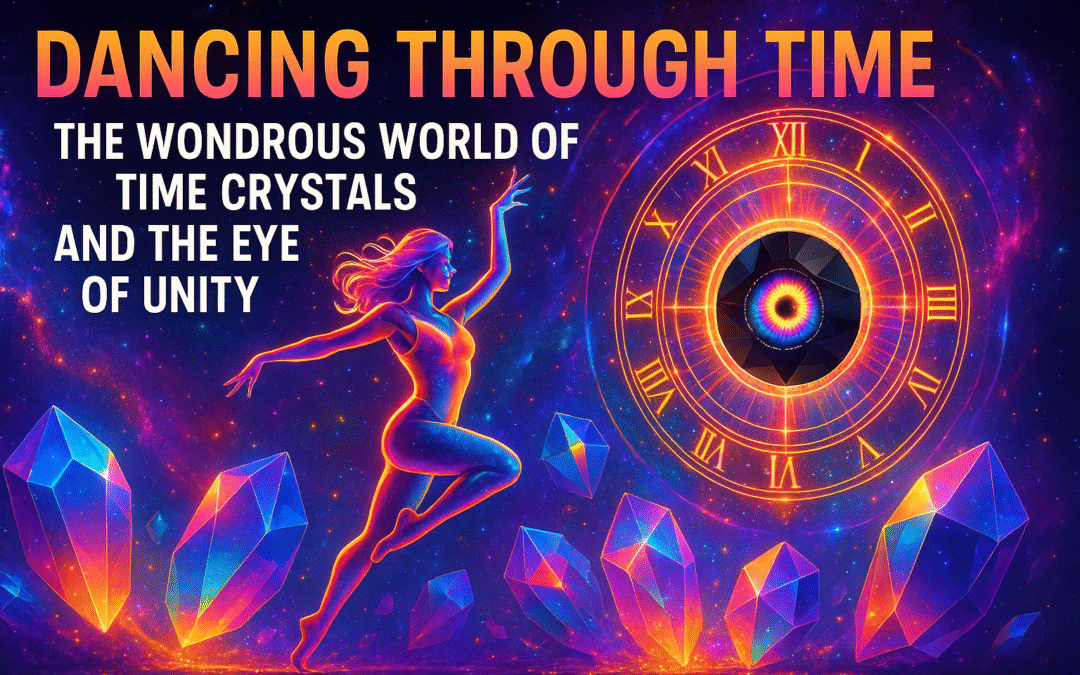
Introduction: Into the Marvelous Rhythm of Reality
What if the objects around you didn’t just shimmer in space, but twinkled and repeated in time? What if there existed a mysterious “Eye of Unity” that peered through myth, modern mysticism, and the all-too-real dreams of quantum physics, weaving together the eternal dance of unity and time? Welcome, adventurer: today we plunge into the magical crossroads of time crystals and the Eye of Unity—a journey through bold science, philosophical mystery, and a dash of speculative fiction sure to tickle your imagination.
Prepare for quantum elevators and mystical NFTs, secret societies and laser-driven atoms. Along the way, you’ll learn why the future of computers might depend on entities that oscillate forever, and why ancient symbols and contemporary creators are remaking reality in both mind and code. This isn’t just a science lesson—it’s an invitation to view reality itself as a grand act of storytelling, blending the factual, the fantastical, and the fiercely futuristic.
So, ready to jump downstream in the river of time, with every moment a glimmering crystal, and every eye a portal to understanding? Let’s begin.
1. What Is a Time Crystal? The Science at the Edge of Perpetual Motion
Time crystals sound straight out of Doctor Who or sci-fi novels, but they are a cutting-edge concept in quantum physics—real, strange, and deeply exciting.
In ordinary crystals—think diamonds, salt, or even snowflakes—atoms are arranged in a tidy, repeating pattern across space. Their order gives rise to beauty, strength, and the ability to split light. By contrast, a time crystal exhibits a periodic pattern in time as well as space. The atoms or quantum bits that make up a time crystal don’t just sit still in a neat arrangement; they enter into a repetitive motion, oscillating—wiggling—in a steady sequence that repeats with every tick of the clock.
But here’s the kicker: this periodic motion happens in their lowest energy state (the ground state), without losing or absorbing energy. It’s like having a clock that never needs winding, a pendulum that never needs a push, or a quantum dance party that keeps spinning—forever.
Why does this matter? Traditionally, the laws of physics (specifically, the laws of thermodynamics) say perpetual motion is a fantasy. Machines wind down, energy dissipates, entropy grows. Yet, time crystals finesse this rule: they don’t do work (so don’t violate energy conservation), but maintain perpetual internal change. As long as the system is isolated and protected, its quantum oscillations never fade.
To get a feel for how bizarre this is, imagine a row of dominoes, not toppling over once, but forever tipping and resetting, to the beat of a hidden cosmic drummer.
In short: Time crystals are matter that is alive with unending rhythm, not just in the universe’s spatial patterns but in its very clockwork heart.
2. The Spark: Frank Wilczek’s Bold Proposal
The story of time crystals begins in 2012, when Nobel laureate Frank Wilczek asked a wild question: If matter can form periodic patterns in space (crystals), why can’t it do the same in time?
Wilczek’s vision was an audacious leap. His key idea was “spontaneous breaking of time-translation symmetry.” Normally, the laws of physics are indifferent to where or when you are; move an experiment through space, the rules stay the same; shift an experiment in time, same thing. But crystals break spatial symmetry by repeating in space. What if a system broke time symmetry—with its particles moving in a repeating pattern even at rest, like a “perpetual clock” inside the universe’s wristwatch?
Wilczek’s paper outlined how such a system could arise in the quantum world, proposing that under certain conditions, a new phase of matter could emerge—the time crystal—with periodic motion in its ground state, creating “order in time”.
Initial reactions were split between excitement and skepticism. Some physicists shouted “Perpetual motion? Heresy!” Others saw the same tantalizing possibilities. The “no-go” theorems of Patrick Bruno and Masaki Oshikawa cautioned that time crystals should not exist in true equilibrium. But Wilczek’s framework inspired a new era of searching, with physicists soon finding paths forward by leaning into non-equilibrium quantum systems.
3. How Do Time Crystals Work? Discrete, Continuous, and the Breaking of Time’s Mirror
3.1. Breaking Symmetry, Making Order
To understand time crystals, let’s revisit a fundamental physics principle: symmetry and its breaking. Emmy Noether’s legendary theorem tells us that every symmetry (such as the invariance of the laws of physics through time) corresponds to a conservation law (energy, in this case).
- Spatial symmetry breaking leads to the formation of normal crystals.
- Time-translation symmetry breaking means a system evolves differently in “identical” moments in time—it rhythmically repeats its state, but not because of an external push. This is what a time crystal embodies.
3.2. Discrete Time Crystals: Beat of the Quantum Drum
Discrete time crystals (DTCs) are the first variety observed in nature. They emerge in periodically driven systems that are inherently quantum mechanical (think: chains of ions, quantum bits, or spins). Instead of oscillating in sync with the driving force (the periodic laser or pulse), these systems lock in to a longer, integer-multiplied period—a “subharmonic” beat.
- Picture a system receiving a series of identical kicks, and instead of following the kicks, it falls into its own rhythm—a dance with a period of two, three, or more times the input.
- This subharmonic response is robust, persistent, and survives interference—a hallmark of spontaneous order.
How is this possible? Quantum mechanics allows particles to couple (entangle) in such a way that these oscillations persist, protected from environmental decay by a phenomenon called many-body localization.
Key milestones:
- 2016–2017: Two teams, at Harvard and Maryland, create the first DTCs using nitrogen-vacancy centers in diamond and trapped ytterbium ions, respectively.
- 2021: Google demonstrates a 20-qubit time crystal on its Sycamore quantum computer, confirming robustness and scalability.
3.3. Continuous Time Crystals: The Quantum Merry-Go-Round
Continuous time crystals are a more recent and even more mind-bending form:
- They break not just the symmetry at specific time intervals, but the continuous flow of time itself, forming a limit cycle (an endlessly repeating loop) with no externally imposed tick.
- In 2022, researchers in Hamburg succeeded in creating a continuous time crystal using a Bose-Einstein condensate—a cloud of ultra-cold atoms—in a light field inside a cavity, with the system’s natural oscillations spontaneously breaking continuous time symmetry.
The latest record?
- 2024: TU Dortmund University’s time crystal remains stable for 40 minutes—almost 10 million times longer than previous attempts—suggesting real-world applications are within sight.
4. The Quantum Computer Connection: Why Time Crystals Matter
Time crystals are more than scientific curiosities. They are potential game-changers for the future of technology.
4.1. Quantum Memory That Never Forgets
In quantum computing, qubits are notoriously fragile: they decohere and lose their quantum magic quickly. The periodic, non-decaying, and protected states of time crystals could serve as a kind of quantum memory—storing information with unprecedented stability.
Think of a time crystal as a quantum pendulum that “ticks” perfectly, unmarred by noise or error, surviving for millions of cycles. This could lead to new architectures for quantum processors, potentially overcoming one of the biggest obstacles in realizing practical quantum computers.
4.2. Time-Tronics: Circuits in the Fourth Dimension
Some researchers are now dreaming of “time-tronic” devices—circuits that use time crystals as fundamental building blocks. Instead of wiring up intricate pathways in space, you could orchestrate interactions in time, allowing for new forms of computation, secure communications, and ultra-stable clocks.
- The temporal printed circuit board is a concept where components are arranged in time, not just space, and connections can be instantly reconfigured during operation.
- Applications could range from ultra-precise timekeeping (atomic clocks) to energy-efficient, next-generation information processing.
4.3. Natural and Biophysical Inspirations
Amazingly, signs of time crystal behavior have even been found in “ordinary” materials, like monoammonium phosphate crystals used in children’s chemistry kits, and some theorists speculate about their potential roles in biology, such as in cardiac rhythms or quantum coherence in the brain.
5. The Eye of Unity: Mysticism, Metaphor, and Modern Magic
Let’s take a detour from the raw quantum lab into the sunlit forests of myth and meaning. Where do the “Eye of Unity” and its symbolic resonance fit in this chronicle?
5.1. Ancient and Mystical Roots
The “Eye of Unity” is not a term plucked from physics textbooks; it’s an ancient and contemporary metaphor, drawing from cultural, religious, and philosophical traditions.
- Ancient Mesopotamia: The “eye” motif stood for the gaze of the gods—protection, justice, and omniscience.
- Egypt: The Eye of Horus, an enduring symbol of wholeness, healing, and the union of opposites.
- Freemasonry and Christianity: The “all-seeing eye” emerges as the Eye of Providence on the US one-dollar bill, linking divine oversight and the unity of all creation.
- Bahá’í Faith: The “pupil of the eye” metaphor exemplifies humanity’s cherished status, underscoring oneness and spiritual clarity.
The message is consistent: the Eye represents the central, integrating vision that unites and harmonizes—across cultures, times, and cosmic cycles.
5.2. Symbolism in Modern Culture and the NFT Revolution
In 2025, the Eye of Unity becomes a dazzling emblem in the world of blockchain, digital art, and contemporary mysticism:
- Eye of Unity NFT Foundation: Founded by Michael Kemble, this trailblazing movement blends digital artistry, philanthropy, and magical intent, all powered by blockchain and NFTs.
- Here, NFTs are not merely collectibles; they become “ritual tools,” tokens of unity, and access points to global creative rituals and charitable giving.
- The Eye of Unity is the digital reinvention of the ancient symbol: a decentralized, philanthropic, and radically inclusive vision for the future.
- Community and Tech Fusion: The Eye of Unity platforms host games, art drops, and social impact campaigns, uniting philanthropy with play, art with activism, and magic with code.
5.3. The Eye as Metaphor for Unity
Scholars and storytellers see the “Eye of Unity” as a living metaphor:
- Unity means wholeness—vision that brings all parts (people, cultures, moments in time) into a single harmonious existence.
- Crystals and Eyes align symbolically: Both structure perception—a lens (the eye) shapes vision, a crystal structures space (and, in the case of time crystals, time). The “Eye of Unity” thus signifies the deeper synthesis—the seeing that unifies, the awareness that interconnects.
Whether in mathematics (the circle, the Ouroboros), art (the unicursal hexagram), or activism (the world map, the raised fist)—unity remains the golden thread connecting all experience, symbolized vividly through the Eye as the cosmic observer, the balancer, and the source of conscious harmony.
6. When Time Crystals Meet the Eye of Unity: Metaphor, Fiction, and Wonder
So how do these concepts—one from the high-tech lab, one from the mystic depths—speak to each other?
6.1. Metaphorical Intersections
- Time crystals represent the potential for harmony in perpetual change—a pattern repeating in the flow of time.
- The Eye of Unity signifies the observer that unifies—a point of focus that recognizes and integrates the many into one.
Combined, they offer a dazzling image: A universe whose moments click forward like facets of a crystal, observed and integrated by a consciousness that sees not just space, but the avenues of time itself.
To contemplate a time crystal is to imagine a “superorganism of moments,” eternally dancing in sync, watched by the Eye that encompasses all—past, present, and possibility.
6.2. Science Fiction: Time Crystals in Storytelling
Writers and creatives can’t resist such wild and evocative concepts:
- In Soman Chainani’s A Crystal of Time, the “crystal” becomes a symbol and artifact around which fate, magic, and identity circle, blurring fairy tale logic with philosophical inquiry.
- Science fiction at large has long relied on “crystals” as plot-points—mcguffins of cosmic power, time travel, or universal balance, as seen in works ranging from Doctor Who to Star Trek.
- These tales serve as modern myths—ways to ask “what if?” and explore how new states of matter or magical artifacts could bend or rewrite the rules of physics and human destiny.
6.3. Magical Realism: The Rituals of Modern Unity
In today’s emergent “digital occult,” time crystals and unity manifest as both real technology and living metaphor. The NFT revolution, the resurgence of ancient mysticism, and the reimagination of ritual all cross-pollinate in platforms like Eye of Unity NFT Foundation:
- Crystals as ritual objects and metaphors—tools for focusing intention, conducting energy, and manifesting transformation.
- Eyes as symbols of awakening and protection—gateways to new perceptions, portals to both self-knowledge and cosmic connection.
- NFTs as talismans—digitally minted but ritually powerful, serving as tokens of participation, creativity, and collective magic.
7. Storytelling as the Bridge: Science, Imagination, and the Art of Unity
Why does storytelling matter, especially when talking about concepts as mind-bending as time crystals or as numinous as the Eye of Unity?
7.1. Making Science Irresistible
Narrative transforms “weird physics” into explorations of wonder. Storytelling:
- Demystifies and makes memorable.
- Hooks the imagination, making the science of time crystals not just comprehensible, but thrilling.
- Connects emotionally, linking concepts to relatable metaphors and lived experience.
7.2. Techniques for Accessible Science Blogging
To build a successful science-meets-magic blog post:
- Begin with a bold, inviting hook.
- Move between explanation and metaphor—let the math and myth dance together.
- Use visuals and infographics to illuminate complex ideas (time crystals diagrammed, Eye of Unity iconography).
- Link to original papers, popular explainers, think-pieces, and community portals.
- Encourage further discovery by inviting readers to check out NFT art, Discord communities, or advanced research.
- Conclude with an open-ended question or inspirational take-away.
Remember: stories shape understanding, and unity—whether ontological or metaphorical—requires participation. Everyone is welcome in the grand narrative of discovery.
Conclusion: The Eternal Dance—Unity in Time, Vision in Now
Time crystals show us a universe that can, under special conditions, pulse in a rhythm immune to the grind of entropy—a perpetual memory, a song that rings through the quantum fog. The Eye of Unity reminds us that everything is interlinked; wisdom, magic, and science are not so separate as they seem.
When we see the world through the Eye—when we understand its rhythms, harmonies, and possibilities—we find that the difference between science and poetry, lab and legend, is as thin as the quantum membrane. The next time you check the time, hold a crystal, or join a digital “ritual” on the blockchain, ask yourself: What is reality but a unity of patterns, a chorus of repetition, and a story we all tell together?
Time crystals embody the scientific realization of recurring wonder; the Eye of Unity, its philosophical and mystical heart. Together, they beckon us toward a universe more dazzling, creative, and united than we ever dared imagine.
Further Adventures: Explore, Create, Unite!
- Explore digital magic: Eye of Unity NFT Foundation, Eye of Unity NFTs on OpenSea
- Join a modern ritual: Check out Discord Events, participate in an NFT drop, or attend a virtual meditation in the Eye of Unity community.
The next beat of time is yours—crystal clear, united, and alive with possibility.
“We’re only as strong as we’re united, as weak as we’re divided.”
— J.K. Rowling
“As above, so below.”
— Hermetic maxim, echoed in unity’s vision
Stay curious, stay united, and—above all—keep dancing with time.
Sponsored Spotify Music Playlists:
https://systementcorp.com/power – Psytrance
https://systementcorp.com/90-degrees – Pop EDM
https://systementcorp.com/my-music – New Underground Rap
https://systementcorp.com/ai-music – AI Psytrance
https://discord.gg/4KeKwkqeeF
https://opensea.io/eyeofunity/galleries
https://rarible.com/eyeofunity
https://magiceden.io/u/eyeofunity
https://suno.com/@eyeofunity
https://oncyber.io/eyeofunity
https://meteyeverse.com
https://00arcade.com