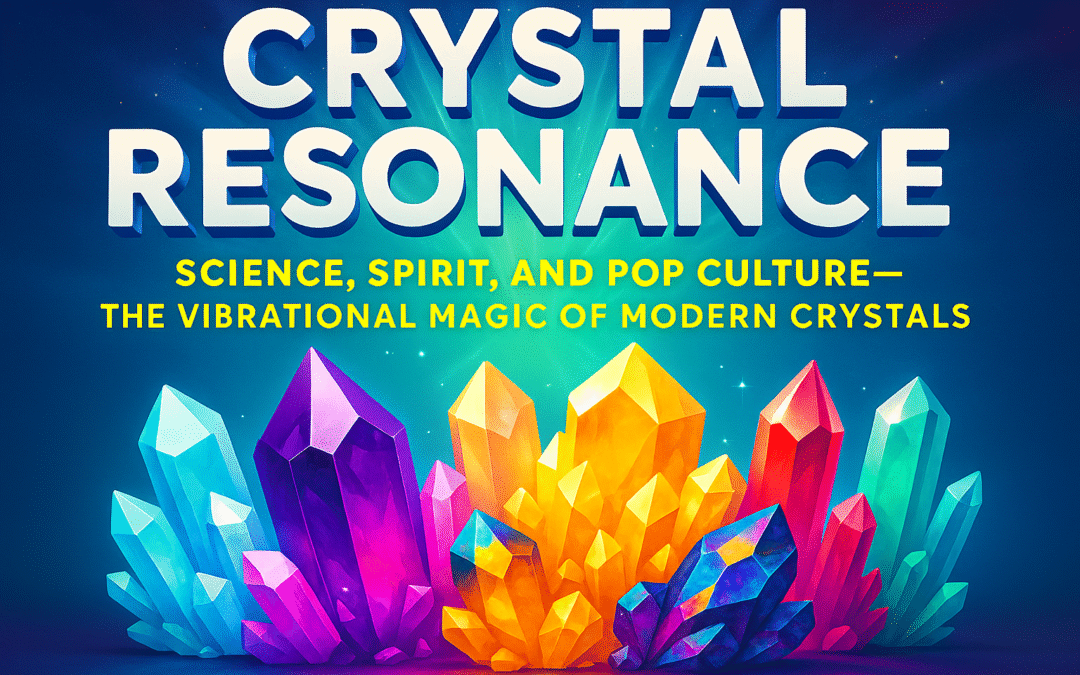
Introduction: The Resurgence of Crystal Power
Step into almost any trendy wellness shop, scroll through TikTok’s #CrystalTok, or listen to Taylor Swift’s new album, and you’ll see a clear cultural shimmer: crystals are everywhere in 2025. From meditation altars to smartphone apps, the ancient allure of gemstones has exploded into a global wellness trend, with enthusiasts swearing by crystal resonance for healing, balance, and manifestation. But what does crystal resonance really mean? Is it science, spirituality, pseudoscience—or just seriously sparkly self-care?
In this deep-dive, we’ll unravel the mysteries and truths of crystal resonance: from its rigorous roots in physics and cutting-edge tech, through the mystical lenses of chakras and metaphysical guides, to its fascinating journey through ancient cultures, ethical debates, modern skepticism, and the dazzle of pop culture. Whether you’re a curious skeptic, a practicing healer, or a lover of beautiful stones, prepare to have your mind (and maybe your energy field?) vibrate at a whole new frequency.
The Science of Crystal Vibrations: Atoms That Dance
Vibrational Frequencies: The Heartbeat of Crystals
At the atomic level, everything is in motion—yes, even those “solid” rocks. Crystals are prized in science for their highly ordered, repetitive lattice structures. Every atom inside a crystal vibrates, creating phonons—quanta of vibrational energy. This isn’t just metaphoric; it’s a cornerstone of materials science, governing properties like heat conductivity, light emission, and even superconductivity.
Imagine millions of atoms in a quartz crystal oscillating in precise harmony, like rows of ballerinas. This microscopic choreography gives birth to fundamental vibrational frequencies—regular, measurable oscillations typically ranging from kilohertz (kHz) to gigahertz (GHz), depending on the crystal type, shape, and size.
Table: Key Scientific Properties of Quartz Crystals
| Property | Description | Typical Value |
|---|---|---|
| Structure | Hexagonal | Repeating atomic lattice |
| Vibrational Mode | Phonons (acoustic + optical) | 10¹⁰ – 10¹³ Hz (THz) |
| Piezoelectricity | Electrical charge when deformed | High Q, stable frequency output |
| Usage | Oscillators, sensors, watches | Accurate time/frequency control |
Quartz’s piezoelectricity—its ability to produce electricity under pressure and vibrate when electrified—makes it the “tuning fork” of the electronics industry, used in watches, radios, sonar, and smartphones.
Scientific Recap
- Fundamental vibrational frequency: Each type of crystal has a natural “resonant” frequency determined by atomic mass, bond strength, and geometry.
- Phonons: Quantum packets of vibrational energy; responsible for heat, sound, and even complex phenomena like superconductivity.
- Piezoelectric effect: Converts mechanical stress to electric voltage and vice versa—core to quartz technology.
Curious? Read a layperson-friendly physics summary here.
Resonance and Entrainment: The Invisible Handshake
Resonance happens when two vibrating systems—whether tuning forks, atoms, or bodies—oscillate at matching frequencies, sometimes amplifying each other’s effects. In crystals, resonance means their vibrations can synchronize with other frequencies in the environment, including biological systems.
But the plot thickens with entrainment: the ability of a strong, steady vibration to pull weaker, nearby rhythms into sync. This concept, rooted in the 17th-century discoveries of Christiaan Huygens (who watched pendulum clocks sets fall into “sympathy”), is now foundational to bioengineering, neuroscience, and—according to crystal enthusiasts—energy healing.
- In crystal resonance: A stable crystal frequency might entrain biological rhythms (e.g., brainwaves), potentially harmonizing subtle energies.
- Real-world example: Quartz crystals entrain the oscillations in timepieces, keeping watches accurate for years.
For a mesmerizing deep-dive on synchronization, from physics to biology, see Physics World’s “The Secret of the Synchronized Pendulums”.
Piezoelectric Magic: Quartz, Tech, and the Human Body
One of the most tangible scientific effects in crystals is piezoelectricity—discovered in the 19th century by the Curie brothers—and now the backbone of modern technology. When you squeeze or bend a piezoelectric crystal (like quartz), it generates a tiny but measurable electric charge. Apply electricity, and it vibrates at a precise frequency.
Applications:
- Quartz Watches: The quartz crystal regulates timekeeping more accurately than any gear or spring.
- Medical Ultrasound: Piezoelectric transducers in ultrasound imaging both send and receive sound waves to create internal images.
- Sensors and Actuators: Used in pressure sensors, microphones, and even electric lighters.
The science is rock solid: Quartz’s properties summarized by Boston Piezo-Optics.
But can this physical property directly influence the “human energy field”? That’s where mainstream science meets the metaphysical frontier…
Metaphysics & Biofields: Beyond Physics, Into Energy Medicine
Biofield Science: Mapping Energies in and Around the Body
While mainstream physics is clear about vibrations and resonance in measurable terms, the concept of biological energy fields (or “biofields”) is still controversial yet widely explored. A biofield, according to alternative medicine, comprises subtle electromagnetic, thermal, and possibly quantum fields generated by living organisms.
Clinical research into biofield therapies—including Reiki, Therapeutic Touch, Healing Touch, and a growing collection of crystal modalities—has shown mixed but occasionally promising effects on pain, mood, and wellbeing, usually comparable to the placebo response.
Resources:
The challenge: Beyond some fascinating results, reproducible mechanisms linking crystal vibration to living biofields remain scientifically elusive.
Chakras and Crystal Harmony: Metaphysical Alignments
Enter the world of chakras—energy centers originating in ancient Indian spiritual traditions, corresponding to major nerve plexi and glands. Each chakra is said to have a specific color, frequency, and associated crystals. When chakras spin in harmony, mind, body, and spirit are balanced.
Common Chakra-Crystal Correspondences:
| Chakra | Color | Typical Frequency* | Crystals | Role |
|---|---|---|---|---|
| Root | Red | ~396 Hz | Red Jasper, Black Tourmaline | Grounding, stability |
| Sacral | Orange | ~417 Hz | Carnelian, Orange Calcite | Creativity, sexuality |
| Solar Plexus | Yellow | ~528 Hz | Citrine, Yellow Jasper | Power, confidence |
| Heart | Green/Pink | ~639 Hz | Rose Quartz, Green Aventurine | Love, compassion |
| Throat | Blue | ~741 Hz | Blue Lace Agate, Aquamarine | Communication, expression |
| Third Eye | Indigo | ~852 Hz | Amethyst, Sodalite | Intuition, insight |
| Crown | White/Violet | ~963 Hz | Clear Quartz, Selenite | Spiritual connection |
(*) Based on Solfeggio frequencies and metaphysical texts.
Chakra energy mapping: The theory is that a crystal with a particular frequency or color will harmonize its matching chakra, clearing blockages and realigning the system.
References for practical guides:
- Crystal Stones: “20 Most Useful Crystals For Chakra Alignment – The ‘How To’ Guide”
- Crystal Vaults’ Chakra Healing Guide
Healing Rituals: Intention, Entrainment, and Crystal Use
Crystal healing rituals, as outlined in countless modern metaphysical guides and online resources, often combine intention-setting, meditation, chakra placements, crystal grids, and ritual baths. The core metaphysical beliefs:
- Crystals resonate with human energy fields, facilitating balance.
- Intention amplifies a crystal’s effect (conscious mindfulness).
- Grids and sacred geometry multiply the focused energy.
- Meditation with crystals can help harmonize, ground, or uplift emotional states.
Key guidebooks:
Crystal Culture: Ancient Histories and Modern Booms
Ancient Civilizations: Power, Ritual, and Symbolism
Crystals and gemstones have graced human rituals, burial sites, and jewelry for millennia. Across continents and cultures, their uses are richly documented:
Egyptians: Lapis lazuli for wisdom, protection; turquoise and carnelian in royal amulets and burial regalia. Scarab amulets for rebirth and afterlife—often inscribed with spells for protection.
Greeks: Believed quartz to be eternally frozen ice. Amethyst protected from intoxication; the word “amethystos” literally means “not drunk”.
Chinese: Jade valued for immortality, carved into imperial seals, burial suits, and talismans associated with flow of Qi (life force).
Historical Use Table
| Culture | Crystal | Purpose/Meaning |
|---|---|---|
| Ancient Egypt | Lapis lazuli | Wisdom, connection to gods |
| Turquoise | Protection, fertility | |
| Carnelian, Scarab | Power, rebirth, protective amulet | |
| Ancient Greece | Amethyst | Sobriety, clarity, healing |
| Quartz | Purity, water, connection to gods | |
| China | Jade | Immortality, virtue, health |
| Quartz | Balancing qi, harmony |
References: World History Encyclopedia, Metropolitan Museum of Art.
Crystals in literature and lore: Gemstones are omnipresent in sacred texts, myths, and stories, from the breastplate of the Hebrew High Priest to the “Philosopher’s Stone” in alchemical and Harry Potter tales.
Modern Booms: Social Media, Wellness, and Pop Stardom
Crystals exploded into the mainstream in the late 2010s and 2020s, fueled by social media (#CrystalTok, Instagram mood boards), celebrity endorsements (Taylor Swift, Adele, Miranda Kerr), fashion houses (Gucci, Dior), and mass-market shops (Urban Outfitters, Goop). The global crystal market, once niche, is now a billion-dollar industry.
- Pop culture moments: Taylor Swift’s “Opalite” (2025) triggered a rush in opalite and opal jewelry sales, underlining the power of celebrity and symbolism in crystal trends.
- TikTok and Instagram: Billions of views for crystal ASMR, demos, unboxing, and “crystal grid” tutorials.
- Wellness integration: Crystals are now standard offerings in retail wellness kits, yoga studios, and even workplace wellness programs.
Dazzle in fiction: Movies (Superman’s kryptonite, Lord of the Rings’ gems, Harry Potter’s Sorcerer’s Stone) and TV (Steven Universe) amplify the cultural association of crystals with power, transformation, and healing.
From Technology to Transcendence: Crystals in the 21st Century
Technology: Advanced Resonance, Water Structuring, and Wearables
New frontiers have emerged at the intersection of crystal physics and alternative wellness. Companies like ARK Crystal blend rigorous material science, quantum theory, wellness marketing, and metaphysics into next-gen “bioenergetic devices”.
What is the ARK Crystal?
- High-purity, tetrahedral quantum quartz, cut to precise (holographically inspired!) dimensions.
- Subjected to electromagnetic field treatments to “activate” resonance with quantum vacuum field.
- Marketed as a wearable pendant or water-structuring device, claimed to create a toroidal field of “coherent” energy, enhancing physical and mental well-being.
Claims (with mixed evidence):
- Enhanced hydration and water “structuring.”
- Improved strength, balance, focus, and mood outcomes in small placebo-controlled studies.
- Interaction with acupuncture meridians and bioelectrical systems, proposed as a bridge between ancient wisdom and unified field theory.
Learn more: See the tech’s claimed science here and ARK Crystal research overview.
Caveat: While the physics of resonance, piezoelectricity, and electromagnetic coupling are real, claims about “quantum vacuum coupling” and water memory in the wellness context outpace current scientific consensus.
Wellness, Spirituality, and Intuitive Personal Practice
Crystals are the centerpiece of numerous contemporary wellness practices, from breathwork and yoga meditations to “energy cleansing” and creative intention-setting. Popular metaphysical writers and crystal therapists provide guides for every desire: abundance, love, protection, clarity—even pet healing.
- Personalization: Choosing stones “by intuition” (what draws your eye or resonates with your needs) is just as common as referencing guides or astrological placements.
- Cleansing and charging: Rituals involve smudging with sage, bathing crystals in moonlight, burying in salt or earth, or charging under full moons for maximum energy.
- Crystal grids: Arranging stones according to sacred geometry to amplify intentions and manifest outcomes.
Notable crystal guides: Judy Hall’s “Crystal Bible” series, Karen Frazier’s “Crystals for Healing,” Athena Perrakis’s “Crystalpedia,” and Robert Simmons’s “Book of Stones” rank among the most cited references for beginners and seasoned practitioners alike.
Critique, Skepticism, and the Placebo Effect
Scientific Scrutiny: Placebo or Power?
Mainstream medical and scientific institutions remain skeptical—if not outright dismissive—of crystal healing’s metaphysical claims. Key arguments:
- No robust evidence: Controlled studies show no effect of real crystals beyond placebo (as in Dr. Chris French’s 2001 double-blind experiment where real and fake crystals elicited equal “tingling” when paired with suggestive instruction).
- Unmeasurable energies: “Biofields” and crystal “energy” have yet to be reliably detected by physics or medical instruments.
- Placebo and ritual: Positive effects reported by users are attributed to suggestibility, intention, and the soothing, mindful rituals that surround crystal use.
Science-based medicine has investigated crystal healing’s claims and found them lacking in empirical rigor but not in cultural traction or psychological benefit. The same diagnostic skepticism is found among skeptical blogs and public science educators.
The Power of Belief—and Mindfulness
While science struggles to validate crystal healing as more than placebo, modern research into belief, ritual, and psychological wellness supports one crucial takeaway: meaningful rituals, especially multisensory and tactile ones, enhance focus, reduce stress, and promote healthy mindsets. Holding a crystal, setting an intention, or meditating mindfully may offer significant subjective benefits regardless of the physical properties of the stone involved.
If it helps you, grown-up magic is still magic; the line between mind and matter is sometimes just the color of your intention.
Ethical Sourcing: The Environmental and Human Cost of Crystal Boom
Crystals may symbolize spiritual harmony, but their popularity has exposed uncomfortable truths about their earthly origins. Ethical concerns include:
- Environmental harm: Strip mining, habitat destruction, and deforestation linked to large-scale crystal mining, especially in Madagascar, DRC, and Brazil.
- Labor abuses: Dangerous conditions, low wages, and sometimes even child labor are prevalent in artisanal mines.
- Conflict stones: Some sources, such as Afghanistan’s lapis lazuli mines, have been linked to the funding of armed conflict and insurgency.
What is “ethical crystal mining”? Responsible sourcing includes:
- Ensuring fair wages and working conditions.
- Minimizing environmental damage.
- Supporting local communities and indigenous rights.
- Transparent, traceable supply chains, ideally with certification.
What can consumers do?
- Research and seek out retailers with transparent supply chain practices.
- Ask about origins, labor, and mining methods.
- Support businesses investing in fair trade, land reclamation, or local community partnerships.
Ethical guides: National Geographic’s buyers’ guide, Gemrock International’s ethical mining explainer.
Note: Truly “pure-energy” crystals ought also be conflict-free in the material world.
Crystals in Pop Culture, Media, and Everyday Life
From pop songs and TV series to high fashion and digital well-being apps, crystals now saturate contemporary life:
- Music: Taylor Swift’s “Opalite” (2025) created an “opalite craze,” with fans learning the nuances of synthetic versus real opals, and sellers scrambling to ride the trend honestly.
- Social Media: TikTok’s #CrystalTok, Instagram mood boards, and YouTube ASMR videos keep crystals trending for Gen Z, millennials, and beyond.
- Fashion: Designers and influencers showcase “energy jewelry,” blending style and spiritual symbolism.
- Home Decor: Amethyst geodes and rose quartz clusters serve as both statement pieces and “energy cleansers” for living spaces.
- Fiction: Crystals remain central in Hollywood and literature as metaphors for power, transformation, and otherworldly magic.
The Crystal Zeitgeist
Crystals have become “lifestyle objects”—symbols of hope, intention, beauty, and the desire for alignment in an anxious world. Their power is as much cultural and psychological as it is, possibly, vibrational or energetic.
Conclusion: The Resonance Revolution—Science, Spirit, and Self-Care
We are each vibrating in a universe of motion; the real magic may be our quest to tune our lives to ever-greater harmony. Crystal resonance bridges the tangible wonders of physics and material science with ancient traditions, modern metaphysics, mindful self-care, and the pop culture sparkle of our times.
Science tells us: Crystals are marvels of molecular order, whose resonance and piezoelectric effects power much of modern technology.
Metaphysics reminds us: Meaning, intention, and energy shape our inner experience—and possibly our health and happiness.
Culture shows us: Crystals, whether placebo, proof, jewelry, or sacred object, reflect a universal longing for beauty, healing, and connection.
Ethics compels us: To respect the Earth and the hands that bring these wonders from mountain to medicine pouch.
Whether you see a crystal as a quantum miracle, a mindful anchor, or a gorgeous geological artifact, its resonance speaks to as many layers as you’ll allow yourself to feel. So, keep your mind open, your sourcing ethical, your intentions clear—and let those good vibrations roll.
Curious to deepen your knowledge?
- Physics: Vibrational frequencies of crystals explained
- Crystal healing science, skepticism, and practice
- Beginner and advanced metaphysical crystal guides
- Global trends and ethical sourcing in crystals
- Pop culture, celebrity, and crystal trends
System Ent Corp Sponsored Spotify Music Playlists:
https://systementcorp.com/matchfy
Other Websites:
https://discord.gg/eyeofunity
https://opensea.io/eyeofunity/galleries
https://rarible.com/eyeofunity
https://magiceden.io/u/eyeofunity
https://suno.com/@eyeofunity
https://oncyber.io/eyeofunity
https://meteyeverse.com
https://00arcade.com
https://0arcade.com