
Introduction: Surgery—A Story of Blood, Brains, and Brilliance
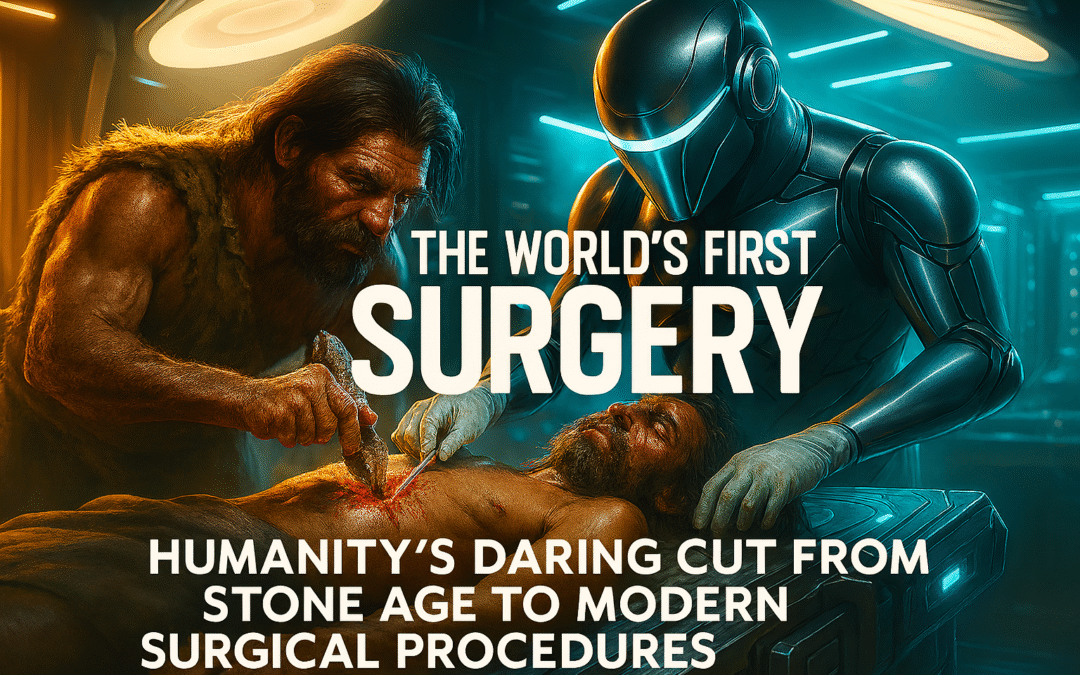
Imagine a shaman clutching a sharpened stone under the flicker of torchlight, an injured leg trembling before him. Or, fast-forward millennia, and see a patient wheeled into a humming, fluorescent-lit theater as robotic arms hover overhead. Surgery—the very act of opening the body to heal, to rescue, to renew—captures the most primal intersection between risk and hope, curiosity and courage. But where did it all begin? Who was the first to dare the cut?
What follows is a journey through the astonishing saga of the first surgeries on record and the genius leaps—sometimes horrifying, often heroic—that advanced the craft from prehistoric necessity to modern marvel. Buckle up: we’re cutting deep into the story of how Homo sapiens learned to save itself through the blade.
Archaeological Clues: Prehistoric Surgeons and the Dawn of the Scalpel
Long before scalpels gleamed under hospital lights, ancestral humans were already experimenting with bodily interventions that stagger us even today. The most astonishing discovery came in 2022: in a remote cave in Borneo, archaeologists unearthed the skeleton of a young hunter-gatherer. But this wasn’t an ordinary find—the skeleton was missing the lower part of its left leg, which had been meticulously amputated using stone tools 31,000 years ago.
This patient didn’t just survive; he lived for years post-operation. Bone growth showed healing, while the stunted leg bore none of the telltale signs of infection that would suggest a botched job. What’s more, the Borneo find predated all previous examples of human amputation by more than 20,000 years. Until then, the oldest known surgical amputation had been the forearm of a Neolithic French farmer, dated “just” 7,000 years ago.
What does this mean? Our “primitive” ancestors possessed remarkable anatomical knowledge and surgical daring. They didn’t just lop off a limb in haste—they sliced muscles, tied off blood vessels, and kept infection at bay, almost certainly relying on forest-derived plant antiseptics. The operation hints at advanced wound management skills and, perhaps, an understanding of both pain control and compassion. After all, to survive such a trauma in a foraging society would require a patient, knowledgeable surgeon—and a community committed to lengthy post-op care.
This moment in prehistory—the first living amputation—shows us that surgery’s story isn’t just a modern tale: its roots entwine with humanity’s earliest problem-solving instincts. While we may never know the surgeon’s name, this child of Borneo reminds us that the first surgery was as much an act of community as of medical boldness.
Journey Into the Skull: Trepanation Through the Ages
If amputation was prehistory’s ultimate gamble, trepanation—drilling or scraping a hole in the skull—was its mind-bending encore. Archaeologists have discovered over 1,500 trepanned skulls from epochs as early as 10,000 years ago, spanning every inhabited continent. Why did our ancestors willingly let someone cut into their heads?
Early scholars speculated it was all about superstition; letting out “evil spirits” that caused madness or epilepsy. But analysis of bone regrowth shows that more than half of these prehistoric patients survived, some living for years after their cranial surgery. In fact, in some regions, rates of surgical survival outstripped those of 19th-century European hospitals. The wounds showed signs of careful technique and sometimes even repeated operations.
The methods of trepanning were as creative as they were terrifying:
- Intersecting cuts with flint, obsidian, or later metal tools
- Scraping the bone patiently with abrasive stones
- Drilling a ring of holes and then connecting them (not so different from modern neurosurgical flaps)
The tools and approaches varied, but so did the motivations. Some openings relieved the pressure of skull fractures, some may have been “ritual” expulsions of spirits, and others perhaps treated chronic headaches or even (as the Inca believed) fostered mystical insight.
Throughout antiquity, trepanation persisted—ancient Greek, Roman, and later Islamic medical texts describe precise instruments and recommended procedures. Even Hippocrates wrote specific instructions for the safest way to cut into a skull, pledging care not to injure the delicate dura mater beneath.
The survival of trepanned individuals across time—proved by bone healing and burial evidence—reminds us that these first “brain surgeries” weren’t just desperate stabs in the dark. They were, astoundingly, calculated attempts at treatment, and they set the template for medical risk-taking that would echo through the ages.
Breaking and Mending: Bone Setting and Casting in Antiquity
It’s easy to forget that in a world without X-rays or orthopedic surgeons, a broken bone could be a death sentence. Yet from Egypt to India, ancient healers developed practical, sometimes ingenious methods for diagnosing and repairing fractures. The Edwin Smith Papyrus, dating to around 1600 BCE, is filled with detailed case studies—how to examine, set, and bandage fractures of the jaw, arm, and leg.
Egyptian surgeons were skilled at applying wooden splints wrapped in linen—one adolescent femur found at Naga-ed-Der showed attempted immobilization with five wooden boards. Although not all patients survived, many healed with the telltale shortening and deformation of malunited bones, revealing that primitive bone-setting was, at times, highly effective.
“Traditional bonesetters” thrived in every ancient culture. In India, Egypt, Greece, and Rome, they used hands, traction, and surprisingly sophisticated splinting. Manuals taught how to realign bones, immobilize limbs, wrap fractures with mixtures of flour and egg white (a harbinger of plaster casts), and reduce dislocations.
Perhaps most strikingly, the Sushruta Samhita from ancient India lays out substantial sections on joint manipulation, fracture reduction, and the fabrication of splints and supports. Students were instructed to practice on gourds and animal bladders before attempting the real thing.
These approaches survive even today among folk bonesetters the world over—evidence that some ancient knowledge remains timeless.
Fire, Iron, and Hemostasis: The Fiery Tale of Cauterization
Blood loss has always been the surgeon’s nemesis. Imagine amputating a limb or cutting into a brain without today’s ligature, cautery, or even a basic understanding of blood circulation. Enter cauterization: the audacious tactic of burning or chemically searing tissue to stop bleeding, ward off infection, or destroy diseased flesh.
The practice is referenced from ancient India’s “Agnikarma” to Hippocratic Greece, right through to the Romans and Islamic golden age surgeons. How did it work? Sometimes with white-hot irons, other times with boiling oil (as Renaissance surgeons did on gunshot wounds), or with caustic chemicals that ate away decayed tissue. Hippocrates famously declared, “What drugs will not cure, the knife will; what the knife will not cure, fire will”.
This “remedy by fire” wasn’t precise—it caused agony and sometimes more harm than good—but it persisted for centuries. Cautery was brandished as a universal tool: a bloodless knife, a counter-irritant, a destroyer of tumors and abscesses, and a barricade against sepsis in an age before germs were understood.
Medieval and Renaissance manuals detail cautery irons in a variety of designs for every part of the body. The ultimate leap came in the Renaissance, when Ambroise Paré showed that simple clean bandages achieved better results than boiling oil. Later, electrocautery would bring this ancient technique into the modern era, transforming a desperate measure into a refined surgical art.
Cutting Edge Law: Surgery in Mesopotamia and the Code of Hammurabi
The earliest written evidence of “regulated surgery” emerges not just from a medical text but from the law: the Code of Hammurabi (c. 1750 BCE). Inscribed on a massive basalt stele in Babylon, it laid out explicit rules for surgical practice, fees, and malpractice—a system that makes today’s medical boards look tame.
Consider these stipulations:
- If a doctor operated on a free man and saved his life, he received ten shekels of silver.
- If the patient was a slave, the fee dropped to two shekels.
- If the patient died or was blinded by surgery, the physician’s hands were cut off.
Harsh? Absolutely. But this codification shows Babylonians recognized surgery’s power and peril. Surgery in Mesopotamia wasn’t only the domain of the priestly caste—archaeologists have uncovered bronze scalpels, knives, trephines, and more, endemic to Nineveh and Babylon.
Yet, as records suggest, the Sumerians and Babylonians wove surgery into a web of medicine, ritual, and law, crediting disease as the wrath of demons, interpreted by divination, and treated with a hybrid of spiritual cleansing and careful “hand work.” In this, we glimpse the real first “surgical teams”—both priest and practitioner.
Imhotep: Egypt’s Medical Maestro and the First “Celebrity” Surgeon
No early surgeon is as lauded as Imhotep, the Egyptian vizier, architect, high priest, and, crucially, physician to Pharaoh Djoser around 2700 BCE. Not only did Imhotep mastermind the majestic Step Pyramid at Saqqara, but he became the semi-legendary father of Egyptian medicine.
Imhotep’s reputation was so stellar that later generations deified him; Greeks equated him with Asclepius, their healing god. His influence endures in the Edwin Smith Papyrus, the world’s oldest surviving “textbook” of surgery. Attributed to Imhotep’s teachings, it’s a remarkable manual from c. 1600 BCE that abandons magical incantation for empirical diagnosis, prognosis, and advanced wound care—for example, treating skull fractures with bandaging, honey (as an antiseptic), and surgical closure.
Imhotep is often called the first “true physician” to emerge from the mist of myth into the light of historical record. His approach—rational, methodical, empirical—was radical for its time, and sets the precedent for generations of scientific medical thinkers.
Egyptian Medical Texts: Papyrus, Scalpel, and Sinew
The legacy of Egypt’s medical schools rests in an astonishing corpus of medical papyri, including the Edwin Smith, Ebers, Kahun, and others. They show, sometimes in explicit detail, how Egyptians cut abscesses, set bones, trepanned skulls, and bandaged wounds.
Most remarkable among them:
- The Edwin Smith Papyrus (c. 1600 BCE): forty-eight trauma cases, presented with diagnosis, prognosis, and treatment instructions—bandaging, closure, and even the use of honey and grease as infection prevention.
- The Ebers Papyrus (c. 1550 BCE): over 700 prescriptions, including references to bone-setting, abscesses, tumor excision, and burn treatment. It mixes surgery with spells but clearly distinguishes practical “knife work.”
- The Kahun & Berlin papyri: Focused on women’s health, including obstetrical maneuvers and early surgical gynecology.
Egyptian art supports these texts; reliefs at Kom Ombo and Memphis depict scalpels, forceps, hooks, and surgical saws, bearing witness to a thriving surgical tradition.
Surgery Goes Global: Innovations in Ancient India and China
India’s Surgical Superstar: Sushruta
If the ancient world had a “father of surgery,” outside the Mediterranean, it was Sushruta. Living and teaching near Varanasi, India, around 600–1000 BCE, Sushruta’s name adorns the Sushruta Samhita—a treatise often called the encyclopedia of ancient surgery.
Sushruta’s contributions are astonishing:
- Detailed lessons on dissection, advocating corpse study and hands-on practice (with fruits and animals) to hone surgical skill
- Step-by-step descriptions of more than 300 surgical procedures and over 120 surgical instruments, including lancets, forceps, needles, saws, and probes
- The world’s first documented nose reconstruction (rhinoplasty)—a technique for restoring mutilated noses using cheek or forehead flaps, a method that still underpins modern “Indian flap” surgery
- Descriptions of cataract surgery (couching), hernia operations, lithotomy (removal of bladder stones), cesarean section, and even prosthetic limbs
Sushruta’s ethical code is also notable, stressing that the surgeon must care for body and spirit, take pains to cause minimal injury, and avoid operating “without due cause.”
Surgery in Ancient China
While surgery in ancient China was less systematically codified than in India or Egypt, remarkable developments occurred, especially the use of herbal anesthesia. Hua Tuo, a legendary figure of the Han Dynasty (c. 2nd century AD), is credited as the first to use general anesthesia (mafeisan, a mixture possibly containing cannabis and wine) for major operations, including resection of gangrenous intestines.
Meanwhile, Chinese records detail techniques for wound binding, bone setting, abscess drainage, and use of acupuncture needles to treat pain—signifying a parallel, if divergent, evolution of surgical skill.
Greek and Roman Masters: Hippocrates, Galen, and the Toolkit of Civilization
Hippocrates and the Greek Ideal
The Hippocratic Corpus—a collection of 60 or so medical texts composed around the 5th century BCE—is the birthplace of Western surgical (and medical) ethics. Hippocrates didn’t just codify the physician’s oath but elevated the standards for wound care, reduction of dislocations, and care of broken bones.
His treatises detail:
- Trepanning with a saw rather than scraping, to limit bone damage
- Wound suturing and careful semi-sterile dressing with wine and vinegar
- Cautious incisions, favoring the “least invasiveness necessary,” and warning against quackery
Galen: The Roman Master and the Animal Experiment
Galen (129–200 CE) was surgeon to the gladiators, the emperor’s physician, and a relentless experimentalist. He advanced the use of ligatures to control bleeding (at least in animal surgery), refined trauma management, and described anatomical details like the use of “catgut” (animal intestine) as internal sutures—a practice that persisted for centuries.
Galen’s surgical tools, many made from bronze and iron, included:
- Scalpels, forceps, elevators
- Catheters, specula (for using in diagnostic and minor surgical exploration)
- Cautery tools and bone saws
His techniques (and his reverence for cleanliness) were recorded and adopted widely, forming a foundation for Middle Eastern and medieval surgery.
Roman Surgical Wonders
Archaeological finds at Pompeii, Herculaneum, and elsewhere have revealed entire kits of Roman surgical instruments—diagnostic probes, scalpels with interchangeable steel blades, vaginal and rectal specula, bone levers, and more—many echoing designs still used today.
Recent 3D scanning of Roman-era tools from London, for example, shows remarkably advanced craftsmanship, with handles built for replacing worn blades and instruments designed for specialized tasks—mixing medicines, sewing bandages, examining wounds.
Roman surgical texts, such as those by Celsus and Soranus, further exemplify the blend of practical “hand work” and an emerging rational, empirical approach to healing.
The Islamic Golden Age: Abulcasis and Surgical Renaissance
When the Western world’s surgical knowledge waned after the collapse of Rome, the torch was carried by scholars and practitioners in the Islamic world.
Abu al-Qasim al-Zahrawi (Abulcasis, c. 936–1013) compiled the encyclopedic “Kitab al-Tasrif,” a thirty-volume work, with its final treatise devoted solely to surgery. Inside, he drew diagrams for over 200 surgical instruments, described operations for removing bladder stones, cauterization for bleeding, forceps for fetal extraction, and even the pioneering use of catgut for internal sutures. His innovations included designs for tonsil guillotines, concealed knives for abscesses, and the first mention of plaster-of-Paris casts for fractures.
Abulcasis insisted on anatomical study, caution, and postoperative care, and his reputation spread so far that Latin translations of his surgical work became university standards in Europe for five centuries.
His influence echoed across the continent, as later Renaissance surgeons adopted or credited his instruments and methods.
Into the Renaissance: Ambroise Paré and a New Era of Gentle Hands
The Renaissance era’s surgical star was Ambroise Paré (1510–1590), a barber-surgeon whose innovations and experiments abolished centuries-old dogma.
On the battlefield, Paré witnessed the agony of treating wounds with boiling oil, the then-standard practice for cauterizing gunshot injuries. When he ran out of oil, he improvised with a mixture of egg yolk, rose oil, and turpentine. To his amazement (and that of his patients), those so treated healed with less pain and faster recovery—a dramatic rebuttal to orthodox wisdom.
Equally revolutionary, Paré reintroduced ligature of arteries (first seen in Galen’s animal work and Abulcasis’s writing) to staunch bleeding during amputations. Whereas cauterization had often led to shock and death, ligatures allowed patients to survive both the surgery and the days after.
Paré documented his findings in vernacular French, democratizing surgical knowledge long locked away in Latin. Thanks to his widely illustrated books, the status of surgeons rose from mere handicraft “barbers” to respected healers, and his fundamentals—gentle hands, observation, patient-centered care—form the cornerstone of modern surgical thinking.
From the Ether Dome to the Germ Theory: Modern Surgery Is Born
Fast forward to the mid-19th century, and the next leap in surgery came not in the brilliance of the blade, but in the dull fog of “ether.” In 1846, at Massachusetts General Hospital’s now-legendary “Ether Dome,” Dr. Crawford Long and dentist William T.G. Morton publicly demonstrated the first use of inhaled ether as anesthesia during tumor excision. For the first time, surgery could be performed without a patient’s screams echoing down the halls.
Chloroform, introduced by James Young Simpson, soon followed, famously used to soothe Queen Victoria during childbirth. These advancements transformed horrendous “cutting races” (when speed and brute force were the only mercy a surgeon could offer) into veritable procedures of healing.
Yet anesthesia, for all its power, was only part of the final puzzle. For every life saved on the table, many more died from rampant infection— gangrene, sepsis, and “hospital rot.”
Enter Joseph Lister in the 1860s. Inspired by Louis Pasteur’s germ theory, Lister pioneered the use of carbolic acid (phenol) to disinfect instruments, wounds, hands, and the air itself in the operating theater. His meticulous system dramatically reduced surgical mortality and made “clean” surgery possible, earning him the title “Father of Modern Surgery”.
The 20th and 21st Century: Surgery Without End
With anesthesia and antisepsis in hand, surgeons of the 20th century shattered the limits of possibility:
- Organ transplantation: First successful kidney transplant in 1954 between twin brothers ushered in the age of life-saving grafts.
- Open-heart surgery: Daniel Hale Williams performed the first repair of a pericardial wound in 1893; Christiaan Barnard transplanted a human heart in 1967.
- Antibiotics: Postoperative infection rates plummeted following the mass deployment of penicillin and other antibacterials.
- Minimally invasive laparoscopic surgery: From the 1980s, “keyhole” incisions replaced massive wounds, inspired by pioneers like Kurt Semm. Today’s surgeries use fiber optics, CO₂ insufflation, and robotic platforms to minimize trauma and speed recovery.
- Robotic and remote surgery: The 21st century’s da Vinci system enables surgeons to operate across the room—or across the world—heralding an era where the “first cut” is ever more precise and ever less invasive.
From Bloodletting to Biomedicine: The Surgical Innovations That Changed the World
Let’s pause to appreciate just how far we’ve come. In the Stone Age, a successful surgery meant a living patient and a healing wound. Today, patients routinely walk out of hospital hours after having a tumor excised by a remote-controlled robot.
Table: Milestones in Surgical Innovation
| Era | Surgical Innovation | Key Figure(s) | Noteworthy Achievement |
|---|---|---|---|
| Prehistory (31,000 years ago) | Amputation, trepanation | Unknown, Borneo surgeon | Survived lower leg amputation (Borneo) |
| Neolithic/Bronze Age | Skull trepanation, bone setting | Various | Up to 50% survival rates observed |
| Ancient Egypt (2700–1600 BCE) | Empirical trauma surgery | Imhotep, scribes | Edwin Smith and Ebers papyri |
| India (600 BCE) | Plastic surgery, anatomical dissection | Sushruta | Nasal reconstruction, Sushruta Samhita |
| Mesopotamia (1750 BCE) | Surgical law | Hammurabi | Regulated payment and malpractice |
| Greece/Rome (500 BCE–500 CE) | Rational ethics, advanced instruments | Hippocrates, Galen, Celsus | Ligature, catgut, trephine, surgical manuals |
| Medieval Islam (900–1300 CE) | Encyclopedic surgery, new instruments | Al-Zahrawi (Abulcasis) | Kitab al-Tasrif, >200 surgical instruments |
| Renaissance (1500s) | Ligature, field surgery, empirical method | Ambroise Paré | Abandoned boiling oil, promoted ligature |
| Mid-19th c. | Anesthesia, antisepsis | Morton, Lister | Ether, chloroform, carbolic acid |
| 20th century | Antibiotics, transplantation, laparoscopy | Fleming, Murray, Semm | Penicillin, organ transplants, “keyhole” surgery |
| 21st century | Robotic surgery, AI, minimally invasive advances | Intuitive Surgical, others | da Vinci system, natural orifice surgery |
Each milestone reflects courageous trial and error, cross-cultural fertilization, and the gradual emergence not just of surgical tools but surgical ethics. If the first surgeries were reckless gambles, the modern procedure is an exquisite choreography of wisdom, empathy, and ever-sharper precision.
Conclusion: The Next Frontier—From Ancient Wounds to Robotic Wonders
So what defines the first surgery? A single moment? A set of tools? Or the spirit that drives one human to dare the blade, to cut so that another may live? From the Borneo amputation to the Sushruta Samhita and into today’s blinking, beeping, antiseptic theaters, every procedure is a link in humanity’s endless quest to heal.
Surgery is the ultimate mix of terror and hope, invention and tradition. Its roots are wild and deep. Whether wielded by a painted shaman, a priest of Imhotep, an Indian sage with a bronze blade, or a robot guided by human hand and mind, surgery cuts to the heart of what it means to be human: vulnerable, ingenious, and unyieldingly resilient.
As we leap into the future—nanorobotics, regeneration, AI-guided incisions—let us never forget the shuddering bravery of our ancestors’ first cut.
Want to dig deeper into this fascinating history?
- Discover the first amputation in Borneo
- Journey through the Edwin Smith Papyrus
- Explore Hippocrates’ legacy
- Understand the Sushruta Samhita
- Marvel at the surgical treasures from ancient Rome
- Read about Ambroise Paré’s surgical revolution
- Discover Lister’s antisepsis system
- Track the path to modern robotic surgery
Surgery’s saga is as long as human memory, written in scars, hope, and the wisdom of unbroken chains. Cut on! Great choice! I’m diving into a research task to craft a lively and informative blog article on The First Surgery. It’ll explore the origins of surgical practice, highlight key historical figures, and trace the evolution of techniques from ancient times to today—all in an upbeat and engaging tone. I’ll also include smart hyperlinks to reputable sources so readers can explore further. This will take a little time, so feel free to step away and check back later. Your article will be saved right here in this conversation!