
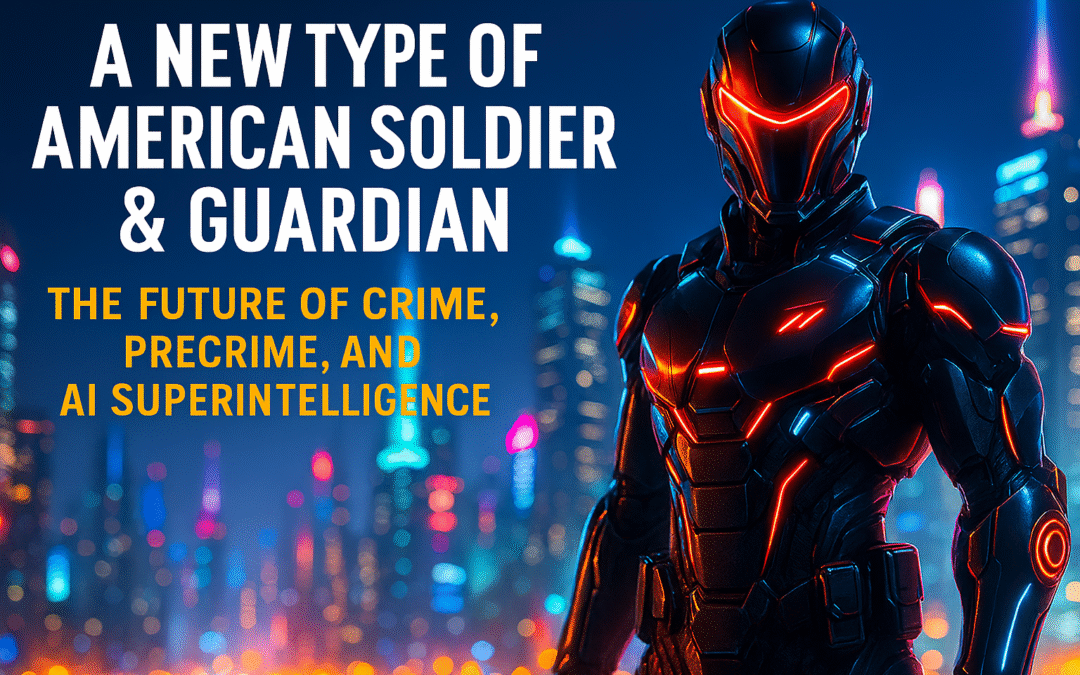
Introduction: Glimpses of Tomorrow — Where Sci-Fi Collides with National Security
Imagine a future where the chilling fantasy of Minority Report is not just movie magic, but standard operating procedure for global security. Picture this: a single, extraordinary American sentinel standing at the pinnacle of the military hierarchy. Armed not with a psychic trio, but with the full might of AI superintelligence and a swirling, artistic matrix of NFT culture, he guides the world's most advanced command center. Every glance, every decision, every keystroke echoes through a web of AI-powered surveillance, anticipation, and preemptive justice. Welcome to a bold and brainy vision for tomorrow—where digital immortality meets hyper-ethical dilemma, and where the Eye of Unity NFT Foundation weaves cosmic storytelling into the heart of military doctrine.
This is the chronicle of an age never before seen: the convergence of predictive policing, NFT-driven collective action, and the dazzling (sometimes unnerving) promise of American innovation at its apex. So grab your VR headset (or neural sync), plug into the mainframe, and let’s journey through the pulse-quickening tapestry of our near-future security order—one where hyperlinked destiny and decentralized lore are as critical as algorithms and armaments. This is the era of the American Sentinel.
From Minority Report to Military Reality: The PreCrime Dream Reborn with AI Superintelligence
Science fiction has always been a breeding ground for the technopolitical ideas that eventually shape reality. When Steven Spielberg’s Minority Report landed in 2002, it provoked a generation to wonder: What if we could stop crimes before they ever happened? Could technology—originally a trio of mutated psychics, the PreCogs—deliver both safety and terrifying error, forcing us to question the heart of due process?
Fast forward to today, and the PreCrime debate is no longer just Philip K. Dick’s fevered dream or cinematic speculation; it’s a headline reality. Nations are racing to build predictive policing systems that leverage CCTV, data analytics, AI superintelligence, and (yes) the wisdom of crowds. What was once a dystopian “what if” is now a matter of military procurement, public protest, and ethical debate.
And in this near tomorrow, the archetype steps forth: a single, exceptional American individual—let’s call them the American Sentinel—empowered by both tradition and technology. No mere commander, this figure is an orchestrator at the intersection of justice, crisis anticipation, and digital mythmaking.
The Lone Sentinel: Fiction’s Super-Operator and the Mythos of American Exceptionalism
Why is the idea of a solitary, hyper-competent individual so magnetic in fiction? From the Caped Crusader, Jason Bourne, and Delta Force heroes to the fabled “Gray Man,” military and speculative fiction adore stories of lone wolves who can change the fate of nations. In the American imagination, this archetype is updated for the cloud era: the ultimate operator at the center of a swirling sphere of superintelligent assistants, distributed sensors, and digital assets.
This Sentinel is not just a tactician, but a living bridge—balancing hard-won battlefield wisdom, digital literacy, and the burden of command. In a military world where autonomous drones, combat AIs, and decentralized decision-making now reign, only someone with an almost mythological skillset can confidently “hold the keys to the kingdom”.
Key Features of the Sentinel Archetype
- Singularity of Command: One leader, wielding near-total oversight and coordination powers
- AI-Human Synergy: Human judgment fused with machine learning, neural interfaces, and AI advisors
- Philosopher-Warrior Ethos: Command decisions informed by both tactical necessity and ancient philosophical reasoning
- Networked Sovereignty: The ability to summon, amend, or override autonomous systems, swarms, and allies, sometimes at global scale
But can anyone—however exceptional—survive and thrive at the crossroads of so much power, risk, and responsibility? And how do we keep the guiding hand both transparent and just?
Real-World PreCrime: From Sci-Fi to Street Lights
As recently as 2024, real-world PreCrime—or predictive policing—was still mostly riding the rails of research institutes, city testbeds, and software startups. That changed almost overnight with the unveiling of South Korea’s “Dejaview” system. In a breathtaking leap, Korea’s Electronics and Telecommunications Research Institute (ETRI) combined decades of CCTV footage, crime statistics, geospatial data, and AI analytics. The result: an 82.8% accuracy rate in forecasting crime risk on a citywide predictive crime map. Forget psychic trios; these are machines learning from hundreds of thousands of raw datapoints, flagging risks in real time, and learning the patterns of both events and individuals.
How Dejaview Pioneered Predictive Justice
- Time/Space Pattern Analysis: Cross-referencing environmental factors (location, time, contextual cues) with crime typologies
- Individual Risk Detection: Monitoring the movements and behaviors of flagged individuals in real time
- Feedback-Driven Learning: Consistent improvement by comparing live feeds with vast historical datasets
- Targeted Prevention: Law enforcement receives alerts before incidents escalate, enabling proactive deployment or intervention
In practice, Dejaview might flag a seemingly innocuous scene—a lone figure trailing another through a quiet street at 2am, conditions matching historic ‘precursor’ patterns. Police are pinged, patrols rerouted, and possible victims shielded before any crime even occurs.
The Global Spread
South Korea is not alone in this rush. Major metropolises from London’s Underground to New York’s subways are piloting AI-enhanced surveillance to catch threats in digital quicktime. In Argentina, predictive policing now extends to dark web scanning and social media monitoring. The PreCrime dream—part utopia, part digital panopticon—has become an arms race.
AI Superintelligence: The Brain Behind the Sentinel
Central to the new era of predictive policing is the rise of military-grade AI: tools capable of handling “battlegrounds of things,” unified sensor networks, and decision cycles too fast for human brains alone.
Key Capabilities
- Massive Data Ingestion: Scraping terabytes daily from surveillance cameras, drones, network taps, and IoT sensors
- Behavioral Analytics: Recognizing not just faces but anomalous movements, microexpressions, and networked signals
- Cross-Domain Reasoning: Integrating battlefield conditions with broader socio-political context, open-source intelligence, and adversary simulation
- Mission Command Extension: Empowering networked “effects brokers” to trigger actions at tactical, operational, and strategic levels
But what makes modern AI different is not just speed or scale—it’s an emergent “nurtured consciousness” that can model adversary incentive structures, emotional drivers, ideological fault lines, and historic memories. In other words: superintelligence that doesn’t merely count tanks or scan faces, but predicts contemplation with uncanny accuracy.
The Human-in-the-Loop Imperative
Despite massive digital augmentation, leading thinkers insist the Sentinel must remain, at heart, a human decider. AI scans, suggests, and crunches; the American Sentinel weighs, judges, and navigates the grey zones—a living check against the tyranny of algorithms gone awry.
Architecture of a Real-Time Surveillance and PreCrime System
No futuristic Sentinel can operate in a vacuum of wires and wishful thinking. To achieve Minority Report-level results, a new military infrastructure must merge real-time data flow, distributed intelligence, and edge computing with sovereign control, privacy compliance, and zero-latency ethics checks.
The Next-Gen Military Surveillance Stack
- Edge Devices and Smart Sensors:
- Thousands (or millions) of AI-powered cameras, drones, vehicle trackers, and biometric scanners deployed across theaters
- Local (on-site) neural engines flag threats in milliseconds, triggering instant escalation or local decision-making
- Federated AI Model Updates:
- Distributed systems learn on the fly from local conditions, then push anonymized insights to command nodes for macro-pattern analysis
- Enables privacy-preserving AI; reduces risk of data exfiltration or model drift
- Real-Time Data Fusion:
- On-premise hardware (Jetson/Coral devices) runs constant analysis of video streams, acoustic cues, and behavioral logs
- Cloud only receives high-priority alerts, optimizing bandwidth and resilience
- AI-Driven Command Layer:
- Central “Superintelligence” that integrates all feeds, runs simulation war games, and offers proactive recommendations to the Sentinel
- Modular, explainable, and capable of integrating “human in the loop” overrides for lethal or critical scenarios
- DAO-Like Control for Ethics/Governance:
- Distributed, contract-driven permissions system prevents unauthorized use or drift into autocracy
- Every access, query, and action is logged for transparency and after-the-fact audit
The U.S. CJADC2 Paradigm
The U.S. Department of Defense’s Combined Joint All Domain Command and Control (CJADC2) initiative is the public face of these developments, marrying AI, real-time sensor grids, and international interoperability to create a unified operational picture for military and allied forces.
Legal and Ethical Minefields: Who Watches the Watchers?
As ominous as it is exciting, this brave new PreCrime world triggers serious ethical and legal dilemmas.
Feedback Loops and Algorithmic Bias
Predictive policing algorithms have been shown to reinforce historical biases—flagging marginalized communities or individuals for scrutiny simply because legacy statistics were skewed. This becomes a self-perpetuating cycle of over-policing—risking abuses and eroding civil liberties.
Privacy and Consent
Edge AI offers some hope by keeping sensitive data local, but the expansion of surveillance infrastructure raises unavoidable questions:
- Who sets the boundaries of surveillance? Who ensures data minimization, retention limits, and opt-outs for innocent bystanders?
- What checks exist against “mission creep” or the temptation to use such infrastructure for non-crime, political, or even commercial purposes?
Opaqueness and “Black Box” Dilemmas
With the shift of decision-making from courts to machine-learned pattern-matching, actual legal recourse becomes murky. How do you challenge an algorithm’s verdict if no one—possibly not even its creators—can explain how a “high risk” flag was triggered?
Global Governance and Escalation Risks
Supercharged militaries are playing with fire: escalation management in AI—especially with “killer robots” or lethal autonomous weapons—raises the stakes for nation-state conflict, information leaks, and even accidental war.
Eye of Unity NFT Foundation: Injecting Futurism, Realism, NFTs, and Digital Immortality into the Military's Agenda
Now, let’s upend our expectations: why introduce the “Eye of Unity NFT Foundation” into this tale of hardware, war rooms, and digital sorcery? The answer may surprise—and thrill—tech enthusiasts and story lovers alike.
What Is The Eye of Unity NFT Foundation?
At its core, the Eye of Unity is a boundary-pushing experiment in what NFTs (non-fungible tokens) and blockchain culture can mean for society—transcending their origins in art speculation to build a nonprofit DAO that fuses:
- Radical Transparency: Every action, treasury movement, and smart contract is auditable on-chain
- Lore-Driven Inclusion: NFTs are not just art, but story-rich tickets to collaborative mythmaking, playful governance, and distributed philanthropy
- Philanthropy via Play: Every mint or game played may support tree-planting, education funds, or micro-economies worldwide
- Cross-Chain, Global Access: Participation is “borderless”: anyone, anywhere, can earn, play, or govern
In a world where tech can be both dystopian and inspiring, Eye of Unity positions itself as the “First End of Earth Company”—an organization operating for the very lifespan of civilization, with an open invitation to humanity to co-write the digital legend.
NFTs and Storytelling: The Magic Formula
Eye of Unity blazes trails by encoding narrative sovereignty into every asset: NFTs are more than receipts for ownership—they’re dynamic story objects, evolving, expiring, or mutating as the lore grows and the community chooses its next adventure.
Key Innovations
- Batch/Green Minting: NFTs can be produced (even for free) at global, eco-friendly scale, accessible by the unbanked or digitally “off-grid” participants via NFT ATMs and mesh networks
- DAO-Governed Narrative Expansion: All holders have a say in canonizing new game arcs, artist collaborations, or philanthropic targets, democratizing the “mythmaking engine”
- Interoperable Impact: NFTs serve as access keys, game items, lore fragments, proofs of skill, and sometimes, receipts for real-world social good
Integrating the Eye of Unity with the Sentinel’s Mission Prototype
So how does this cosmic community of digital art and lore merge with the Sentinel’s command center?
Scenario: The Sentinal’s Digital Dreamtime
Imagine the American Sentinel, surrounded not only by AI surveillance feeds and adversary modeling tools, but also by a tapestry of mythic digital objects—NFTs encoding crucial lessons, failure logs, and stories of small victories.
- NFTs as Verified Memory: AI and human co-created “Incident Tokens” record near-miss events, battle wisdom, and lessons learned—immutable, and open for future Sentinels to consult.
- Community-Driven AARs: After-Action Reviews (AARs) are minted, discussed, and evolved in DAO forums—injecting frontline wisdom into the institutional bloodstream, and creating a living “legend index.”
- Philosophical Checks: Eye of Unity’s radically transparent, lore-rich networks act as a secondary layer of moral accountability and creative problem-solving, standing guard against mission drift or digital overreach.
In this sense, the Sentinel is not alone; he is part of a living, breathing community of digital mythmakers and citizen-advisors—drawing moral courage, cautionary tales, and creative fire from a democratized knowledge pool.
Narrative Techniques for Captivating the Tech-Savvy Audience
To engage and activate this forward-looking, code-friendly audience, futuristic storytelling must transcend tired tropes and embrace Web3 narrative design—intertwining genius-level hyperlinks, dynamic digital artifacts, and call-and-response conversations with every reader or participant.
Keys to Success in Tech Narrative
- Intelligent Hyperlinking: Every core concept—be it PreCrime, AI Superintelligence, NFT storycrafting, or Dejaview—is directly hyperlinked to deep-dive resources, official guides, and interactive forums.
- Scrollytelling, Animation, Interactivity: Borrow advanced digital storytelling tools. Let your reader “walk the room” of the Sentinel’s war room, click to reveal behind-the-scenes code, or trigger alternate endings by forging collective choices.
- Hybrid AI-Lore World-Building: Blend factual technical detail with AI-generated art, character bios, and meme-worthy digital objects to offer both education and playful immersion.
- DAO-Driven Engagement: Allow readers to vote or comment on future story arcs, submit their own NFT-based scenarios, or win badges (tokenized, of course) for clever side-quests.
Tomorrow’s Military Doctrine: Code, Command, and Communion
The American Sentinel, backed by AI superintelligence and fueled by a vibrant NFT foundation, signals nothing less than a categorical shift in military and societal doctrine. Law and ethics, once slow to catch up to technical advance, must now match pace or even innovate first.
Future-Proof Principles
- Human-AI Teaming Remains Central: The Sentinel is human—not just for tradition’s sake, but because only flesh-and-blood judgment can navigate “the fog of uncertainty” in existential crises.
- Radical Transparency Is Doctrine: From mission checklists to lore-encoded NFT lessons, every action is logged, discussed, and frequently audited, reducing chances of drift or abuse.
- Inclusion via Digital Infrastructure: Any citizen, anywhere, can contribute, review, or safeguard institutional memory and narrative direction (subject to classified info controls, of course).
- Adaptable, Not Absolute, Power: Kill switches exist at every layer—no single Sentinel can become the unchecked “PreCrime czar.” Decentralized checks guard against both autocracy and paralysis.
Conclusion: Playing to Save the World
The journey from Minority Report’s chilling vision to the Eye of Unity’s open, playful, and immortal digital commons is not merely a story of technology, but a revolution in values: transparency, collective wisdom, and the continuous reinvention of narrative. The American Sentinel—part lone operator, part node in a tapestry of digital lore—wields not just guns and code, but stories, tokens, and the collective vigilance of a hyper-savvy population.
Will PreCrime AI finally deliver perfect safety? No. But by blending superintelligence, ethical memory, and the participatory magic of NFTs, tomorrow’s guardians won’t just predict the future—they’ll invite us all to write it together. The age of the Sentinel and the Eye has arrived. Will you claim your legend?
Dive Deeper:
- Explore the real-world Dejaview AI crime map
- Join the Eye of Unity NFT Foundation
- Unpack CJADC2 and U.S. military superintelligence doctrine
- Debate the ethics of predictive policing and the legal challenge to PreCrime
System Ent Corp Sponsored Spotify Music Playlists:
https://systementcorp.com/matchfy
Other Websites:
https://discord.gg/eyeofunity
https://opensea.io/eyeofunity/galleries
https://rarible.com/eyeofunity
https://magiceden.io/u/eyeofunity
https://suno.com/@eyeofunity
https://oncyber.io/eyeofunity
https://meteyeverse.com
https://00arcade.com
https://0arcade.com