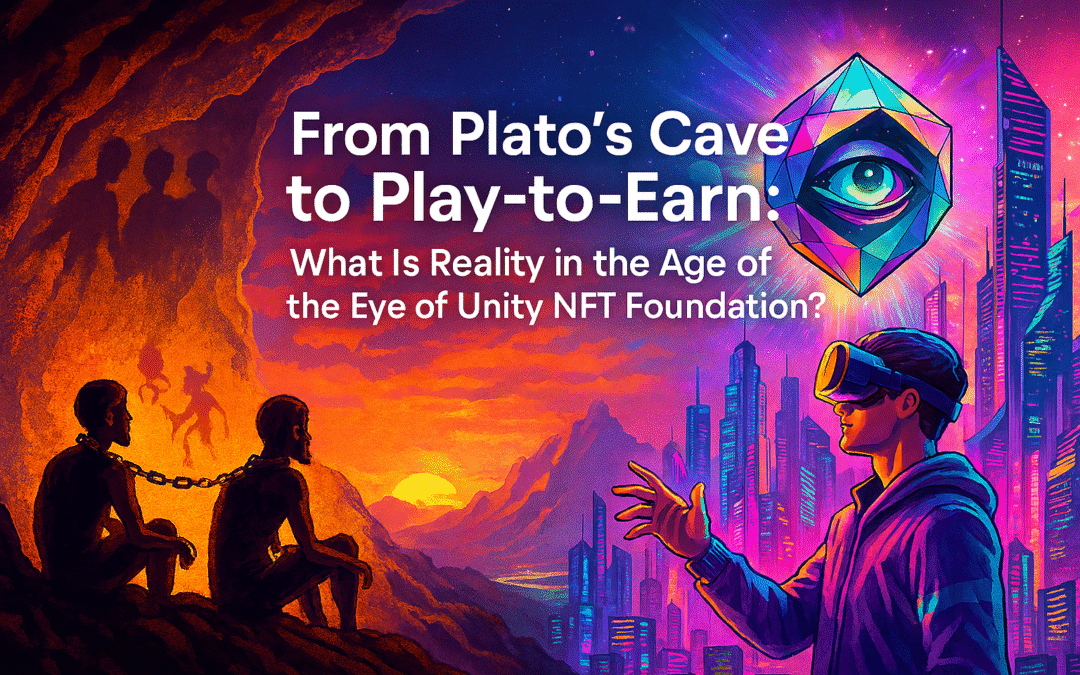
Introduction: Peeking Behind the Curtain of Reality—With a DAO Twist
Reality! Is it a concrete slab beneath our feet, the flickering shadows of Plato’s cave, or an open-source algorithm running atop a blockchain node in some grand cosmic metaverse? For millennia, philosophers have endlessly debated the true fabric of existence. Now, the digital age—and the wild, wonderful Web3 movement—invites us to remix this age-old question with new metaphors, technical marvels, and platforms that don’t just speculate about alternate realities, but actively build them.
Enter the Eye of Unity NFT Foundation: a nonprofit, community-powered DAO and technical playground where cryptocurrency, game theory, art, and social activism converge. Here, blockchains mediate value, art pulses with dynamic metadata, and governance is cast not by oligarchs but by the collective. More than collectibles, Eye of Unity crafts “living NFTs” that serve as portals for both inner discovery and global action.
If reality is a game, Eye of Unity is not a player on the sidelines—it’s rewriting the rules, inviting anyone with curiosity and an internet connection to mint, build, vote, and shape worlds. But what does this actually mean for the metaphysics of reality? And how do technologies like blockchain, NFTs, and DAOs inform—perhaps even redefine—our collective grip on the “real”?
Let’s dive into a playful, mind-bending expedition that weaves together the deepest philosophical puzzles, the most rigorous scientific models, and the ingenious, optimistic engineering at the core of the Eye of Unity.
1. What Is Reality Anyway? Three Pillars, Infinite Games
The Classical Philosophical Foundations
When you ask “What is real?” philosophers offer three enduring worldviews:
- Physicalism (Objectivism): The real is matter—energy, particles, quantum fields—the stuff measured by science and built upon the bedrock of physics. Think Sean Carroll’s “Poetic Naturalism,” where reality is complex, but thoroughly physical—your cat is real (even if it’s not fundamental), and reality’s layers emerge from quarks to culture.
- Idealism (Subjectivism): The real, say thinkers like Bernardo Kastrup and Donald Hoffman, is consciousness itself. The universe is a mind or a set of minds; matter is a “user interface” for perception, not a hard external thing in itself.
- Social Constructionism (Intersubjectivism): Reality is forged in the crucible of language, agreement, and shared meaning. Kenneth Gergen and Jacques Derrida argue that what counts as real is shaped, inescapably, by negotiation, narrative, and community.
These are not mere academic subtleties: our digital tools, platforms, and protocols—especially those running on the blockchain—uniquely entangle all three. When you mint an NFT in Eye of Unity, you’re engaging physical infrastructure, subjective perception, and communal consensus coded into smart contracts.
Scientific Models: The Universe as Process, Information, or Simulation?
Contemporary science zooms in further:
- Quantum Mechanics insists upon fleeting, probabilistic quantum fluctuations as the base layer of reality—reminding us that, even at the most “fundamental,” the universe is weird, dynamic, and not entirely “solid.”
- Cosmology and Information Theory: Thinkers like Melvin Vopson posit that information—not just matter or energy—may be the most fundamental aspect of existence.
- The Simulation Hypothesis: Popularized by Nick Bostrom, this idea suggests we might be characters in a colossal computer simulation; in a sense, reality is code, and we are avatars—not unlike your favorite NFT.
Social Construction: We Build the World, Together
Every game, economy, or social system—even in Web3—runs on consensus. Money is real because enough of us agree it’s real. NFTs and DAOs take this a step further: they make consensus, rules, and provenance transparent and programmable.
This web of physical, mental, and social processes is not theoretical in the blockchain era. Projects like Eye of Unity put them on-chain, out in the open, and in play.
2. Consciousness: The User Interface to Reality (and Reality as an Interface)
The “Hard Problem” Stumpers
Why do we have first-person experiences? David Chalmers called this the hard problem of consciousness—that is, why does a blob of neurons produce “what it’s like” to be me (or you, or a virtual avatar)?
Contemporary theory splits on consciousness:
- Physicalists want to explain it by neuron circuits and evolutionary complexity.
- Idealists (like Donald Hoffman) posit that consciousness is the base layer, and “reality” is a mental construct, an evolved user interface for survival.
- Panpsychists suggest consciousness, in some form, is fundamental to everything—call it proto-consciousness.
Perception as Interface: Hoffman’s Theory
Hoffman’s “Interface Theory of Perception” casts our sensory world as a desktop OSC—an evolved interface for navigating fitness payoffs, not objective reality. We perceive the “icon,” not the raw code.
This elegantly aligns with NFTs: on a blockchain, metadata and provenance are the interface—what you see is only part of the story; the real magic lies in the coded protocols, interactions, and communal rules running “under the hood.”
Constructionism: Reality As a Network of Meanings
What we perceive as real is always filtered through culture, language, and inherited bias. Every NFT collection, Discord community, or blockchain protocol is both a set of coded rules and a social story—its “realness” negotiated in every forum post and group vote.
3. The Blockchain as Metaphysics: Eye of Unity and the Encoding of Trust
3.1 The Blockchain: From Abstract Ledger to Digital Ontology
Blockchain technology is not just a database. It is, as some philosophers argue, a notational ontology—that is, a protocol for creating, maintaining, and managing digital representations of assets, agreements, and even personalities. Each NFT or smart contract encodes a narrative of provenance, authorship, and value that is cryptographically irrefutable and socially legible.
In platforms like Eye of Unity, this system becomes “reality” for participants. Experiences, possessions, and even identities are minted, verified, and traded on-chain.
3.2 Narrative Ontologies: Story-Coding the Social World
Philosophers like Ricoeur and Fisher have shown how storytelling creates reality—the difference being that blockchain narratives are now executable code. In Eye of Unity, each NFT is not just a JPEG or in-game sword, but a story with a traceable chain of author, owner, and lore changes—the social construction of meaning formalized in digital provenance and metadata.
3.3 DAOs: Decentralizing Governance, Encoding Ethics
A DAO (Decentralized Autonomous Organization) is an open-source, smart-contract-based system where rules, voting, and funds are all on-chain. In the Eye of Unity, DAO governance models are not just administrative abstractions, but living systems that produce trust, distribute power, and shape collective decision-making in real time.
Quadratic voting, snapshot audits, community grants—all these tools code the “democracy” of the platform, updating what counts as reality for all members.
4. Eye of Unity NFT Foundation: Building Reality With Artists, Engineers, and Dreamers
4.1 What is Eye of Unity? A Metaphysical Overview
Eye of Unity is:
- A nonprofit DAO where surplus revenue from NFTs, games, and donations is always recycled into community projects, rewards, grants, and on-the-ground good.
- A blockchain platform spanning Ethereum, Polygon, Solana, and Avalanche—enabling cross-chain NFT creation, play, and trade.
- A game, a story, and a creative studio, where NFTs are not static images, but living artifacts—they can level up, evolve, or unlock lore, AR, and VR experiences based on player actions.
4.2 Symbolism: Mystic Codes for the Digital Age
Eye of Unity infuses its creative output with an eclectic, syncretic mythology spanning Egypt, Mesopotamia, Tarot, and pixel art—a living digital mythos where art is more than just “artwork,” but an evolving, interactive vessel for story, identity, and collective belonging.
NFTs are:
- Avatars you can use across games and platforms.
- Weapons, pets, Tarot cards—each with game mechanics, dynamic powerups, and sometimes even generative upgrades that respond to in-game or real-world events.
4.3 Dynamic, Evolvable NFTs: Artifacts That “Play Back”
Unlike old-school collectibles, Eye of Unity NFTs feature programmable dynamic metadata—they can change appearance, powers, and lore based on gameplay, time, or social engagement. Imagine a piece of art that grows and shape-shifts as players solve mysteries, or a sword that gains new attributes after each boss or DAO event.
| Classic NFTs | Dynamic NFTs (Eye of Unity, etc.) |
|---|---|
| Static image, fixed | Metadata updates over time |
| Art, simple profile | Interactive, responsive to user actions |
| Collectible | Playable, upgradable, narrative-evolving |
These “living assets” are metaphysically provocative—are they “art,” “game,” or “identity”? They’re all—and more.
4.4 Cross-Chain Interoperability: The Multiverse Dream
Eye of Unity doesn’t just mint on one blockchain; with EVM and non-EVM asset bridges, avatars, weapons, property, and tokens move fluidly between Ethereum, Polygon, Solana, Avalanche, and more. NFTs become universal passport-keys, carrying player reputation, abilities, and lore across games and communities—a metaverse staple.
| Chain | Feature | Eye of Unity Integration |
|---|---|---|
| Polygon | Eco-friendly, fast NFT mint/trade | Core daily mints |
| Solana | Scalable, low-cost, AR/VR support | Game, ATM, new user onramp |
| Ethereum | Wide ecosystem, DeFi/DAO apps | DAO governance, deep liquidity |
| Avalanche | Speed, green chains, NFT expansions | Future DAO votes |
4.5 Frictionless Minting: NFTs for Everyone, Everywhere
Minting an NFT in Eye of Unity is as easy as clicking a link. New users often pay $0 in gas, with the Foundation swallowing costs for global community drops and events. Solar-powered NFT ATMs are deployed in Nigeria, India, and Brazil, allowing first-timers to mint digital assets in local pop-up installations.
4.6 Producer Power: “Play-for-Good” Model and Perpetual Royalties
Every Eye of Unity NFT sale, trade, or game unlock funnels royalties back to the Foundation, which are redistributed to fund green energy, art grants, education, and charity projects. Artists choose their royalty rates (1–10%) and receive passive income for every secondary sale—redefining what it means to “own” or create value.
5. Games, Governance, and Green Energy: Eye of Unity’s Technological Wizardry
5.1 NFT Indexing, Layer-2 Scaling, and Event-Driven Architecture
Eye of Unity games are optimized for scale and minimal environmental impact. The engine batch-indexes game and trading events off-chain and settles only essential changes on-chain. Layer-2 rollups reduce gas and carbon cost by 95–99%. Cross-game and cross-chain APIs enable assets and identities to move seamlessly between worlds.
| Technology | Purpose | Impact |
|---|---|---|
| Batch NFT Indexing | Aggregate state changes off-chain | Lowers fees, carbon, latency |
| Proof of Stake | Consensus, security, green energy | >99.9% less power than PoW |
| Solar NFT ATMs | Physical onramps to digital assets | Empowers underserved communities |
| Dynamic Metadata | Responsive, upgradable NFTs | Playable, user-driven evolution |
5.2 DAO Governance: Quadratic Voting, True Decentralization
Gone are the days of “whale” domination. In Eye of Unity, everyone—regardless of token stake—can propose and vote on new games, loot drops, expansions, or funding for a village solar farm. Quadratic voting empowers new voices, challenge periods prevent errors, and all decisions are transparently auditable.
5.3 Social Impact and Sustainability
Every time you win a battle, unlock a level, or trade an NFT, something good happens in the real world. The Eye of Unity Foundation funds tree-planting, school programs, renewable energy, and makerspace workshops—in-game rewards triggering actual-earth impact.
5.4 Perpetual Royalties and Revenue Loops
The economic engine is ingenious: every NFT trade (even secondary sales) pays a perpetual royalty to both creator and the Foundation, generating resources for growth even if crypto prices tank. The pie is always growing, with surplus funds funneled into:
- Community infrastructure (solar NFT ATMs, digital hubs)
- Tech R&D (smarter contracts, VR development)
- Storytelling and educational grants
Budgets are published on-chain, with all costs and payouts fully transparent.
6. Eye of Unity’s Living Universe: Case Studies and Playful Phenomena
6.1 The Pacman NFT Collection: Retro Magic, On-Chain Lore
The Pacman NFT Collection consists of 20,000 generative avatars, each doubling as an access pass to blockchain-hosted Pacman games. Buy one and you unlock not just pixelated nostalgia, but exclusive interactive game sessions, with all assets and rewards stored on Filecoin and Polygon for permanent, decentralized provenance.
6.2 The Champions NFT Collection: Slimes, Minigames, Artful Play
Another collection, The Champions, offers animated generative NFTs with in-built minigames and VR support. Traits, helmets, and attributes are upgradeable via gameplay and community lore—each asset a “living” bundle of art, identity, and interactive power.
6.3 FlipSuite: Discord as DAO Gameboard
FlipSuite is an all-in-one Discord Web3 suite, turning chatrooms into arenas for earning tokens, scoring NFTs, entering prize draws, and managing cross-chain wallets—no browser extension needed. Every tip, airdrop, or battle royale is immutably registered on-chain, gamifying participation and reward.
7. Reality, Redefined: Lessons from the Eye of Unity Metaverse
7.1 What Eye of Unity Teaches About Reality
- Reality is Participatory: If “to play is to be,” then co-creation—the heart of NFT and DAO culture—reminds us that reality is not imposed, but achieved through action, consensus, and narrative.
- Consensus IS Truth: In decentralized platforms, value, ownership, and even governance are “real” exactly because the code and the community agree it is so—a programmable social contract.
- Layered Realities Co-Exist: Physical/world events, digital artifacts, and shared mythologies interpenetrate. NFTs, like mythic relics, carry stories, rights, and power between worlds.
- Provenance Is the New Church of Ownership: On-chain records mean that history, authorship, and rights are not whispers or paper trails—they are as immutable as math.
- Sustainability and Inclusion: Rethinking energy, money, and play for the digital age, Eye of Unity demonstrates that new systems can be both inclusive and ecologically sensitive, designed for planetary benefit as much as for profit.
7.2 Critiques and Challenges
While Eye of Unity’s vision is genuinely progressive, some challenges and unresolved tensions remain:
- Market Volatility can affect the real-world funding of projects, though rooted perpetual royalties buffer impacts.
- User Experience and Onboarding: Even with frictionless mints, blockchain technology remains intimidating for many; educational outreach is critical.
- Power Dynamics: DAOs, despite anti-whale mechanisms, must vigilantly defend against centralization, apathy, or manipulation.
- Philosophical Limits: Digital realities don’t dissolve the “hard problem” of consciousness, nor the possibility that deeper, stranger metaphysical truths await beneath the blockchain’s elegant shells.
Conclusion: The Infinite Game—Reality as Protocol, Play, and Community
The once-unbridgeable chasm between metaphysical speculation and concrete engineering is closing. In the Eye of Unity, philosophical frameworks, scientific models, and cutting-edge protocols are not simply academic—they are lived, enacted, and minted into new realities. Here, reality is not a solitary puzzle to be decoded, but a multiplayer adventure to be built, explored, and reinvented.
Whether or not we are avatars in some cosmic simulation, we now possess the tools and stories to build universes of our own—coded, governed, and evolved in common. And if every NFT, every DAO vote, every story told in Discord, is a kind of reality-layer, then Eye of Unity’s greatest magic is not in pixels or protocols, but in its invitation: Reality is what we make of it, together. Game on for good.
System Ent Corp Sponsored Spotify Music Playlists:
https://systementcorp.com/matchfy
Other Websites:
https://discord.gg/eyeofunity
https://opensea.io/eyeofunity/galleries
https://rarible.com/eyeofunity
https://magiceden.io/u/eyeofunity
https://suno.com/@eyeofunity
https://oncyber.io/eyeofunity
https://meteyeverse.com
https://00arcade.com
https://0arcade.com