Introduction: Picture the Universe as a Cosmic Egg
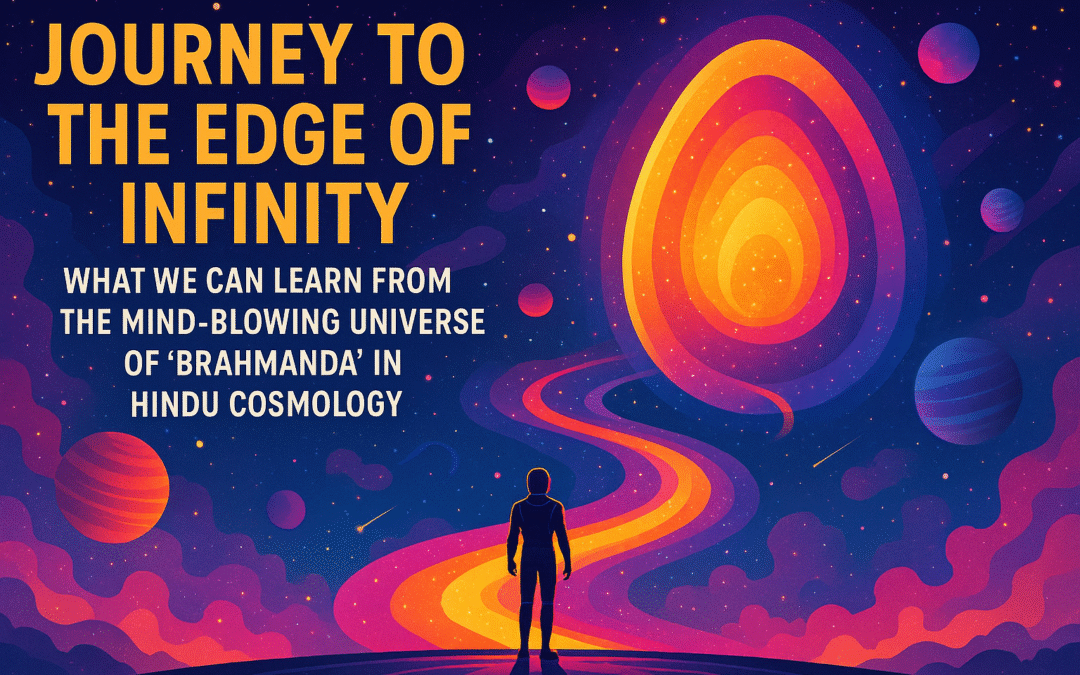
Imagine, for a moment, if the entire universe—galaxies spinning, comets zooming, suns blazing, and even the realms of gods and demons—were all nestled inside a gigantic, radiant egg. An egg that pulses with infinite potential, boundless in its vastness, yet sublime in its symmetry. Welcome to the magical, mind-expanding concept of Brahmanda, Hinduism’s quintessential vision of the cosmos. Much more than a piece of abstract philosophy, Brahmanda paints a tapestry where myth meets mathematics, spirituality meets science, and art, architecture, and everyday ritual all shimmer with cosmic purpose.
Ready to crack open the egg? Let’s embark on a journey through infinity, swirling through ancient Sanskrit, cosmic eggs, world-mountains, cycles of time, and even a sneak peek at parallels in modern science—all from a truly grand Hindu point of view.
The Etymology and Birth of ‘Brahmanda’: Where Words Hatch Worlds
The word Brahmanda is a clever mashup of two Sanskrit terms: “Brahman,” meaning the supreme cosmic spirit or ultimate reality, and “anda,” meaning egg or sphere. So, literally, Brahmanda is the “cosmic egg”—but it’s so much more than a breakfast metaphor! In Hindu cosmology, Brahman represents the infinite, formless source of everything, while the egg (anda) signifies the encapsulation of all the universe, a vessel of unlimited potential.
The story of the cosmic egg first sparkles in the Rigveda’s famous Hiranyagarbha Sukta, “Hiranya” meaning golden, and “garbha” for womb or embryo: the golden womb. This hymn, more than three millennia old, conjures a vision where, before there was anything—before time, space or matter—a resplendent golden “egg” floats in the cosmic waters, bursting silently with the seed of existence. From this egg, all of the universe unfurls. The later Puranas, like the illustrious Brahmanda Purana, anchor this myth by explicitly describing the Brahmanda as the source, shelter, and stage for all cosmic drama to play out.
The Cosmic Egg in Context: A Cross-Cultural Motif
Hold up—did you know the cosmic egg isn’t just a Hindu idea? It’s a recurring image in many world cultures:
- Greek Orphic traditions: The Orphic Egg hatches Phanes, a primordial god of creation.
- Chinese mythology: The universe is born from a cosmic egg, split by Pangu, whose body becomes heaven and earth.
- Dogon people of Africa: Amma, the creator, starts as an egg divided into the four elements and the cardinal directions.
- Finnish epic Kalevala: The world is made from fragments of a broken egg.
- Egyptian, Zoroastrian, and Mayan cosmologies also feature cosmic-egg myths.
But Hinduism injects unique philosophical depth: here, the cosmic egg is both literal and symbolic—a stunning metaphor and a physical cosmological principle rolled into one.
Brahmanda in Hindu Cosmology: The Universe as a Living, Layered Egg
Structure of the Brahmanda: Fourteen Lokas, Seven Lokas Up, Seven Lokas Down
So, what exactly is inside the cosmic egg? According to the ancient texts, the Brahmanda isn’t a simple sphere—it’s a multi-storey mansion where every floor and basement is a whole domain of existence.
Here’s the classic cosmological floor plan, each realm called a “loka”:
| Level | Loka / Realm Name | Description |
|---|---|---|
| 14th (top) | Satya/Brahmaloka | Abode of Brahma (Truth, ultimate liberation) |
| 13th | Tapaloka | Realm of great sages, ascetic wisdom |
| 12th | Janaloka | World of divine sages, creative intellect |
| 11th | Maharloka | Home to enlightened seers, long-lived rishis |
| 10th | Svarloka | Svarga or Indra’s Heaven, luxury and bliss |
| 9th | Bhuvarloka | Region between Sun and Earth, spirits reside |
| 8th (middle) | Bhuloka | Physical Earth (our familiar home) |
| ———— | ——————- | ———————————————- |
| 7th | Atala | The first lower world (Patala) |
| 6th | Vitala | Next lower world, demonic realms |
| 5th | Sutala | Ruled by king Bali – a paradise among nether |
| 4th | Talatala | World of the demonic architect Maya |
| 3rd | Mahatala | Home to Nagas (divine serpents) |
| 2nd | Rasatala | Abode of Danavas (another class of demons) |
| 1st (bottom) | Patala (Nagaloka) | Depths of the underworld, Vasuki the serpent |
Upper 7: The spiritual and moral “heavens”—Satya Loka at the top, Bhu Loka (Earth) in the middle.
Lower 7: The “netherworlds” or “underworlds,” known collectively as Patalas—not hell in the Christian sense, but realms of mystery, luxury, or challenge.
And it’s all wrapped—per the Puranas—in concentric cosmic shells of the elements, until the entire Brahmanda is cocooned in a sevenfold barrier, “each layer ten times the thickness of the previous,” as described in Srimad Bhagavatam.
What Holds It All Together? Mount Meru: The Cosmic Axis
At the very center of the cosmic egg stands the legendary Mount Meru, a soaring pillar connecting all realms—the literal and metaphysical axis mundi. According to the Vishnu Purana, this golden mountain rises from the very heart of the Brahmanda, surrounded by mythical rivers, sacred islands, and continents.
Mount Meru isn’t just myth: it’s a master metaphor for spiritual ascent, cosmic order, and the link between the mortal and the divine. Ancient Hindu (and Buddhist, Jain) temples across India, Southeast Asia, and beyond echo Meru’s geometry—a harmonious model of the universe in stone.
Brahmanda Purana: The Epic of Creation and Cosmological Wisdom
No discussion of Brahmanda is complete without the Brahmanda Purana—the ancient Sanskrit scripture that takes the cosmic egg from a poetic idea to a dazzling system. Considered one of the oldest and most encyclopedic Puranas, it covers everything from creation stories and structure of universes, to cycles of time, geography, yogic techniques, genealogies, and even architectural blueprints for temples.
Major Themes in the Brahmanda Purana
Creation and Cosmology. The Purana unspools detailed narratives of how the universe emerges from the cosmic egg—Brahma awakes, seated on a lotus sprouting from Vishnu’s navel, and starts the act of the universe, from fundamental elements to gods, demons, humans, and animals.
Genealogy and Myths. The text gives elaborate family trees of gods, rishis, and kings, weaving human history into cosmic destiny.
Sacred Geography. Not just philosophy, but maps! The Purana describes Jambudvipa (the central “continent”), Mount Meru, the rivers, and places of pilgrimage—melding the spiritual map of India with cosmic structure.
Ritual and Devotion. From the epic Lalita Sahasranama (hymn of 1,000 names of the goddess Lalita) to descriptions of ceremonies and dharma, the Purana details both transcendental philosophy and down-to-earth religious life.
Yuga Cycles & Temporal Framework. The Purana’s treatment of time is deliciously vast—millions and billions of years, with cosmic creation and destruction cycling endlessly, each epoch called a kalpa or manvantara.
Multiverse and Parallel Universes. The Brahmanda Purana goes meta: it describes multiple Brahmandas—countless cosmic eggs—each holding their own creator, preserver, destroyer, lifeforms, and cycles of rise and dissolution. Modern physicists, are you listening?
Hiranyagarbha: The “Golden Embryo” and the Dawn of Existence
Let’s rewind: way before the universe took shape, before Brahma, the Trimurti, or any cosmic egg, there was Hiranyagarbha, the “golden womb” or “golden seed.” As invoked in the Rigveda (10.121), Hiranyagarbha is the radiant egg floating on the cosmic waters, an archetype that sparkles through many Upanishads and later literature.
The metaphysics here are profound: Hiranyagarbha is not just some proto-god or proto-matter, but the seed of consciousness and creative power—the intermediary state of infinite possibility before the manifest forms of gods, elements, and beings. The golden egg splits, and duality—heaven and earth, mind and matter—is born. This moment is celebrated as the point where the One becomes many, the archetype of all cycles of birth, death, and renewal.
The Fourteen Lokas of the Universe: Realms for Every Level of Consciousness
The Puranic worldview is cosmic in scale and intricate in detail: the 14 Lokas structure both the universe and the individual consciousness.
Let’s zoom in on each:
Seven Higher Realms:
- Satya/Brahmaloka: Realm of Brahma, final liberation.
- Tapaloka: For ascetics and sages; pure contemplation.
- Janaloka: Home of divine sages (Kumaras, Sanaka, etc.).
- Maharloka: Abode of advanced rishis.
- Svarloka (Svarga): Heaven, ruled by Indra; a place of reward, pleasure.
- Bhuvarloka: In-between; spirits, celestial beings.
- Bhuloka: The Earth, the field of karma and action.
Seven Lower Realms (Patalas):
8. Atala: Illusions and pleasures.
9. Vitala: Wealth, indulgence.
10. Sutala: Bali’s paradise—luxury with humility.
11. Talatala: Illusion, sorcery.
12. Mahatala: Nagas’ (serpent) realm.
13. Rasatala: Demonic beings, darkness.
14. Patala/Nagaloka: Deepest, with Vasuki; sometimes depicted as opulent!
These aren’t places of absolute reward or punishment, but states of being—each representing different levels of spiritual awareness, truth, illusion, reward, and ignorance. They are also mapped onto the subtle body and consciousness—Brahmanda is not just out there, but in you.
Mount Meru: Cosmic Axis, Sacred Mountain, and Mandala of the Universe
Ever wondered why so many Hindu—and Buddhist, and even Angkor Wat in Cambodia—temples rise like tiered mountains? They’re all riffing on the cosmic Mount Meru, the navel of Brahmanda.
- Physical and Mythical Center: Rooted in the deepest primordial waters, Meru soars to the zenith, connecting all 14 worlds. Its peak is the golden summit, its slopes the abode of devas, rishis, and celestial beings.
- Art and Architecture: Hindu temple spires imitate Meru’s form—a constant reminder that the divine is both above and within. The sacred architecture—even the temple’s floor-plan—mirrors the universe’s geometry, harmonizing cosmic order with earthly experience.
- Symbol of Ascent: The climb up Meru echoes the journey from ignorance (base) to liberation (summit)—a spiritual roadmap encoded in every sanctum.
The Trimurti: Brahma, Vishnu, and Shiva—Cosmic Choreographers of the Brahmanda
Inside every Brahmanda, the cosmic show is run by three star performers: the Trimurti.
- Brahma—The Creator: Emerges first, conjures the worlds, the lokas, and the beings. Sits atop a lotus, four heads gazing in all directions (symbolizing the four Vedas).
- Vishnu—The Preserver: Perpetually maintains balance, incarnates as avatars whenever dharma is in peril (think Rama, Krishna).
- Shiva—The Destroyer/Transformer: Destroys illusions, dissolves worlds at each cosmic night (pralaya), only to make way for creative renewal.
These are not rival gods, but cosmic functions—the constant cycling of creation, sustenance, and dissolution, beautifully modeled in the endless expansion and contraction of countless Brahmandas.
Cycles of Time: Yuga, Manvantara, Kalpa — The Hindu “Time Machine”
Hindu cosmology doesn’t just map space—it sculpts time into cosmic cycles like no other civilization. Time here is emphatically cyclical, with repeating epochs called Yugas, grouped into Manvantaras and Kalpas, forming the days and years of the creator Brahma.
Yuga Cycles
| Yuga | Divine Years | Human Years | Attributes |
|---|---|---|---|
| Satya (Krita) | 4,000 | 1,440,000 | Truth, purity, dharma |
| Treta | 3,000 | 1,080,000 | Rituals, beginnings of decline |
| Dvapara | 2,000 | 720,000 | Duality, conflict, waning dharma |
| Kali | 1,000 | 360,000 | Discord, spiritual darkness |
One full cycle = 4.32 million years (a Maha-yuga). Seventy-one Maha-yugas make one Manvantara, fourteen Manvantaras build a day in Brahma’s life—a “kalpa” of 4.32 billion years. Brahma’s life? A whopping 100 years—311 trillion human years. Talk about long-term planning!
Why Cyclical Time?
This cosmic clock reminds us: nothing is permanent, renewal follows decay, and liberation — moksha — is always possible, at any point in the cycle. It also mirrors the cycles of nature, of history, of self-improvement, and even echoes recent Big Bang–Big Crunch theories in modern cosmology.
Brahmanda in Art, Architecture, and Rituals: Living Temples of the Cosmos
Sacred Geometry and Temple Construction
Ever noticed how Hindu temples have towering spires and floor patterns radiating like mandalas? That’s Brahmanda encoded in stone!
- Shikhara / Vimana: The temple’s spire symbolizes Mount Meru; its tiers represent overlapping realms (lokas).
- Garbhagriha (sanctum): The innermost sanctum is the “womb” or “seed”—garbha—a direct echo of Hiranyagarbha, the golden embryo.
- Mandala/Mandapa: The temple’s plan is ritual geometry, aligning the human, natural, and divine.
These patterns foster a sense of “axis mundi”—walking to the sanctum is ascending the cosmic mountain.
Symbolism in Sculpture and Iconography
Statues of Brahma, Vishnu, Shiva, and the Goddess, as well as cosmic lotus motifs, churning oceans, and multi-headed serpents, all echo elements of the Brahmanda mythos.
- Brahma: Four-headed, often on a lotus, holding scepter, Vedas, and a water pot—emblems of knowledge and creativity.
- Vishnu reclining on Ananta: On the serpent in the cosmic ocean, with the lotus rising from his navel.
- Shiva dancing the Tandava: Performing the cosmic rhythm of creation and destruction.
Ritual Timekeeping: Yugas in Action
Major Hindu rituals and festivals—Maha Shivaratri, Holi, Diwali, Navaratri—are timed to cosmological cycles, and some temple ceremonies replicate the creation cycles of Brahmanda in their liturgies.
The Cosmic Egg vs. Modern Science: Multiverses, Big Bangs, and Infinite Bubbles
Is the Brahmanda just an ancient fairy tale, or is there a hidden echo of truth that modern science is only now catching up with?
- Big Bang: A singularity, an instant of infinite “egg-like” density, erupting into space-time.
- Cycles in Modern Cosmology: Recent Big Crunch and Big Bounce theories posit cyclical universes swelling and shrinking endlessly—no beginning, no end, but endless renewal.
- Parallel Universes: The Puranas’ vision of “innumerable Brahmandas,” each with its own gods, time, and physical laws, strikingly prefigures the modern “multiverse” hypothesis.
As one physicist put it: “Modern cosmology is starting to sound a lot like ancient metaphysics.”
Brahmanda’s Cultural Legacy: Deeper Than Myth, Wider Than Science
Festivals and Practices
Brahmanda’s principles aren’t just meditated upon; they’re performed and celebrated:
- Temple rituals align with cosmic cycles.
- Festival myths (Diwali, Navaratri, Holi, etc.) reenact creation, the triumph of dharma, and cosmic renewal.
- Stories of the gods—Vishnu’s avatars, Shiva’s cosmic dances, Brahma’s acts of creation—all unfold within the spatial and temporal bigness of Brahmanda.
Philosophy and Spirituality
The cosmic egg is not only the outside universe but echoes the microcosm within. Philosophies like Vedanta and Yoga teach that the Atman (individual soul) is a reflection of Brahman—and the journey within is the journey to the center of Brahmanda.
From Upanishads to modern swamis, the message is clear: You are the universe; the universe is you. Know the Brahmanda, and you’re halfway to enlightenment.
Comparative Mythology: The Cosmic Egg Across the World
Hindu thinkers stand in good company: cosmic egg myths span the world—from Greece (the Orphic Egg) to China (Pangu), from Egypt (Ogdoad and primordial egg) to West Africa (Dogon’s Amma). But Hinduism laces the egg with an interplay of time, karma, cycles, and cosmic functions, bridging the gap between philosophical abstraction and lived experience, science and spirituality, metaphysics and architecture.
Conclusion: The Brahmanda as Wonder, Wisdom, and Way of Life
To stroll through the cosmic garden of Hindu imagination is to stand in awe of the Brahmanda—the universe that is at once an egg and an endless sea of egg-universes, a place where the cycles of time, the dance of gods, the rise and fall of galaxies, and the quest for self-knowledge all interlace seamlessly.
Brahmanda is not a static artifact of dogma but a living theory—embodied in temples, sung in hymns, mapped in rituals, and pondered in philosophy. It invites everyone, believer and skeptic alike, to embrace the possibility that the cosmos, seen and unseen, is as much a reflection of consciousness as it is a mystery to be scientifically explored.
So the next time you crack open an egg for breakfast, pause. The ancient rishis invite you to see, in that fragile shell, the glimmer of infinity and the wonder of creation waiting to hatch again, and again, and again.
Explore more:
- Discovering Brahmanda: The Vastness of Hindu Cosmology
- Hiranyagarbha: The Golden Egg in Myth and Philosophy
- Mount Meru: The Cosmic Axis
- Brahmanda Purana Complete English Text
- Multiverse Concepts in Hinduism
- Iconography and Symbolism in Temple Architecture
- Comparative Cosmic Egg Theories
System Ent Corp Sponsored Spotify Music Playlists:
https://systementcorp.com/matchfy
Other Websites:
https://discord.gg/eyeofunity
https://opensea.io/eyeofunity/galleries
https://rarible.com/eyeofunity
https://magiceden.io/u/eyeofunity
https://suno.com/@eyeofunity
https://oncyber.io/eyeofunity
https://meteyeverse.com
https://00arcade.com
https://0arcade.com