
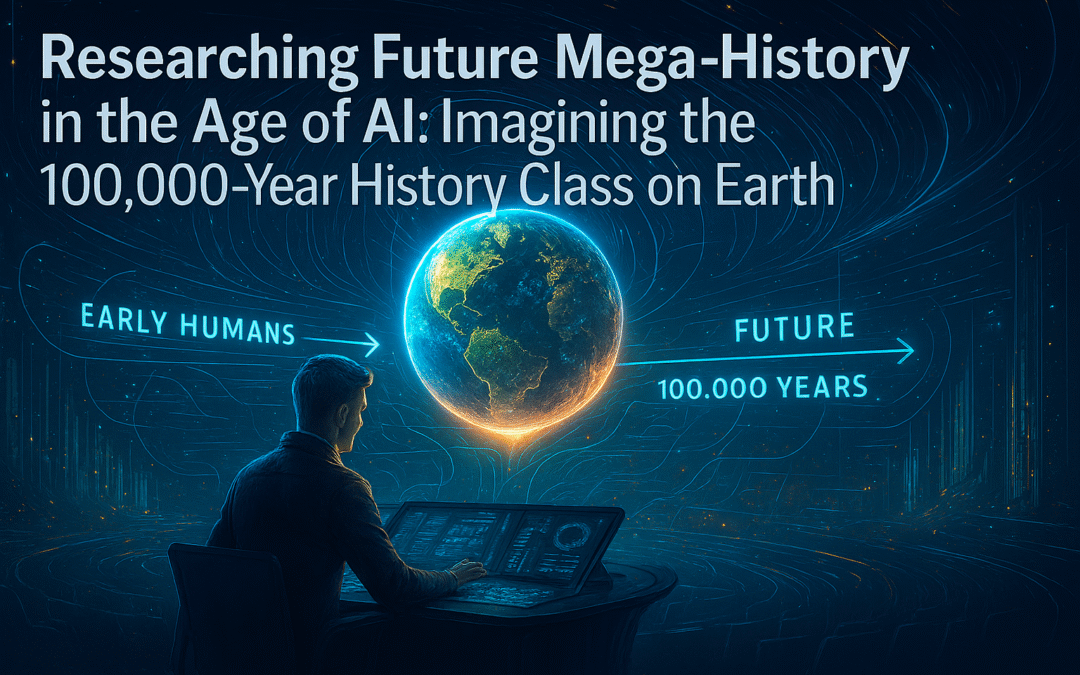
Introduction: Welcome to Mega-History Class!
What if your next history lesson didn’t just cover the Age of Revolutions, the Ancient Greeks, or even the earliest written civilizations—what if it blasted off all the way back to humanity’s origins, and beyond, spanning 100,000 years of the human experience?
Picture this: You walk into class, and instead of a teacher handing out a timeline that starts at 3,000 BCE, an interactive wall-sized 3D map unfurls. It reveals the migration trails of early Homo sapiens, the first cave paintings, the ice ages, the rise and fall of empires, all the way up to AI’s own meteoric ascent. Voices and faces from across the millennia come alive—not just as words on paper, but as digital beings you can question and debate.
The task: to teach, organize, and make sense of a timeline so dizzying in scope that it would tie any ordinary curriculum in knots.
That’s where artificial intelligence (AI) enters stage left, not as a magic fix, but as an ingenious partner—capable of organizing, personalizing, and visualizing the wild sweep of the human story in ways that would make even the most ambitious educators’ heads spin. This article explores, with humor and awe, how such a Mega-History class might work in the AI age, what wonders it could offer, and the dazzling suite of tech that’s already changing the game.
Imagining a 100,000-Year History Class: The Ultimate Deep Time Adventure
A “Mega-History” Curriculum: What Would It Cover?
First, let’s grasp the audacious scale of this project. 100,000 years encompasses:
- The emergence, migration, and adaptation of anatomically modern humans
- All of prehistory and protohistory, including vanished civilizations with no written record
- The dawn and explosion of agriculture, cities, religions, and empires
- The technological leaps: stone, bronze, iron, steam, electricity, information, and now AI
- Global interconnectedness, wars, plagues, revolutions, and restructurings
- The rise of digital civilizations, climate change, and the Anthropocene
Trying to capture all of this using traditional educational methods—chalk, talk, and textbooks—would be like playing 100 hours of Netflix at 5x speed. Students would spin out! Instead, a Mega-History class would need to become an immersive, interactive, and highly adaptable journey.
“Deep Time” and “Big History”: Shifting Our Perception
Conventional history classes stick close to what’s familiar: the “ancients” (e.g., Egypt, Greece, Rome), followed by medieval Europe, then “modern” times. But “deep time” and “Big History” provide radical new organizing principles. They connect the dots from 13.8 billion years ago (the universe’s birth) to today, weaving together geology, biodiversity, climate shifts, and the uniquely human saga.
Some schools and educators, inspired by projects like The Big History Project, are already experimenting with this approach—helping students develop wide worldviews, appreciate cross-disciplinary links, and see humanity as part of a much vaster cosmic story.
The Pedagogical Challenge: Teaching Deep Time Without Blowing Minds
Why Teaching 100,000 Years is So Difficult (and Exciting!)
The sheer volume of content—and gaps in the record—makes “deep time” intimidating for students and instructors alike:
- Chronological scale: It’s tough for anyone (not just kids!) to picture an event from 50,000 years ago or to differentiate between “really old” and “ancient”.
- Uneven evidence: Earlier periods rely mostly on archaeology and indigenous oral traditions—not neat written sources.
- Global and inclusive: Telling a global story (not just Western civilization) requires integrating Indigenous, African, Asian, and so-called “outsider” perspectives.
- Critical thinking and complexity: Avoiding the temptation to flatten history into a list of “firsts” or “great men” narratives.
Pedagogically, a Mega-History class needs to bridge:
- Scale (“What counts as ancient?”)
- Narrative complexity (“Is there a single storyline, or billions of threads?”)
- Source analysis (“How do we know what we know?”)
Enter Artificial Intelligence: From Content Curation to Student Engagement
Here’s the kicker: AI isn’t about automating teaching (the job of teachers is safe!), but about empowering teachers and students to tackle complexity, customize learning, and visualize timelines in astonishing new ways.
Let’s investigate exactly how.
How Artificial Intelligence Supercharges the Mega-History Classroom
1. Organizing the Chaos: Knowledge Graphs for 100,000 Years
If one of history instruction’s biggest difficulties is keeping track of staggering amounts of content, AI-powered knowledge graphs are the answer.
What is a Knowledge Graph?
A knowledge graph is a vast network of entities (think people, places, events, ideas) and relationships (who influenced whom, what caused what). Google uses a knowledge graph to power its search engine; now, education platforms are employing the same logic to map curriculum.
Why Does This Matter for Mega-History?
- Semantic scaffolding: Maps how the “Neolithic Revolution” connects to “The Anthropocene” or how “fire” leads to “artificial light.”
- Personalized navigation: Students can dig deep into an era, zoom out, or follow thematic threads (gender, technology, migration, religion).
- Dynamic updating: As scholars unearth new evidence (say, a DNA sample from 70,000 years ago), the AI graph updates in real time.
In Practice: Knowledge Graphs in EdTech
- SmythOS and KGCD are among the platforms now offering educators tools to build and maintain adaptive, AI-driven curricular graphs.
- These systems don’t just organize data—they recommend what to teach, when, and adapt as students progress, ensuring logical coherence and improved learning outcomes.
2. AI-Powered Timelines: Making Deep Time Visual and Interactive
Timelines are crucial for grasping scale, cause, and connection—but a 100,000-year timeline is intimidating to create, let alone to use.
The Traditional Timeline Bottleneck…
Imagine fitting early human migration, the Egyptian pyramids, and the invention of the internet on a single physical timeline. Not going to happen.
…and the AI Solution
AI timelines use natural language input (just type “show me key turning points between the Last Glacial Maximum and the present”), powerful visualization engines, and dynamic zoom to create customizable, explorable visual stories.
- Adaptable scale: Zoom from “centuries” to “decades” to “days,” or toggle to spiral and layered views.
- Rich media: Embed images, maps, audio, and even AR/VR content for fully immersive timelines.
- Collaboration: Students can co-create timelines, annotate historical events, or track family or local histories in long-term context.
Examples of AI Timeline Tools
- EdrawMax
- Piktochart
- Tiki-Toki
- ClassVR for AR/VR-infused timelines
These tools are transforming the dry, static timeline into an interactive, collaborative, and visually compelling learning experience.
3. Personalizing the Mega-History Journey: Adaptive and AI-Driven Learning
No two students are alike; some are fascinated by Neanderthal extinction, others by the digital revolution. AI-powered adaptive learning systems promise to customize each student’s experience without adding burden to teachers.
How Does AI Personalization Work?
- Initial assessment: AI evaluates students’ background knowledge and interests.
- Adaptive content delivery: The curriculum automatically serves up readings, videos, challenges, and prompts pegged to each learner’s level, learning style, or curiosity.
- Automated feedback: Real-time feedback encourages revision, deeper analysis, and prompt exploration of gaps.
In Practice: Adaptive Learning Platforms
- Whatfix: Context-sensitive prompts and support for any historical topic.
- EdApp: Offers microlearning based on performance and engagement.
- Knewton Alta: Famous for its continuous data-driven adaptation in math and sciences; similar models are now used for social studies and history.
- Khan Academy’s “Khanmigo”: Delivers personalized recommendations, feedback, and engagement strategies suited to the learner’s pace and progress.
Research-Backed Results
Studies reveal adaptive platforms boost motivation and retention—particularly for low-performing students or those new to the subject. These platforms create more efficient and fair learning journeys, bridging gaps and opening opportunities for deeper exploration.
4. Visualizing and Experiencing Deep Time: XR, VR, and the History Metaverse
Want to walk with early humans out of Africa, travel the Silk Road, or witness the Moon landing? Welcome to AI-powered immersive learning with XR (Extended Reality) and VR (Virtual Reality).
Why VR/XR Matter for History
- Activate historical empathy: Students don’t just read about past lives—they “step into” them, fostering a visceral connection to history.
- Multi-sensory engagement: Interact with historical artifacts, explore archaeological reconstructions, or attend live-simulated events.
- Egalitarian access: VR field trips level the playing field for students unable to travel to distant sites.
Real-World Examples
- The Anne Frank House and The British Museum offer VR experiences that transport students into their historical settings.
- ClassVR allows virtual visits from the Great Wall to Stonehenge, letting students explore “first-person” perspectives that were previously impossible to access.
- “Big History” modules incorporate simulation and participatory activities, blending scientific, anthropological, and historical narratives.
5. AI Storytelling and Gamification: Bringing the Human Story Alive
Storytelling is the beating heart of history. AI is turbocharging storytelling in three critical ways:
- Conversational Agents & Historical Figures AI chatbots, like Hello History, allow students to speak to avatars of Cleopatra, Confucius, or Rosa Parks—each trained on authentic texts, speeches, and context. This deepens engagement and critical analysis.
- Story Generator Platforms Tools such as Magic Story AI and Storybird use AI prompts to help students construct their own stories set in any era, supporting creativity, comprehension, and empathy.
- Gamified History Modules AI enables “branching narrative games,” where students make choices as historical actors and see how the course of history might have changed (counterfactual history).
Why Gamification Works
Gamified, story-driven experiences increase both retention and critical thinking, transforming rote memorization into deep exploration.
Notable Projects
- Minecraft Education includes historical building and scenario modules, supported by AI assistants.
- “Reacting to the Past” (RTTP) role-plays integrate AI-generated scenarios for collaborative decision-making.
6. AI Tools for Source Analysis and Historical Critique
For any truly global Mega-History class, teaching how to read and critique primary sources is paramount. AI now acts as a research assistant that:
- Finds and contextualizes primary and secondary sources with lightning speed (PrimarySourceFinder and Anara)
- Aids in source analysis, highlighting bias, context, and contradictions in historical documents (Primary Source Analyzer)
- Verifies citations and source chains, rooting out error or fabrication.
The Educational Pay-off
Students no longer just gather sources—they analyze them, compare interpretations, and develop critical AI literacy to spot hallucinations and misinformation.
The Mega-Toolbox: Top AI EdTech Platforms in History Education
Here’s a rapid-fire look at standout platforms transforming the Mega-History classroom:
| Platform/App | Key Features | Sample Use Cases | Link |
|---|---|---|---|
| Humy/Hello History | AI-generated chatbots of historical fig. | Students “interview” anyone from Socrates to Mandela | humy.ai |
| ClassVR | Immersive VR field trips and objects | Virtual exploration of global heritage sites | classvr.com |
| MyMap.AI Visualizer | AI timeline and event mapping | Visualizing migrations, empires, revolutions | mymap.ai |
| EdrawMax / Edraw.AI | Timelines, infographics with AI | Create layered, dynamic history timelines | edrawmax.com |
| Khanmigo (Khan Academy) | AI tutor, personalized feedback | Socratic questioning, revision guidance, timely revision | khanacademy.org |
| Quizalize’s ChatGPT | Automated quiz creation and scoring | Formative/summative assessments, personalized quizzes | quizalize.com |
| Diffit for Teachers | Text simplification/modification | Making primary sources accessible across reading levels | diffit.me |
| Microsoft Copilot | Lesson planning, student progress, feedback | Automated curriculum creation, report generation | Microsoft Copilot |
| PrimarySourceFinder | Semantic AI search for sources | Finding and comparing both primary and scholarly sources | primarysourcefinder.com |
In hundreds of districts and universities worldwide, these tools are rapidly moving from the margins to the mainstream.
Ethical and Practical Considerations: Not All That Glitters…
With great AI power comes great responsibility. Fresh challenges arise:
Academic Integrity and Critical Thinking
- AI-generated “hallucinations” (fabricated facts or sources) can trick the unwary.
- Plagiarism risk increases if students simply pass off AI work as their own.
- The wise course: Train students in AI literacy—teaching them to cross-check, validate, and critique AI output for reliability, citing sources properly, and using AI as a thinking partner, not a crutch.
Data Privacy and Security
With more student data flowing through AI systems, robust safeguards are non-negotiable.
- Major platforms like Microsoft Copilot and California State University’s new AI initiative are embedding strong privacy, access, and control protocols.
- National and international frameworks, as championed by the Institute for Ethical AI in Education, stress the principles of transparency, consent, and data minimization.
Equity and Bias
- Digital divides—schools and students without access to high-quality hardware or broadband miss out on the VR/AI revolution.
- Algorithmic bias—AI must be trained on diverse, global, and inclusive historical sources to avoid amplifying prejudices or distorting the narrative.
- Content authenticity—AI tools can generate highly compelling historical “simulations” that are nonetheless fabrications. Students must learn to distinguish between plausible narratives and established realities.
Future Directions: XR, Metaverse, and the Mega-History Classroom of Tomorrow
The Metaverse as History Lab
With XR, AR, and the nascent “metaverse” stacking virtual places on top of physical reality, a history class could:
- Run virtual archaeological digs anywhere on Earth—or on Mars!
- Hold debates between avatars of different traditions, from Confucian scholars to Aztec priests
- Attend “real-time” simulations of world-changing events, not as rehearsed videos but as dynamic, AI-responsive environments
Next-Gen AI: Multimodal Learning, Adaptive Assessment, and Wellbeing
The AI models powering Mega-History classrooms are becoming multimodal (integrating text, images, audio, and video), context-aware (knowing where a student is in the curriculum), and emotionally responsive (adjusting challenge or encouragement).
- GPT-4o and its ilk can turn a single prompt into feedback, diagrams, spoken audio, or adaptive quizzes—in real time and at any level.
- Automated assessment tools can score essays, suggest improvements, and flag misconceptions while freeing teachers to focus on discussion, project work, and student wellbeing.
- The largest systems—such as California State University’s AI initiative, involving 460,000+ students and partnerships with OpenAI, Google, and Microsoft—signal a broad institutional embrace of AI-powered learning ecosystems.
Educators, take note: The job isn’t to cede the classroom to robots, but to guide students through a more complex landscape—one where AI is a co-pilot, not an autopilot.
Conclusion: Humanity, History, and the AI Revolution
A 100,000-year history class would be impossible—irretrievably complex, astonishingly global—unless we had bold and creative tools to organize, visualize, and personalize the experience.
Artificial intelligence is not the enemy of history education; it’s the “mega-multiplier” that lets us ask bigger questions, traverse deeper timelines, and tell richer, more inclusive stories. It can scaffold and deepen the journey for learners of all backgrounds, making it possible to truly see ourselves as historical beings—products of deep time, and agents in shaping the future.
The core secret? Even in an AI-powered classroom, the skills of critical thinking, evidence analysis, storytelling, and empathy—skills that make us human—are more essential than ever.
Welcome, then, to history class, version 100K. Strap in. The ride just got a whole lot wilder.
Ready to time travel with AI? Explore these links to try out the latest tools:
- MyMap.AI Historical Visualizer
- Big History Project
- Humy Hello History
- ClassVR for Virtual History
- Primary Source Analyzer
- Microsoft Copilot in Education
System Ent Corp Spotify Music Playlists:
https://systementcorp.com/matchfy
Other Websites:
https://discord.gg/4KeKwkqeeF
https://opensea.io/eyeofunity/galleries
https://rarible.com/eyeofunity
https://magiceden.io/u/eyeofunity
https://suno.com/@eyeofunity
https://oncyber.io/eyeofunity
https://meteyeverse.com
https://00arcade.com