
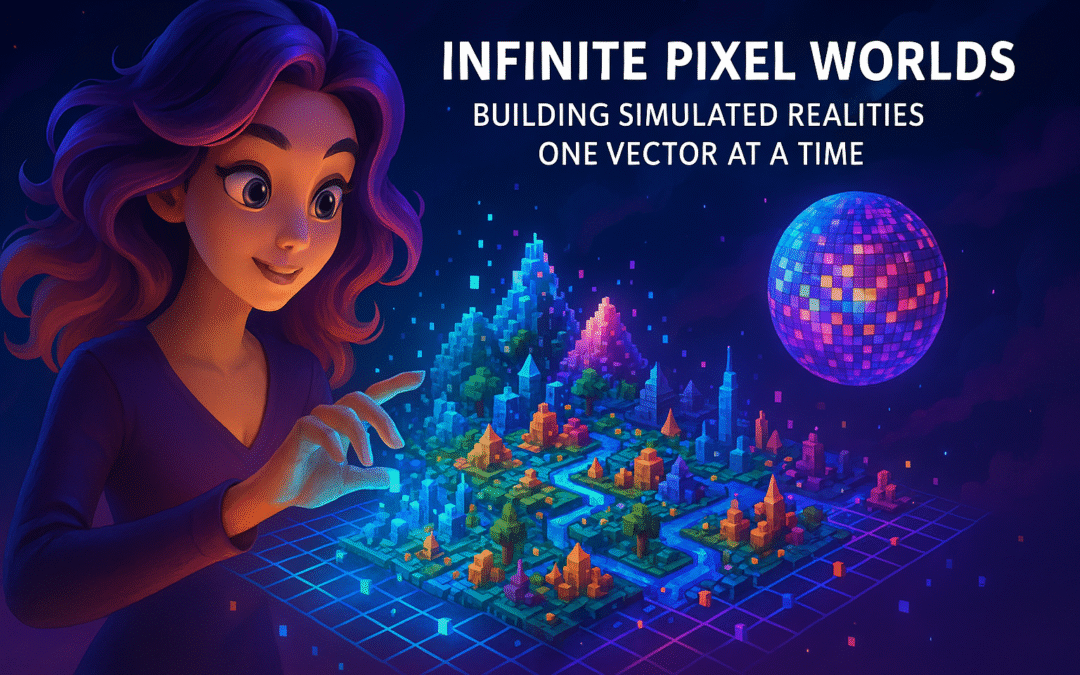
Beyond the glow of our screens lies a universe of infinite potential, a playground built from flickering pixels and boundless imagination. What was once science fiction – immersive simulated realities indistinguishable from life – is now an exciting frontier in technology, gaming, and digital art. We live in an era where virtual worlds can feel as rich and real as the physical one, inviting us to explore realms limited only by our creativity. From retro pixel art landscapes to sprawling 3D metaverses, these worlds are constructed bit by bit, vector by vector, into experiences that captivate millions. This article dives into how these infinite pixel worlds are made, the role of vectors as their building blocks, and the endless possibilities that emerge when we simulate reality one step at a time.
In the sections that follow, we’ll journey from the fundamentals – what simulated reality really means – to the technical magic under the hood of our favorite games. Expect a fun, upbeat exploration peppered with examples ranging from classic 8-bit games to cutting-edge virtual reality. Strap in, player one; it’s time to press Start on Infinite Pixel Worlds!
Simulated Realities: From Sci-Fi to Sandbox
A simulated reality is essentially an approximation of the real world engineered inside a computer simulation. In plain terms, it’s making something look and feel real when it’s not. This concept has long been a staple of science fiction – think of Neo waking up in The Matrix’s computerized dreamworld, or the virtual playgrounds in Ready Player One. Those stories captivated us with the idea of stepping through a screen into another life. Today, technology is turning those ideas into (virtual) reality. Modern virtual reality (VR) headsets already let us strap in and wander immersive worlds that respond to our movements in real time, fooling our senses into believing we’re inside the simulation.
Interestingly, the term simulated reality doesn’t just apply to VR games or holodecks. It can also mean any situation where a computer-generated world mimics the rules and experiences of reality. This could be an advanced physics simulator that models real-world weather or a social MMORPG where people live out alternate lives. As one writer put it, “all fiction can be said to present a simulated reality” since we willingly suspend disbelief and emotionally engage with worlds we know aren’t real. In gaming, we purposefully enter these made-up universes – whether a fantasy MMORPG or a city-building sim – and treat them as real for the sake of enjoyment and exploration. The allure is obvious: in a simulation, anything is possible. Gravity can be turned off, magic is real, and worlds can be crafted to defy physics or stretch to infinity.
Modern simulated worlds span a huge gamut. On one end, we have hyper-realistic simulations – for example, professional flight simulators or open-world games with life-like graphics and physics. On the other end, we have whimsical pixelated sandboxes that look nothing like Earth yet feel authentic on their own terms. In all cases, the goal is the same: to create a convincing world that users can lose themselves in. As we’ll see, achieving this involves two fundamental ingredients – pixels and vectors – working in harmony to build experiences that blur the line between the virtual and the real.
Pixels and Vectors: The Building Blocks of Digital Worlds
Pixels and vectors are the raw materials of computer graphics, the way bricks and beams are to a building. Understanding them is key to grasping how simulated worlds are constructed.
Pixels (short for “picture elements”) are tiny squares of color that make up the images on our screens. If you’ve ever zoomed into a digital photo or a retro game screenshot and seen a mosaic of little colored blocks, you’ve seen pixels. They form what’s called a raster graphic – essentially a grid of pixels. Classic pixel art in games (think Super Mario’s 8-bit landscapes) is created pixel-by-pixel. Because pixels have a fixed size, raster images are resolution-dependent. This means if you enlarge a pixel image too much, it becomes blurry or “pixelated” (you start noticing the individual blocks). For example, a small icon blown up to poster size looks blocky, because the computer is just making the pixels bigger. Raster graphics are ideal for detailed, richly colored images like photographs, but they don’t scale up gracefully. A low-resolution raster image will blur or pixelate excessively if enlarged too far.
Vectors, on the other hand, represent images in a completely different way: mathematically. A vector graphic is made of shapes – points, lines, and curves – defined by equations on a coordinate plane. Instead of coloring in each pixel, a vector image might say “draw a circle of radius R at position (X, Y)” or “fill a polygon with these vertices.” Because of this, vector graphics are resolution-independent. You can zoom in or out infinitely, and the shapes stay crisp, since they’re recalculated for each new size. A simple example is text: fonts are usually stored as vectors (curves for each character outline) so that whether your letter is 12-point on a phone screen or blown up on a billboard, it renders with sharp edges. In fact, vector art is ideal for printing at any size and keeping the same crisp quality – a vector image can be scaled from business card size to a huge poster with no loss of clarity.
Both pixels and vectors have their place. Raster (pixel) graphics excel at rich detail and organic visuals – that’s why photographs and painterly game art use pixels. Vector graphics shine for clean, geometric visuals and technical designs – they’re favored in domains like engineering blueprints, typography, and any images requiring a high degree of precision. Modern 3D games actually use vectors behind the scenes: every 3D model is a collection of vector-defined polygons (typically triangles) that get filled in with pixels when rendered.
To clarify these differences, here’s a quick comparison:
| Pixel (Raster) Graphics | Vector Graphics |
|---|---|
| Composed of tiny colored squares in a grid (pixels). | Composed of geometric shapes defined by mathematical points and paths. |
| Resolution-dependent: fixed detail; enlarging image causes blur/pixelation. | Resolution-independent: can scale to any size without losing clarity. |
| Great for rich detail and organic images (photographs, painted art). | Great for crisp lines and curves (logos, fonts, schematic art). |
| File size grows with image dimensions (more pixels = more data). | File size depends on scene complexity (more shapes = more data). |
| Classic retro game aesthetic (8-bit pixel art evokes nostalgia). | Clean and modern aesthetic (used in CAD, vector illustrations, 3D models). |
In practice, most simulated worlds use a mix of both. A 2D game might use pixel art for characters but vector math for physics calculations. A 3D game uses vector-defined models but ultimately draws them as pixels on your screen. Even 3D “voxels” (like the cubes in Minecraft) are essentially 3D pixels. By combining pixel-based rendering with vector-based logic, developers get the best of both: rich visuals and flexible, scalable world design. Next, we’ll see how these building blocks come together as we move from simple 8-bit worlds to the infinite universes of today.
Game Worlds: From 8-Bit Pixels to 3D Vectors
Video game graphics have come a long way from the chunky pixels of the 1970s and 80s to the sophisticated 3D environments of today. Early games had to work within severe technical limits, which shaped their worlds. Classic arcade hits like Space Invaders or Super Mario Bros. rendered their worlds as grids of pixels because early displays were raster-based. Meanwhile, some pioneering games used vectors even back then – not the 3D polygons we know now, but actual drawn lines on special displays. For example, Atari’s Asteroids (1979) ran on a vector monitor that drew crisp white line segments on a black screen to represent the spaceship and asteroids. These vector graphics games had a distinctive neon-line look, and their bright, flicker-free shapes mesmerized arcade-goers with how sharp they looked compared to the era’s blocky pixel games. Titles like Battlezone and Tempest continued this vector tradition in arcades, giving players a uniquely clean visual experience. However, as technology advanced and color raster displays took over, vector monitors faded away. By the mid-1980s, raster graphics (pixels) had largely won out in arcade and console games due to their ability to depict filled surfaces and colorful scenes.
Throughout the 8-bit and 16-bit console eras, game worlds were predominantly built of pixels. Designers hand-drew tiles and sprites pixel-by-pixel, often turning graphical limitations into a charming art style. The result is that the term “pixel world” often brings a wave of nostalgia – we imagine the mushroom kingdom of Mario or the towns of early Final Fantasy games. These worlds were obviously not realistic in appearance, yet players found them deeply engaging. With just 16x16 pixel characters and tile-based environments, developers hinted at rich worlds that our imaginations gladly filled in. Pixel art remains popular to this day for its aesthetic and the creative constraints it imposes; many indie games deliberately adopt it to invoke that retro magic (titles like Stardew Valley or Undertale are recent examples of beloved modern pixel worlds).
The leap to 3D game worlds in the 1990s introduced vectors in a big way. Games like Quake or Super Mario 64 defined their environments with 3D geometry – essentially lots of triangles in 3D space, each a vector-defined shape. The computer’s GPU (graphics processing unit) transforms these vector-defined models into the pixels you ultimately see (a process aptly named rasterization). As 3D hardware improved, game worlds became larger and more detailed, yet the principle remained: vector math creates the structure; pixels paint the picture.
Today’s open-world games use billions of pixels to render, but those pixels are driven by underlying vector data – from the coordinates of a mountain to the direction of the sunlight. We even see a return of sorts to vector display ideas in modern VR and AR headsets, which must draw shapes very sharply across varying resolutions and angles. Meanwhile, pixel art lives on in parallel, proving that visual fidelity isn’t the only key to an engaging world; style and creativity matter just as much.
In short, game worlds have evolved from simple pixel mosaics to massive vector-modeled universes. Yet at every step, pixels and vectors have worked together. The old dichotomy of “pixel vs. vector” has blended into a symbiosis: we use vectors to construct and position objects, then pixels to present them to players. Next, we’ll peek under the hood at how exactly vectors power the mechanics of these worlds – literally building simulated realities one vector at a time.
One Vector at a Time: The Math Behind the Magic
If pixels are the paint, vectors are the blueprint and the laws of physics in a simulated world. In game development, nearly everything is represented as vectors or related mathematical structures. You can think of a vector as an arrow with a direction and length (magnitude). In math terms, it’s an array of numbers like (x, y) or (x, y, z) that indicate a direction or position in space. Game engines use vectors ubiquitously because they are perfect for describing motion and spatial relationships. Here are some ways vectors come into play:
- Position and Coordinates: Every object’s location in a game world is given by a position vector (e.g., (x, y, z) in 3D space). A character might be at coordinates (10, 0, 5) relative to some origin point. These numbers form a vector that pinpoints where the character is. Change the vector, and you move the object. Vectors make it easy to compute distances (distance is just the length of the difference between two position vectors) and to know if something is nearby. In fact, game developers use vectors to determine positions, measure distances, and check collisions or proximities.
- Movement and Velocity: Movement in games is typically a velocity vector – it describes where an object is heading and how fast. For example, a car might have a velocity vector (2,0,0) meaning it’s moving 2 units per second along the X-axis (eastward, say) and not moving in Y or Z. By adding the velocity vector to the position each frame, the game updates the car’s location. If the player steers, the velocity vector’s direction changes accordingly. This vector math produces smooth, natural motion. For things like bullets or arrows, the game might set an initial velocity vector from the firing point and then let gravity (another vector) gradually curve it downward.
- Acceleration and Forces: Game physics engines use vectors for forces and acceleration. Gravity is a constant acceleration vector pointing downward (e.g., (0, -9.8, 0) m/s² in Earth units). When a character jumps, an upward force vector is applied briefly, then gravity (downwards vector) pulls them back. If they get hit by an explosion, a force vector might push them away from the blast center. All these interactions are computed with vector addition and multiplication, thanks to Newton’s laws coded in.
- Orientation and Camera: The direction an object faces can be represented by vectors too (often with more complex math involving matrices or quaternions, but conceptually an orientation vector pointing forward). Cameras in 3D games have a position vector (where the camera is) and a forward vector (where it’s looking). By manipulating these, games implement looking around, aiming, and perspective changes.
- Scaling and Sizing: Even the size of objects can be stored as a vector (width, height, depth). This becomes handy for collisions (a bounding box) or for scaling an object up/down dynamically.
Under the hood, all these mechanics boil down to vector math – lots of it. Fortunately, computers are extremely good at crunching vectors, and modern CPUs/GPUs have special instructions to handle multiple vector operations in parallel (SIMD instructions and shader cores). A well-known fact is that a 3D game engine is essentially a big linear algebra system, moving vectors around to simulate an interactive world.
So, when we say “building simulated realities one vector at a time,” it’s quite literal. The game computes one vector’s new value, then the next, and so on, thousands of times per second. This constant calculation updates positions, checks physics, and redraws the scene for your eyes – creating the illusion of continuous reality. The end result is a convincing interactive world that obeys whatever rules (physical or fantastical) the developers have encoded as math.
For the player, none of this math is visible – we just see a spaceship flying or an explosion sending debris flying. But it’s all vectors in action. As a developer interviewed about game physics once quipped, “Games, especially game graphics, are made up of a lot of mathematics. The mathematics used in games... we use vectors to describe and manipulate fundamental properties like position, rotation, and scale”. Mastering vectors is thus core to crafting how things behave in a simulation. And by tweaking those vectors, you can create realistic physics or completely off-the-wall alternate physics (imagine a world where gravity points upward or sideways – just flip the gravity vector and it’s so!).
With the fundamentals of pixels and vectors covered, let’s move on to one of the most exciting aspects of simulated worlds: how to make them infinite (or at least feel infinite). This is where clever algorithms and procedural generation come into play, leveraging the power of math to ensure there’s always more world to explore.
Procedural Generation: Crafting Infinite Worlds
One of the coolest tricks in the toolbox for creating vast simulated realities is procedural generation. Instead of hand-crafting every mountain, tree, or galaxy, developers create algorithms that generate content on the fly using random seeds and mathematical rules. This approach can spawn endless environments and surprises, making a game world effectively infinite (or at least way too large to fully explore manually!). In computing terms, procedural generation means creating data algorithmically rather than manually, often leveraging randomness to ensure variety. In gaming, it’s used to automatically create huge amounts of content – from terrain and maps to enemy layouts or loot – which would be impractical to design by hand for an expansive world.
If you’ve wandered the never-ending landscapes of Minecraft or marveled at the billions of star systems in No Man’s Sky, you’ve experienced procedural generation firsthand. Minecraft is a textbook example: its worlds are generated by combining simple noise functions (like Perlin noise) with rules for biomes, caves, ores, etc. When you start a new Minecraft world, you provide a random seed number, and that seed is used to pseudo-randomly create a unique terrain that goes on for tens of millions of blocks in each direction. How big is that exactly? Well, as of recent updates, a Minecraft world spans about 30 million blocks out from the center on the X and Z axes. In practical terms that’s roughly 1.5 billion square miles of virtual land – about seven times larger than Earth’s surface! It’s not truly infinite (there is a boundary where technical limits kick in), but from a player’s perspective, it might as well be endless. You could walk for real-life weeks without hitting the edge. The world keeps unfolding with new terrain as you go, thanks to the procedural algorithm that generates chunks on demand. As one playful article noted, “they’re not quite infinite, but you might as well brace yourself for infinity” when exploring these kinds of worlds.
A visualization of the Mandelbrot fractal, a mathematical set that contains infinite detail. Zooming into such fractals reveals ever-finer patterns endlessly. This concept of infinite complexity from simple rules inspires how procedural algorithms can generate limitless worlds.
Even more mind-boggling is No Man’s Sky, which took procedural generation to the galaxies. This space exploration game uses algorithmic generation to create planets, ecosystems, and even alien creatures across an entire galaxy. The developers didn’t individually model 18 quintillion planets (who could?!) – instead, they wrote formulas to produce them. The universe is generated using a 64-bit random seed, which mathematically leads to approximately 2^64 possible unique planets. In fact, No Man’s Sky’s algorithm maps that 64-bit number into a consistent galaxy of about 18,446,744,073,709,551,616 planets (around 18 quintillion). Yes, that’s 18 quintillion, an unimaginably large number. It’s been calculated that if a player visited a new planet every second, it would still take billions of years to see them all. Talk about infinite pixel worlds!
The techniques behind procedural generation often draw from math and nature. Fractals are a great example: a simple equation can generate a coastline-like fractal pattern that has detail at every scale. In fact, early games like the 1980s title Elite used fractal algorithms to generate whole star systems and terrain with very little memory. The famous Mandelbrot set fractal is often cited as inspiration because it shows how simple rules can yield infinite complexity. As you zoom into a Mandelbrot set image, new patterns keep emerging no matter how far you go – the boundary never smooths out. In other words, a fractal image “when zoomed into, has infinite detail”. Game worlds aren’t truly fractal, but procedural noise layered with multi-scale detail can give a similar effect – as you go closer, more details (rocks, plants, etc.) can appear, theoretically without end.
Another procedural technique are L-systems (used for plant generation), and Wang tiles or other algorithms for stitching together pre-made pieces in varied combinations. For instance, in the game Noita, which we’ll discuss soon, the world uses a form of Wang tiling to piece together chunks of level in a semi-random way. The key idea in procedural generation is often balancing randomness with rules. Too random, and the world is messy or boring. Too structured, and it feels repetitive. A well-tuned procedural system can create just the right mix – a world that is vast and always surprising, but still follows a coherent style and gameplay logic.
Of course, procedural generation isn’t a silver bullet. Designers joke about the “procedural oatmeal” problem – if you generate tons of content with no creative spark or variation, it can all feel similarly bland (like an endless sea of oatmeal). The best procedurally generated games add layers of handcrafted content or clever constraints to avoid monotony. For example, Minecraft will always place certain structures like villages or strongholds in particular ways, to ensure there are goals and points of interest amid the randomness. No Man’s Sky, after initial criticism of planets feeling samey, added more handcrafted diversity and interesting phenomena in updates.
When done right, though, procedural generation achieves the holy grail: infinite worlds with finite resources. A bit of code and math can explode into an entire universe of content. This not only saves labor for creators but gives players a unique experience every time. No two players’ adventures are exactly alike. The sense of true exploration – that around any corner could be something completely unseen before – is unparalleled. It’s the same thrill one might imagine exploring a real galaxy, but compressed into a game.
In summary, procedural generation and vectors together allow simulated realities to break the usual limits. Developers define vector-based rules and formulas; the computer uses them to spit out endless pixels of world. We as players get to chart worlds that feel boundless. Now, let’s zoom back in from galaxies to the level of individual pixels, and see how even at the smallest scales, simulations can surprise and delight us.
Pixel Simulations and Emergent Complexity
One might assume that to get complex behavior in a simulation, you need complex rules or fancy 3D engines. Surprisingly, incredible complexity can emerge from very simple pixel-based simulations. A classic example of this is Conway’s Game of Life, a deceptively simple program invented in 1970. It isn’t a “game” you play, but a zero-player simulation on a grid of square cells (pixels) that are either alive or dead. Each tick, every cell updates based on a couple of basic rules involving its neighbors (to summarize: overcrowding and loneliness cause death, a perfect little crowd causes a birth). That’s it – a few rules. Yet from those rules emerges a whole zoo of patterns that move, breed, and die, almost like organisms. Conway’s Life is famous for demonstrating emergence and self-organization: you can get gliders, oscillators, even patterns that simulate logic circuits, all arising naturally. Remarkably, it’s been proven that within this simple pixel grid, one can construct a Turing-complete computer – meaning, given a large enough grid and the right initial setup, the Game of Life could perform any computation imaginable. All of that from a handful of pixel rules! It’s a profound illustration that simulated worlds don’t need realistic physics to be interesting; even abstract “cellular automata” can mirror aspects of life and complexity.
In the gaming realm, there’s a whole category inspired by this: falling-sand simulations and cellular automata games. These are the kind of sandbox where you drop pixels of sand, water, or oil and watch them interact and pile up. Each pixel represents a material and follows simple rules (sand falls down, water flows, fire burns flammable pixels, etc.). When you tinker in these, you often witness delightful unexpected phenomena – complex flowing rivers, explosions, erosion-like effects – all emergent from local interactions. A falling-sand game is basically a 2D particle simulation using cellular automaton rules. You, the user, can place and remove particles on the canvas, set up scenarios, and then let the simulation run, resulting in complex emergent behavior as the various elements interact. There’s no specific goal; the fun is in the experimentation and seeing what happens (will the fire spread? will the water put it out? what if oil is in the mix?). These sandbox toys (such as “The Powder Toy” or “SandSpiel”) exemplify infinite possibilities arising from pixel-level simulation.
A standout modern game that took this concept to new heights is Noita (2019). Noita is a magical action-adventure where every single pixel in the world is physically simulated. The developers essentially turned a falling-sand simulation into a full game. Terrain isn’t just backdrop; it’s made of powders, liquids, and gases that all obey physics. This means you can do things like kick a pile of sand to collapse a tunnel, break a bottle of water to douse flames, or set oil on fire and watch the blaze spread dynamically. Noita’s world is “an endless amount of simulated pixels” reacting to your actions. Liquids flow, gases rise, wood burns away leaving smoke – it’s incredibly emergent. The simulation is underpinned by cellular automata rules akin to those in sand games. For example, each water pixel tries to fall down or sideways each frame, fire pixels try to ignite neighbors that are flammable, etc., all according to simple local rules. Put together, these rules create a rich sandbox where literally anything can happen. Players frequently encounter unforeseen situations – a chain reaction causes a structure to collapse, or a monster accidentally sets off an explosion that opens a new path. “Simulating every pixel” leads to gameplay that’s unscripted and full of surprise, requiring players to invent creative solutions on the fly. As one of Noita’s creators noted, it functions as an “emergence-generating machinery” – always producing novel scenarios and problems to solve.
What’s fascinating is how these pixel simulations can mirror aspects of reality (fluid physics, fire propagation) yet also deviate wildly, often to the player’s entertainment. Because everything is algorithmic, you can even have materials or behaviors that don’t exist in nature, yielding imaginative new gameplay. The key point is that complexity in simulated worlds doesn’t always come from top-down design; it can emerge bottom-up from simple components. This is a powerful idea. It means small creations like a pixel toy can surprise you just as much as a big-budget open world – in their own way, they offer a kind of infinite possibility too, contained in a Petri dish of pixels.
On the flip side, designing with emergence in mind comes with challenges. It’s hard to predict everything that can happen. Noita’s devs discovered many edge cases and had to decide whether to embrace them or tame them for game balance. Emergent simulations can sometimes produce outcomes that break the game or confuse the player. But when balanced right, they provide incredible replayability and a feeling of a truly living world. Many players recount stories from games like Noita or Minecraft that sound like unique adventures, almost as if the game had a will of its own in shaping events.
In summary, starting from the humble Conway’s Life to today’s pixel sandboxes, we see a common thread: simple rules + many interacting parts = endless intrigue. Simulated realities built on pixels can be little universes with their own laws, where surprising “life” emerges. It’s a reminder that even as our technology races toward higher resolutions and realism, there’s plenty of magic left in exploring simulations at the pixel level.
Art, Imagination, and Infinite Possibilities
Beyond the algorithms and math, what truly makes infinite pixel worlds special is the human imagination behind them – both from the creators and the participants. Building simulated realities isn’t just a technical feat; it’s an artistic and communal one.
Digital artists and game designers essentially paint worlds into existence. Whether using pixel art or modeling in vectors, they must envision entire environments – geography, architecture, ecosystems – often from scratch. In pixel-based simulations, artistry might mean dabbing individual pixels to create a charming village or carefully choosing the color palette that sets a mood. In vector-based 3D worlds, it means designing 3D models and textures that make the world believable or fantastical. Some games even give these world-building tools to players. Titles like Minecraft provide players with digital “blocks” to create their own castles, cities, or circuits inside the simulation. The result has been a flourishing of user-generated worlds – from replicas of real cities to complete fantasy realms – effectively infinite worlds within an infinite world. It’s turtles (or rather worlds) all the way down! Online communities share maps, mods, and art, pushing the boundaries of what’s possible in the sandbox provided.
The interplay of technology and creativity also leads to delightful hybrids of pixel and vector art styles. For example, modern 2D games often use dynamic lighting and physics (vector-driven) on pixel art scenes, yielding a unique look that blends retro aesthetics with modern effects. We see vector outlines married with pixel shading in digital illustrations, or low-poly 3D models textured with pixel art for a stylistic flair. These combinations show that the lines between pixels and vectors can blur in service of a particular artistic vision.
Looking at the big picture, one can’t ignore the buzzword of the day: the Metaverse. While much hyped, the idea of a massively connected simulated universe where people work, play, and socialize is a natural extension of what we’ve discussed. It’s essentially about stitching together infinite pixel worlds created by different people into one shared space. Whether or not the grandest metaverse visions come true, we already have proto-metaverses like Second Life, Roblox, or VRChat, where users create and inhabit virtual spaces together. In these, the role of vectors is again crucial (for rendering 3D content efficiently), and the possibilities are endless because users keep adding new worlds, games, and experiences. User-generated content turns players into world-builders, unleashing exponential possibilities. One person can only craft so much, but millions of users building together? That library of worlds truly has no limit.
Furthermore, advances in AI are beginning to touch simulated world creation. We now see AI that can generate textures, 3D models, or even entire Minecraft-like scenes based on prompts. This could further amplify the infinite nature of these worlds – imagine worlds that evolve or expand autonomously using AI, or personalize themselves to each player on the fly. That remains experimental, but it’s on the horizon and very much in spirit with “building realities one vector at a time” automatically.
Finally, it’s worth noting how simulated worlds can reflect reality in unexpected ways. Some architects and city planners use digital twins or simulations to model real cities (traffic flow, weather impact, etc.), effectively creating a parallel world for testing ideas. Conversely, players in something like Minecraft have built functioning computers, cities with working economies, and even hosted live events in-game. The simulated and the real intermingle. As these pixel worlds become more persistent and interconnected, philosophical questions arise: Could our reality be a simulation too? (We’ll leave that to The Matrix and philosophers; but it’s a fun thought that gets bandied about: if we can simulate worlds within our world, are we sure our world isn’t simulated from a higher one?)
At the end of the day, Infinite Pixel Worlds are a celebration of creativity and exploration. They tap into a fundamental human joy – the joy of building, discovering, and storytelling. Every block placed in a sandbox, every vector plotted in a game engine, contributes to a narrative. And when players enter these narratives, they create their own stories: the epic quest across a generated continent, the cunning solution to an emergent puzzle, the collaborative city built with friends. The technology enables it, but the people make it meaningful.
Conclusion: Embracing the Infinite
We’ve trekked through the conceptual multiverse – from tiny pixel cells to sprawling procedurally generated galaxies. What have we learned? That simulated realities are part science, part art, and wholly amazing. Pixels provide the canvas of color, vectors provide the structure and rules, and together they let us conjure universes from zeros and ones. The phrase “one vector at a time” reminds us that even the grandest simulation is built stepwise – every position calculated, every interaction resolved, every pixel drawn in place – billions of these operations coalesce into the rich worlds we experience.
The possibilities truly feel infinite. As computing power grows, our pixel worlds inch closer to realism or push further into imaginative extremes. We can have simulations of entire planetary ecosystems or abstract mathematical worlds that defy physics. Want a universe where time flows backwards or a sandbox where you cultivate virtual galaxies? It’s either already been done or on someone’s to-do list. Each innovation in hardware or algorithms (be it real-time ray tracing for lighting or better physics engines for VR) widens the scope and fidelity of these worlds.
For enthusiasts in technology, gaming, or digital art, this is an exhilarating time. We’re not just consuming content; increasingly, we are participants and co-creators in these simulated universes. The barrier to creating your own game world has never been lower, thanks to accessible tools and engines. Meanwhile, exploring professionally crafted worlds is as easy as downloading the latest indie game or strapping on a VR headset. The invitation is open: step through the screen and explore. There are pixel paradises and vector-vista’d lands out there waiting for you.
In these infinite pixel worlds, imagination is the only boundary. Just as in the online play ethos – where “anything is possible, and the only limit is the one you dare to set” – simulated realities free us from physical constraints. They let us play, create, experiment, and even confront challenges in ways we could not in the real world. They can be escapist fun, but also platforms for learning, socializing, and artistic expression.
So whether you’re roaming a fantasy pixel kingdom, coding a physics simulator, or building a cyberpunk city out of digital blocks, relish the fact that you are part of this grand endeavor of simulated realities. We are, in a sense, digital explorers on infinite frontiers, each vector step uncovering new ground. The pixels may be small and the vectors invisible, but together they form entire worlds for us to enjoy. And as technology marches on, who knows – the simulated realities of tomorrow might just rival the depth and richness of base reality itself. Until then, see you in the next world… one vector at a time!
Help Eye of Unity NFT Foundation by Turning On NFT Ads
Explore & Support
💰 Eye of Unity Ad Benefits:
• 🆓 Ads to other free NFT collection minting websites
• 🎮 Ads to other gaming websites
• 🌐 Ads to other metaverses
• 🤖 Ads to the best new AI software
https://discord.gg/4KeKwkqeeF
https://opensea.io/eyeofunity/galleries
https://rarible.com/eyeofunity
https://magiceden.io/u/eyeofunity
https://suno.com/@eyeofunity
https://oncyber.io/eyeofunity
https://meteyeverse.com
https://00arcade.com
Sponsored Spotify Music Playlists:
https://systementcorp.com/power - Psytrance
https://systementcorp.com/90-degrees - Pop EDM
https://systementcorp.com/my-music - New Underground Rap
https://systementcorp.com/ai-music - AI Psytrance